
ERBIL, Kurdistan Region - Seven months after nationwide protests ended in mass bloodshed, Iran’s rulers remain preoccupied with the possibility that the public could return to the streets, as reflected in the reappointment of some of the most feared security figures by the new supreme leader Mojtaba Khamenei.
That anxiety is visible in the establishment’s relentless emphasis on pro-government crowds gathering night after night in cities and neighborhoods. State media has extolled more than 150 consecutive nights of such gatherings across the country, portraying them as demonstrations of loyalty and national unity.
The Islamic Revolutionary Guard Corps (IRGC) and its Basij militia retook those streets through overwhelming force and left tens of thousands of families to mourn for their loved ones.
The brutality perpetrated in the streets of the country was unprecedented even by the Islamic Republic’s standards, leading many in the country to believe that the regime is prepared to go to any length for its survival.
The deepening economic hardship for the public since the beginning of the US and Israel’s aerial campaign on February 28 has brought many officials to the realization that the country is facing an existential threat - not necessarily from American or Israeli bombs, but from the lack of unity and a crippled economy.
President Masoud Pezeshkian said on Monday that during his last meeting with Mojtaba Khamenei, which he claimed lasted seven hours, the leader emphasized on two issues, namely “unity” and the "livelihood" of the people.
But instead of facing the internal challenges in this new environment that Iran finds itself in due to the war and isolation, Mojtaba Khamenei follows his father’s old methods of spreading terror among civil society to reclaim the public sphere: stifling dissent through arrests, forced confessions, torture, long prison sentences and executions including public ones.
Khamenei has turned to figures long associated with some of the darkest periods of the Islamic Republic’s history.
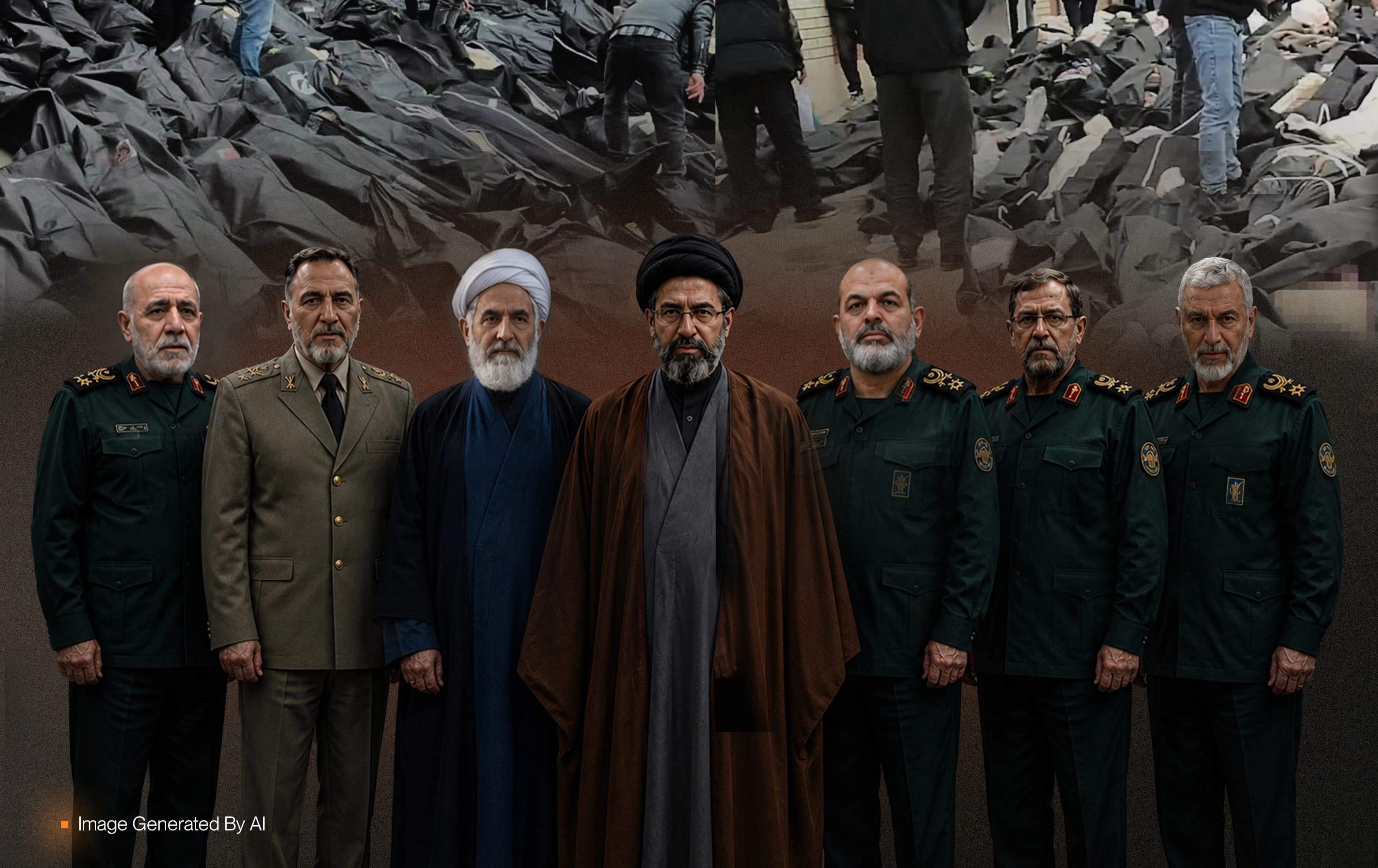
Among six senior military appointments announced on Monday, Khamenei reassigned a close associate, Hossein Taeb, to the leadership of the Basij, the sprawling paramilitary organization embedded in Iranian neighborhoods, schools, universities, mosques, workplaces and state institutions.
Ahmad Vahidi, also from a paramilitary background, was appointed commander of the Islamic Revolutionary Guard Corps (IRGC). Ali Abdollahi was appointed chief of staff of the armed forces, Mostafa Izadi as deputy IRGC commander, Kioumars Heydari as deputy chief of the armed forces general staff and Ali Azmaei as the commander of the IRGC Navy.
A day earlier, veteran IRGC commander Mohsen Rezaei, a particularly hated figure, was appointed by President Pezeshkian as the secretary of the Supreme National Security Council (SNSC) and separately named Khamenei’s representative on the body.
The battle for the street
For much of its 47-year history, the Islamic Republic has understood that control of public space is crucial for the regime’s survival.
The street is where the state stages demonstrations of loyalty, religious processions and rallies supporting the supreme leader several times a year on different occasions. It is also where Iranians have repeatedly challenged the system - in 1999, 2009, 2017-18, 2019, 2022 and, most importantly, January 2026.
The staging of public executions in the early days of the revolution in 1979 served to terrorize those who dared to question the new clerical order in the country. The first executions after the February 1979 revolution were carried out by firing squads in the Kurdish areas west of the country following summary proceedings before newly created revolutionary courts.
Public hangings soon became a recurring feature of the new political order, turning punishment into a spectacle and a warning to those watching.
Nearly half a century later, the gallows are still being erected in Iranian squares.
On July 28, authorities publicly hanged two January protesters, Abolfazl Sepahi Badjani and Amirhossein Safari Hosseinabadi, in Isfahan’s Alikhani Square over the alleged killing of security personnel during the protests. Rights groups said people gathered before dawn in an effort to prevent the executions; they were the first recorded public hangings in Iran this year.
The symbolism was stark: two men accused of challenging the state during protests were returned to the same public space months later and hanged there.
Now, the regime intends to do everything in its power to prevent the Iranian people from gathering in public spaces to challenge the state, and for that, Mojtaba Khamenei has turned to his old confidant, Hossein Taeb, to guard the streets through the mobilization of Basij paramilitary forces.
Backing him stands IRGC chief Ahmad Vahidi, who honed his skills in paramilitary organizations, having risen through its intelligence structures before commanding the Quds Force from the late 1980s until Qasem Soleimani succeeded him.
Unlike a conventional military formation designed primarily to fight a foreign enemy, the Basij extends its tentacles deep into civilian life. Its members operate across nearly every sphere of society, acting as the revolution’s vanguard through intelligence gathering, surveillance and the use of naked force against those who dare to protest.
Taeb commanded the Basij during the disputed 2009 presidential election and the Green Movement that followed. The US Treasury sanctioned him and said forces under his command participated in beatings, killings and arbitrary arrests of peaceful protesters. The European Union went further, citing mass beatings, killings, detention and torture carried out by forces under his command.
He subsequently became one of the most powerful intelligence figures in the country, heading the IRGC Intelligence Organization for more than a decade. The IRGC Intelligence and the Ministry of Intelligence are the two main intelligence agencies in Iran answerable to the supreme leader with huge annual budgets to keep an eye on the people.
Bringing Taeb back to the organization he commanded during one of the Islamic Republic’s defining crackdowns is therefore difficult to view as merely another wartime reshuffle.
Rather, it sends a message to the people who dared to defy the regime in January: Do not defy the regime or you will find yourself in a body bag.
Mohsen Rezaei and the ‘human waves’
"I firmly believe that today, more than ever, national unity and solidarity between the people and officials are a strategic necessity. For Iran to pass through this proud historical juncture, it needs, above all, trust, stronger national cohesion and unity, and prudence," Mohsen Rezaei said in his first statement as the secretary of the SNSC.
Rezaei’s appointment is critical for the success of the state’s response to any internal unrest. Rezaei became IRGC commander in 1981 at the age of 27 and led the force through most of the Iran-Iraq war (1980 - 1988). His tenure remains controversial due to the extraordinary casualties incurred during several Iranian offensives.
Iran’s battlefield strategy during parts of the war relied heavily on large numbers of Basij volunteers, including children, in assaults against fortified Iraqi positions.
Rezaei belongs to a generation formed in a war in which the revolutionary state accepted extraordinarily high human losses to survive.
Both Taeb and Rezaei are Mojtaba Khamenei’s loyalists and both agree that in these extraordinary times the Islamic Republic is up against, any number of casualties is justified so long as the regime can secure its survival.
Iran Human Rights documented at least 1,639 executions in 2025, the highest annual number recorded since 1989 when Ali Khamenei came to power. The organization explicitly described the surge as part of the authorities’ effort to instill fear and deter further protests.
At least 463 people have already been executed in 2026, according to the organization’s latest tally including dozens of political prisoners and protesters.
The state succeeded in clearing protesters from the streets through overwhelming force, mass arrests and an expanding use of the death penalty. However, even its own government speaks openly about damaged trust, unresolved grievances and the need to understand why so many people rebelled.
There has been little visible accountability for the mass killings documented by rights organizations. Instead, the months since January have brought more arrests, more death sentences, public executions and now, the return of security figures whose careers evoke earlier periods of repression.
That may be the clearest way to read Khamenei’s reshuffle.
The leadership is not only rebuilding its ability to fight a foreign enemy; it is reconstructing the very institutions that have historically protected the Islamic Republic when the threat came from within.
Seven months after January, the street remains the place where that unresolved confrontation between state and society could erupt again.