
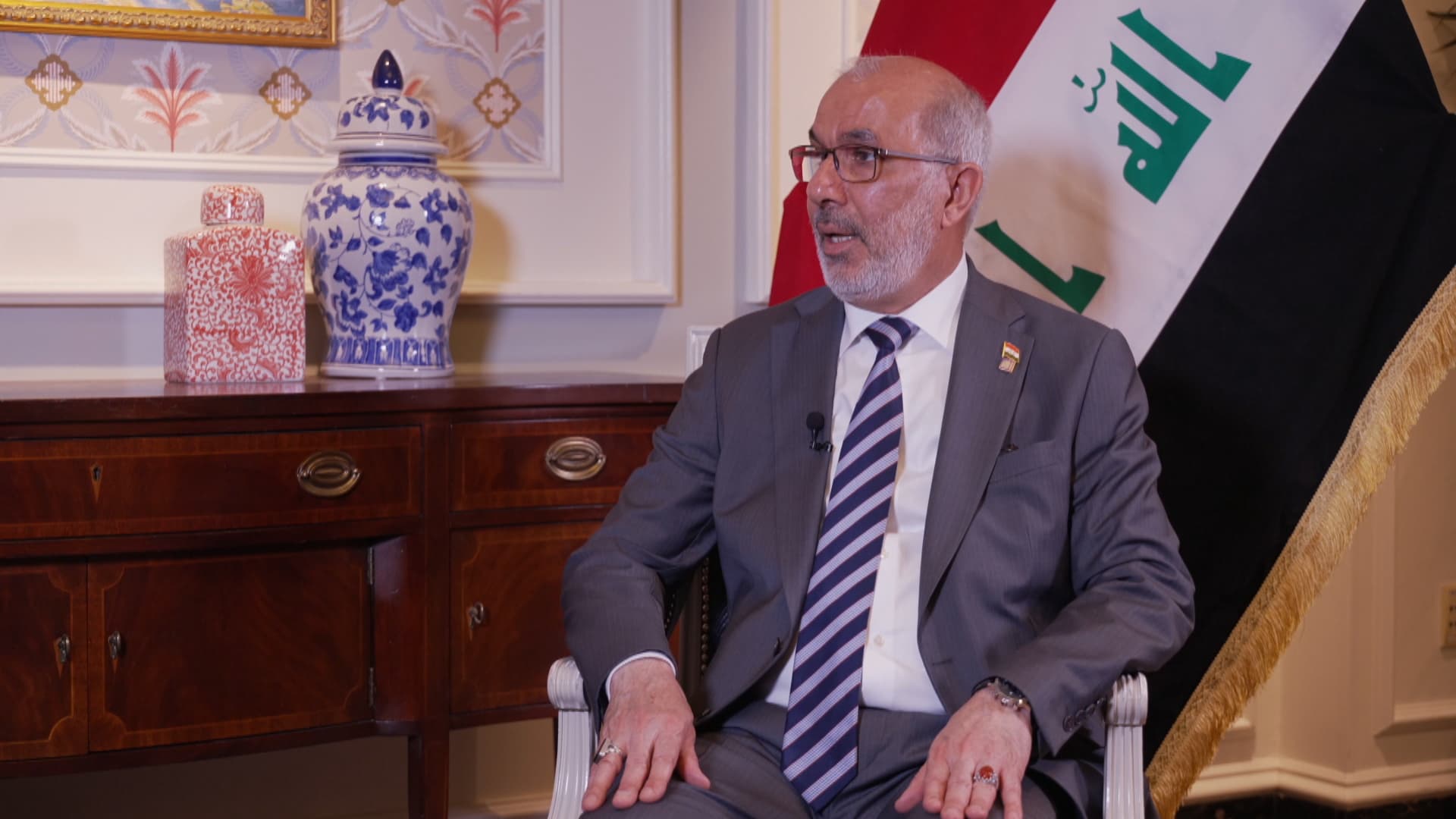
ERBIL, Kurdistan Region - Iraqi Foreign Minister Fuad Hussien said on Friday that the Iraqi Prime Minister Ali al-Zaidi will lead a delegation to Iran, and then to Turkey, days after his return from the landmark, week-long visit to the US.
“Before coming here, we decided to visit Washington, then go to Tehran, and then go to Turkey,” Hussein told Rudaw’s Diyar Kurda in an interview in the American capital aired on Saturday.
“When we return to Baghdad, we are scheduled - on the 23rd of the month [July], meaning in a couple of days to travel to Tehran,” he added.
The Iraqi foreign minister’s remarks come as Zaidi has signed 48 agreements with US public and private entities in various fields, including in oil, agricultural, and technology sectors.
Baghdad has adopted a delicate-balancing act in the wake of the fluctuating hostilities between the US and Iran since February 28, when a direct conflict broke out between the two with Israel siding with the former.
During the nearly six week-long war, the Iran-aligned so-called Islamic Resistance of Iraq - which has overlapping groups with the state-sponsored Popular Mobilization Forces - struck US military, diplomatic, and business interests in Iraq and the region.
Accordingly, Washington has increased pressure on the Iraqi government to disarm the armed groups. Three major groups have already complied while at least two of them refusing to conform.
Saying that Zaidi is “very serious” about the issue, Hussein explained that “some of them desired to lay down their weapons voluntarily and have already started, and some have announced it. Then there are one or two factions that have linked laying down their weapons to the withdrawal of American forces from Iraq, who are scheduled to leave at the end of September.”
Furthermore, Zaidi’s anticipated visit to Turkey coincides with expiry of the decades-long Turkey-Iraq pipeline agreement between Baghdad and Ankara to export Iraqi oil through Ceyhan port.
Signed in 1973, the agreement is set to expire on July 27, two years after the Turkish President Recep Tayyip Erdogan terminated the deal and called for a more “comprehensive” agreement.
Last week, Turkey’s energy minister Alparslan Bayraktar said in a press conference in Baghdad that they have arranged for a one-year interim agreement to continue crude exports.
"Oil flow from Iraq to the Port of Ceyhan will continue. We have finalized an agreement that will cover the next 12 months. We aim to sign it in the coming days and share it with the public," Bayraktar said after a meeting with his Iraqi counterpart as well as Zaidi.
Full transcript of the interview with Fuad Hussein:
Rudaw: What was the primary objective of this visit? Was it political, commercial, economic, or was it to please Donald Trump’s administration?
Fuad Hussein: No, the objective is political, but with economic substance. In reality, you can see that the schedule was packed with discussions with companies, the government, those related to economic affairs, and the Treasury. But naturally, it is also a political visit, and it is meant to benefit the Iraqi people, not to please anyone else.
I want to ask about your meeting with Donald Trump. You participated in the meeting in the Roosevelt Room and also attended the lunch. Tell me, was the food good? What did you eat? And then, share the details of that meeting with us.
Well, the food was quite simple.
They must have prepared it in a rush.
Yes, in a rush; it was chicken and a bit of vegetables, that was all.
Very well. What did you discuss during the meetings?
To be honest, the topics of the meetings were diverse. A major part was related to the agenda that the Prime Minister had for this visit - strengthening economic ties and cooperation with this country [the US] - but part of it was also related to Iraq's internal situation, as well as the regional situation.
I asked around why there was no representative from the Kurdistan Region participating in the meeting, and I was told that Fuad Hussein represents Kurdistan as the Foreign Minister.
I don't know who you asked. I am the Foreign Minister of Iraq, but I represent the people of Iraq. Definitely, I come from Kurdistan.
Did you also represent Kurdistan in that meeting?
Of course.
Then why wasn't a representative from the Kurdistan Regional Government present in the meeting?
It wasn't on the agenda. The program was set as a "one plus five" format - meaning the US President accompanied by five people, who were the ministers. This is determined by the protocol team.
You mentioned the economic aspect, and today we witnessed several contracts being signed at the US Chamber of Commerce. Is the environment now favorable for American companies to come and invest in Iraq and the Kurdistan Region?
Yes it is because, to be honest, the economic situation in Iraq, including Kurdistan, presents opportunities for various companies, particularly oil, gas, and electricity companies, among others. When I say the economic ground or opportunities are fertile, there must also be security opportunities, because if there is no security, it is difficult for people to come. The internal security situation is not that bad, but our problem is the regional situation.
The regional security situation impacts internal security, just as internal security impacts the region.
I am sure you are aware of the ongoing attacks on the Kurdistan Region. Some armed groups based in Iraq have previously launched attacks on Gulf states from Iraqi territory. Was there any concern expressed here regarding these attacks, and what did they tell you?
First of all, the Prime Minister himself posted a tweet regarding the attacks carried out against the Kurdistan Region. However, from what I understand, Iran has announced that these recent attacks were carried out by them. Generally speaking, regarding attacks inside or outside of Iraq, people and foreign nations are very concerned about these strikes - some of which are carried out by Iran, while others originate from within Iraq.
You have a good relationship with the Iranian Foreign Minister [Abbas Araghchi]. Do you intend to give him a phone call to say, "Don't attack us, we are friends"?
When we return to Baghdad, we are scheduled - on the 23rd of the month [July], meaning in a couple of days to travel to Tehran with the Prime Minister and an accompanying delegation.
Is that to maintain a [diplomatic] balance, or was it a pre-planned trip?
It is not a matter of balancing. Before coming here, we had already decided.
Before coming here, we decided to visit Washington, then go to Tehran, and then go to Turkey. I have been to Kuwait, Saudi Arabia, Syria, and Jordan… Now we are returning via Qatar. These relations are important.
Does the Prime Minister intend to visit Syria?
During my visit to Syria, we discussed a visit by the Prime Minister. It hasn't been finalized yet, but we have discussed it.
I was in the Oval Office, and the Prime Minister spoke extensively about armed groups laying down their weapons, stating that September 30th is the final deadline. Is this due to American pressure, or is it his own policy?
The issue of these groups laying down their weapons is something that is brought up all the time; it isn't an issue that just started today. However, this Prime Minister is very serious. He has linked internal security to economic development and believes that without internal security, there can be no development or investment. Therefore, he entered into discussions with the leaders of these factions. Some of them desired to lay down their weapons voluntarily and have already started, and some have announced it. Then there are one or two factions that have linked laying down their weapons to the withdrawal of American forces from Iraq, who are scheduled to leave at the end of September. That is why it is being discussed; they say that when they leave at the end of September, it means by the beginning of October, there should be no armed forces remaining outside the control of the state.
Groups like Nujaba and Hezbollah have not yet responded to the demand to lay down their weapons. Is the Iraqi government not worried about heading toward a civil war or these groups rebelling?
What I have heard from the Prime Minister is that he is very serious about this issue. He says they must either lay down their weapons or we will face another problem. However, I hope all these issues are resolved through dialogue.
Iraq enjoys good relations with Iran, and you intend to visit them. What have you done to ensure Iraq does not become part of this war? Especially you, as Foreign Minister, have played a major role in this regard.
We have been against war in principle; we were against the continuation of war and against the expansion of war. However, the war itself is not in our hands. The war was between the US, Israel, and Iran, but we became victims of that war - particularly the Iraqi economy. Many people fell victim and were killed, but the Iraqi economy bore the brunt because Iraq exports oil, and up to 90 percent of Iraq's revenue relies on oil. If oil is not sold, it means there is no revenue. This has created a major problem for Iraq, and if the Strait of Hormuz remains in this state, it means the problem will persist.
The war is on the verge of restarting; does this increase your concern?
Of course, we are concerned. We are concerned because the war exists, and we are also concerned because the Strait of Hormuz is not open or has not been reopened.
This government has launched a major anti-corruption campaign. Will this campaign remain within its current framework, or will it be expanded to potentially include higher-ranking officials?
I have said in many places that the issue of corruption has become a culture. A lot of people have become involved in corruption. That is why we strongly support this campaign - we support it fiercely. But where it will lead, I do not know.
Meaning it will expand?
I don't know, but what I hear from the Prime Minister is that he is persistent and will continue.
Will it expand further?
It will continue. In what manner it will continue, I do not know.
There is much talk that the US participated by providing information?
Participated in what?
In confronting corruption in Iraq and arresting these officials? Is this true?
I don't think so. This is an internal issue, and the decision is internal. However, it is not unlikely that a specific party in the US is pleased with this, or that the US government is pleased with it, I don't know.
I want to ask a few questions that are important to our people in Kurdistan. The issue of salaries. You have been in Baghdad for several years and have worked with previous governments as well. Is there any hope that the salary issue will be permanently resolved?
The salaries have been delivered now.
Will it arrive on time next month as well?
This government is serious about ensuring it is always on time, but to be honest, there is a financial crisis in Iraq - a major financial crisis.
Do you mean the 120 billion [dinar] issue?
No, no, Iraq itself has a problem.
So there is a liquidity problem?
Our problem is, if oil is not exported, well, where will the money come from? Meaning the country has a problem. I believe we must make every effort to ensure the Strait of Hormuz is opened and this war is stopped, because this war led to the closure of the Strait of Hormuz. If it is reopened, to be honest, we can export oil, and Iraq's revenue will flow. Otherwise, a financial crisis will emerge.
As someone positioned between the Iraqi government and the Kurdistan Regional Government, regarding that 120 billion [Iraqi dinars], does the problem still remain?
Now, they deduct it before sending it. Because previously, there was a decision in the Council of Ministers for it to be 120 billion, based on estimates made for the matter. Now, due to the situation Kurdistan is in, Kurdistan cannot collect that amount. Therefore, the decision still stands within the Council of Ministers. We tried to change it - to be honest, I proposed a change in the Council of Ministers - but clearly, we did not succeed, because when the discussion takes place and goes to a vote. We failed. But that decision exists, and the Minister of Finance, of course, is bound by that decision.
There is something else. As someone from Khanaqin, I believe this is partly relevant to you: has Article 140 [of the constitution] been forgotten, or is it still an important issue for the Kurds?
No, it hasn't been forgotten. But you know what? There is a committee - the Article 140 Committee. I hope it gets reactivated.
Meaning that committee is not active right now?
No, unfortunately.
Do you intend to work on it and reactivate it?
By God, the political forces of Kurdistan must do this as well. Discussing these matters, you know, involves a political struggle. There is an issue that has been proposed; well, it needs to be pushed forward and worked on. But unfortunately, we, the political forces of Kurdistan in Baghdad, have many disagreements.
Meaning this has affected your work as well?
Absolutely, it has an impact. It definitely has an impact.
Very well. My final question: what is it like working with the Prime Minister? He is young and has a lot of energy.
Well, for me, it is something new because I have worked with all the Iraqi prime ministers following the changes of 2003, and I worked directly with some of them. I knew all of them and had relationships with them. But this is the first time I am working with a prime minister who is not a traditional politician, is distant from party politics, has never been a party member, and has not worked in party politics before taking office.
Is this a good thing or a bad thing?
From what I have seen so far, he is frank, courageous, takes decisions, and is straightforward in his work. He has a different background, and I have a different experience; together, God willing, we can help each other. It is my duty to assist him.
They say that incoming Iraqi governments enjoy a honeymoon period with Kurdistan - making promises and facilitating matters - but as time goes on, after six months or a year, things begin to change. Do you share this concern, or do you think relations will improve?
Fuad Hussein: You know, I have been in four or five governments in Baghdad, and I have witnessed all the others. There are problems in Baghdad, but we must also understand Baghdad. The situation in Baghdad is different. There are problems in Baghdad; there is a centralist mindset, a mindset that everything must be under its direct control, and sometimes other factors play a role. However, we must also adapt ourselves to the situation in Baghdad and take Baghdad's calculations into account. To be honest, the situation of Kurdistan and the region dictates that we pay more and more attention to Baghdad, because our work is in Baghdad.

.png&w=3840&q=75)