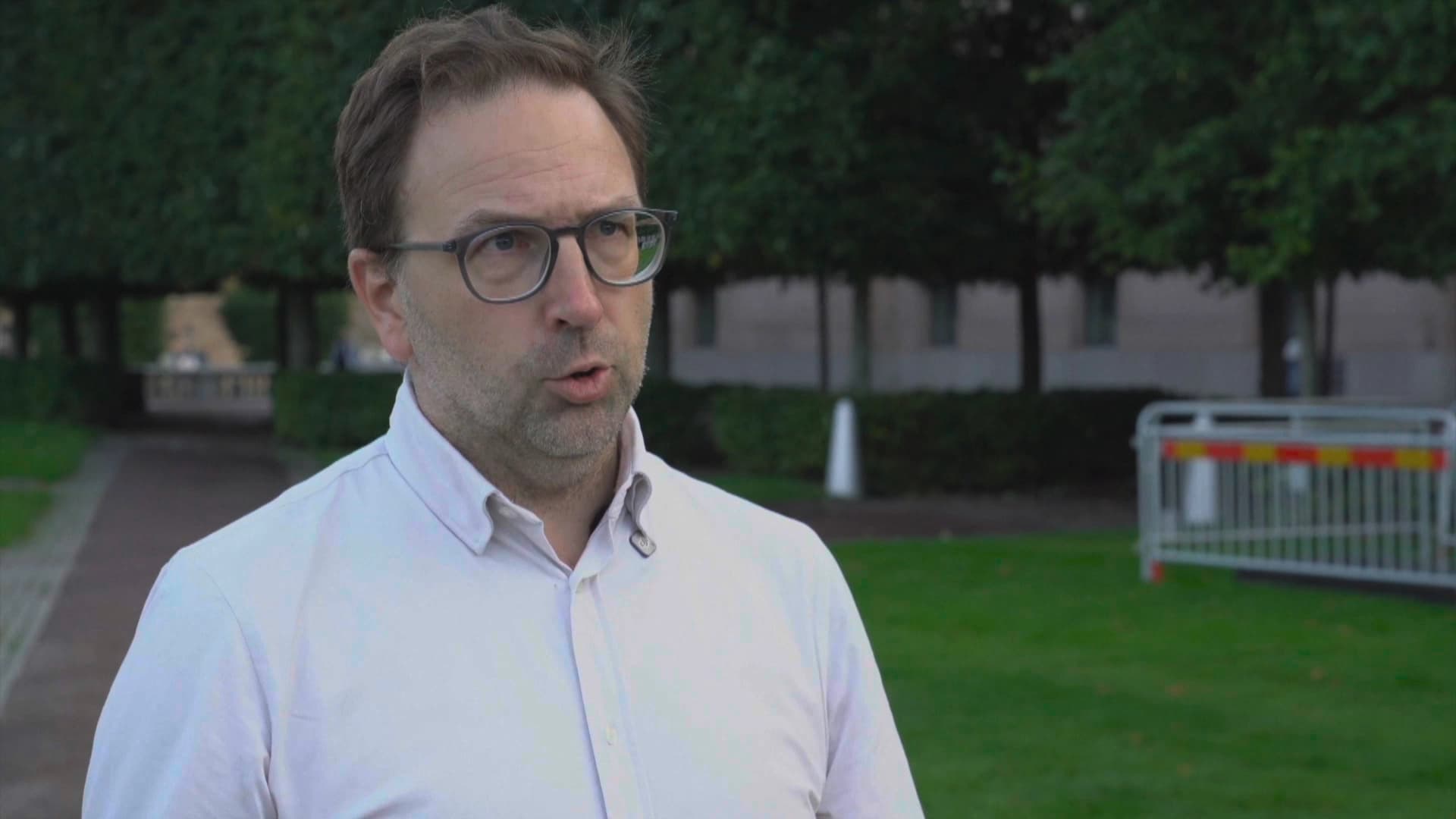

ERBIL, Kurdistan Region - Swedish Liberal Party lawmaker Fredrik Malm told Rudaw that Sweden should pay greater attention to the Kurdistan Region and deepen its diplomatic and economic engagement, saying Stockholm can do more to support the Kurdish cause through trade and investment.
In a recent interview with Rudaw’s Diaspora program, presented by Hemen Abdulla and aired on Saturday, Malm said international attention to Kurdistan has waned in recent years despite ongoing security concerns, including threats from Iran-backed militias and Iranian drone attacks. He also called for stronger trade, investment and business ties between Sweden, Europe and the Kurdistan Region.
“When ISIS, or the Islamic State, captured Raqqa and Mosul and Kurdistan came under threat, a lot of attention was focused on Kurdistan,” Malm said. “But since then, we have seen an even greater threat from the Popular Mobilization Forces (PMF) and Iran-backed militias in Iraq.”
Malm also added “I think Kurdistan’s future also lies in opening up to more trade with Europe,” while calling for Swedish companies and business groups to engage more with the Region.
Malm’s remarks come as the country is set to hold parliamentary elections on Sunday, with voters choosing members of the parliament as well as representatives in regional and municipal elections. The vote will determine whether the current center-right governing coalition remains in power or whether the center-left opposition returns to government.
However, Malm said Sweden’s foreign policy toward the Kurds would not fundamentally change depending on whether a center-right or center-left government comes to power, arguing that the country’s NATO membership has reshaped its security priorities.
Sweden joined NATO in March 2024, ending more than two centuries of military non-alignment, following Russia’s full-scale invasion of Ukraine.
“We had been outside any military alliance for 200 years. When Russia invaded Ukraine, everything changed,” Malm said. “So for us, this is a matter of national security and national sovereignty.”
Malm has also previously called for stronger ties between Sweden and the Kurdistan Region. In a 2023 interview with Rudaw, he said Sweden could maintain good relations with Erbil even amid tensions with Baghdad and argued that cooperation could be expanded in areas including education, technology and agriculture. He also pointed to the large Kurdish community in Sweden and the Swedish-Kurdish Friendship Group in parliament as important links between the two sides.
Malm has remained publicly engaged with Kurdish issues in recent years. In October 2025, he spoke at a Kurdish diplomacy symposium in Switzerland about how Kurdish diaspora groups and political parties represented in Europe can influence politics. In March 2025, he also spoke at a Halabja remembrance ceremony in the Swedish parliament, organized by the Swedish-Kurdish parliamentary network and Kurdish organizations in Sweden.
He said Sweden also needs to maintain relations with Turkey as part of its NATO policy.
“I think building relations with Turkey is one way of influencing them,” he said, while noting that peace negotiations involving the Kurdistan Workers'Party (PKK) and the Turkish government are currently underway.
Turkey initially delayed Sweden’s NATO accession, citing concerns over Sweden’s stance on the PKK and other groups, as well as arms exports.
In June 2022, Sweden and Turkey signed a memorandum addressing Ankara’s concerns. Turkey ratified Sweden’s accession in January 2024, clearing the way for Sweden to join NATO.
Regarding the Kurdish representation in the Swedish parliament, Malm predicted that it would remain significant. Looking back at his five terms, he said there had typically been around five to seven Kurdish members of parliament. “It is likely to be around that number,” he said.
Malm also said the Swedish-Kurdish parliamentary network would continue after the election, with a new board to be elected by the incoming members of parliament. He noted that Kurdish lawmakers have represented different Swedish parties and different parts of Kurdistan. “If you put six or seven Kurdish politicians from different parties and different parts of Kurdistan into one room, they will not agree on everything,” he said. “But they will agree on Kurdistan.”
The following is the full transcript of the interview with Fredrik Malm:
Rudaw: The last time we met was here in this parliament building. We had an interview, and at that time the Liberal Party was a very strong party in this building. But according to the polls, your situation is not very good compared with previous times. What is the reason?
Fredrik Malm: There are several reasons. I think one of the reasons is that it is always easier to be in opposition than to be in government. You have to take responsibility; you also have to negotiate with other parties in order to introduce policies and reforms that perhaps, at the beginning, are not exactly what you wanted. So the negotiations have been very, very difficult.
We have three parties in government and one party outside the government that supports the government through an agreement. All three of the other parties are further to the right than the Liberal Party. We also have some internal disagreements. We have had them for several years, with some people within the party who never want to have any relationship with the Sweden Democrats. Instead, they want to find other solutions for forming a government. The majority of our party also wants to be in this government. I think that what is very important for a political party today is unity. I think it is very, very important that we in the Liberal Party remain united, and we are united now. Our party is now united in participating in this government. We also stand behind our party leader, Simona Mohamsson.
Historically, you have always supported the Kurdish cause. You even supported Kurdish independence. I remember that. Especially you, among Kurds, even outside Sweden, are known as a major supporter of Kurdistan. That is how they know you. But now, when I look at the Kurdish candidates in these elections, I see that there are not many people within the Liberal Party who are Kurdish candidates. I also do not hear from Kurdish voters in Sweden that they are considering what you have done for Kurdistan in the past. How have you supported Kurdistan in order to get them to vote for you and change the result of the polls?
First of all... I am not running for re-election myself because I have served five terms in the Swedish parliament. So I have worked in this building for 20 years on the rights of Kurdistan, Kurdish rights, human rights, as well as land rights and self-government or independence, federalism and other issues. But I am not running again now because, yes, my life is long, but it's not too long either. So I have to see what I can do in the future. But our leader in Stockholm, Gulan Avchi, is Kurdish. She was born in Tatvan, near Bitlis. We also have Kurdish candidates across the country. But I think that when ISIS, or the Islamic State, came and captured Raqqa and Mosul and Kurdistan came under threat, a lot of attention was focused on Kurdistan.
The Kurds and the Peshmerga fought, and in Syria they also bravely fought against ISIS. But what we have seen after that is that there may be an even greater threat from the Popular Mobilization Forces and radical militias backed by Iran in Iraq, for example. I have not seen that attention, either in Sweden, in other European countries, or at the United Nations. But we should be very concerned about that. We are also seeing Iran’s drone attacks on the south, against Iranian political groups in Kurdistan. In Koya, for example. Also against areas around Erbil and other places. So I think we should at least have the same focus on Kurdistan that we had seven or eight years ago. But now the focus has only been placed on... certainly Ukraine, because it is in Europe and very close to Sweden. We also have a complex relationship with Russia. A lot of attention has also been placed on Trump, on Netanyahu, on the Strait of Hormuz and others. But the people of the region... I mean, we have seen that the uprisings in Iran have continued for several years. It started with the Kurdish girl, Jina Amini, who was killed by the Basij or the police while being detained in Iran, and the protests have continued for several years in Iran’s Kurdish cities. That is the most militarized region in the country, along with Baluchistan. They also have the highest proportion of people awaiting execution in Iran. Most of the people executed in Iran are from the Kurdish community.
The last time we met and had an interview was when we were discussing Sweden’s membership in NATO. Do you remember? At that time, Sweden supported Western Kurdistan, supported the YPG and YPJ. We also saw everything change, just for the sake of becoming a member of NATO. I spoke with several prominent politicians from the Social Democratic Party because they are doing well in the polls. They said that four years ago the situation was difficult, and we had to abandon our ideals regarding Kurdistan, but this time it is different because that has come to an end. Now we have a new situation. Do you think that is the case? I mean, if the Social Democrats govern Sweden again, will we see a better situation for the Kurds in the Middle East? I mean in Sweden’s foreign policy.
I don't think it is very important whether there is a center-right or center-left government in Sweden. Foreign policy will more or less remain the same. It also has to do with Sweden’s membership in NATO. We had been outside any military alliance for 200 years. When Russia invaded Ukraine, everything changed. So for us, this is a matter of national security and national sovereignty. Now, for example, over the course of several years, we are providing 5 percent of the budget for defence. We need another way of dealing with Turkey. We cannot really do that in a way where Sweden is outside NATO. I think building relations with Turkey is one way of influencing them, but ultimately that is a particular course.
In Turkey, peace negotiations are currently taking place between the PKK and the Turkish government, or in reality the Nationalist Movement Party, the MHP, in Turkey. But what I think is more important to do for the Kurdish issue is that Sweden can do much, much more by creating more opportunities for trade and exchange. I think the best way for the south, I am specifically talking about the south now, is that it is still a region tied to Baghdad. Because they pay the salaries, if they pay them, then they pay them. You also have oil in Kirkuk and Taq Taq and those fields. But for the future of Kurdistan, I think the future lies in opening up to more trade with Europe. Because your surroundings have now been devastated a lot by the wars in Syria. Iran and Iraq are also in a bad situation. You can trade with Turkey, but especially if you could achieve more trade, Swedish companies should go to the south. Trade delegations, business groups, opening up, these are important. We have a consulate and an embassy section in Erbil. We can do much, much more to improve the economy.
So, diplomatically and economically, and nothing else!
Yes, I think so. And then we also have a diaspora here.
Do you think that is the most realistic approach?
Yes. I think we cannot have this view of Kurdish areas that they are only mountains, sheep and farmers. I mean, this is now a modern region. People are connected, people are globalized, people use the same social media that we use. People interact, and there is a Kurdish diaspora, with millions of people around the world. We can do many other things.
You are leaving parliament, but you have also helped other members of parliament over the years, I mean for several years, through the Swedish-Kurdish Network in parliament. I remember that historically there have often been members of parliament from your party who were Kurdish. What is your prediction? Let's say your prediction for Kurdish representation in this building over the next four years, and what will happen to the Swedish-Kurdish Network?
I think the network will continue and move forward. A new board will be elected by the members who are elected here after the election. Then I think, if I look back at the five terms that I have served, there have been around five or six, and sometimes even seven, Kurdish members of parliament. It is likely to be around that number. It is also very good that they are not all from the same party. They are from different parties, both from the right-wing bloc and the left-wing bloc. They have also come from different parts of Kurdistan. We have had members from all four parts of Kurdistan, and even from a fifth part! One of them was born in Sweden. I think that is very good. But the thing is, if you put six or seven Kurdish politicians from different parties and different parts of Kurdistan into one room, they will not agree on everything. But they will agree on Kurdistan. It is true that they do not agree on Kurdistan’s politics, so they may have differences of opinion among themselves. But the Kurdish community here is very lively and dynamic. The same applies to the Iranian community here. It is also the same for the Assyrian, Syriac and Chaldean groups, which are very large in Sweden. I think sometimes they do not agree with each other... and sometimes they agree more with each other than with the Swedes.
Fredrik Malm, a great friend of the Kurds. Thank you very much.
Thank you. Thank you very, very much.