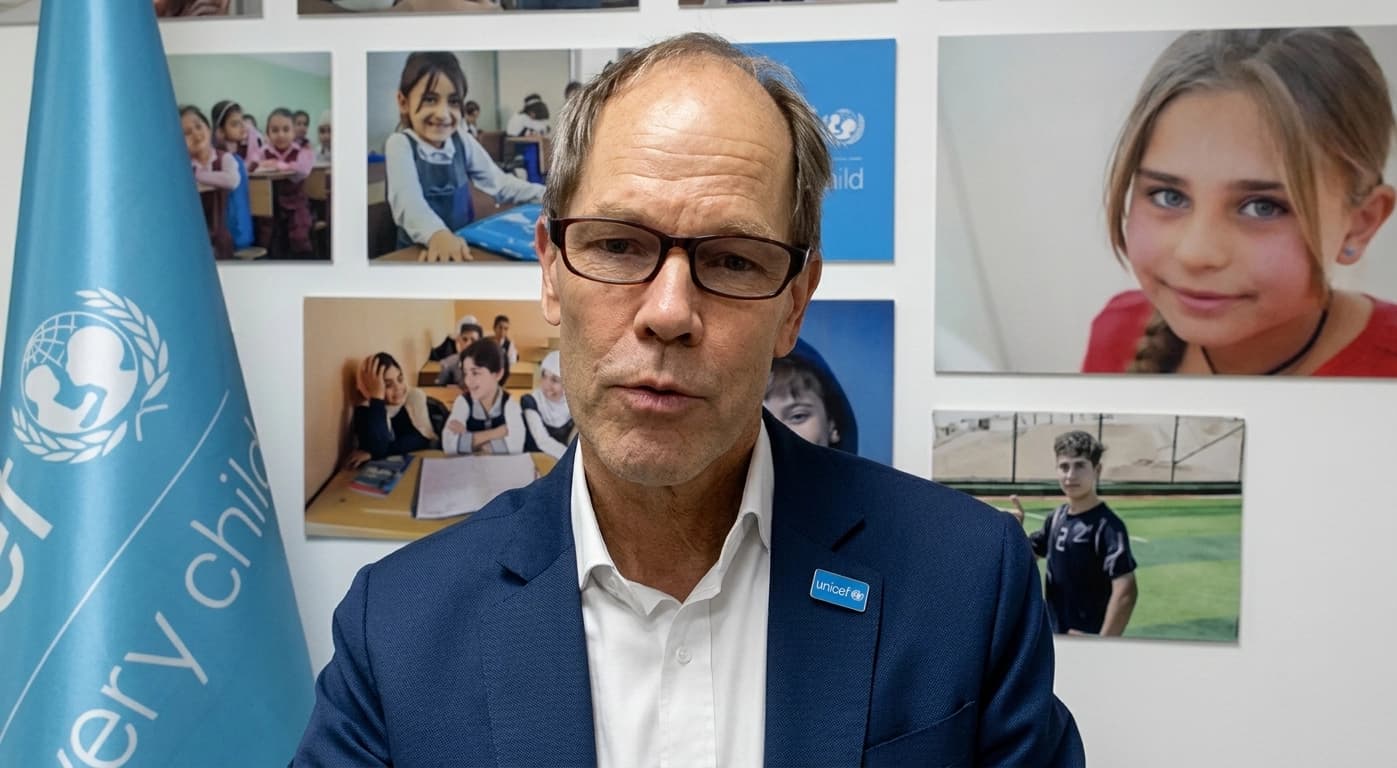
“The certificates of those who obtained their credentials between 2011 and 2024 should be accepted,” Mohammad Turko told Rudaw’s Dilbixwin Dara on Tuesday.
Kurdish authorities in Rojava developed their own curriculum in areas they controlled, rejecting the national one in place at the time that they said promoted Baathist ideology. They also promoted Kurdish as a language of instruction for the first time.
While acknowledging the technical difficulties of aligning the Rojava curriculum with national standards, Turko vowed to develop a plan for certificate equivalency. The issue has become increasingly urgent for thousands of students in Rojava. Turko explained that recognizing these certificates would allow students from Rojava to enroll in Damascus University and other Syrian institutions.
He also pointed to logistical obstacles faced by students in Rojava, who are often forced to travel to distant governorates to sit for baccalaureate exams for grades nine and 12. “All of them cannot be expected to travel to other governorates to take their exams,” he said.
Among his stated priorities are improving teaching quality, rebuilding schools, and integrating more than 2.5 million displaced children back into the education system.
On the issue of mother-tongue education, Turko expressed support for cultural and linguistic rights. “Language is the identity of a nation,” he said, noting that many Kurds would have expectations of him. “I am the minister for all Syrian children,” he added. “Every child has the right to learn.”
He said that Syria’s constitution guarantees language freedoms and framed Kurdish-language education as a cultural right. However, he tempered expectations by noting that practical implementation would require “work and agreements.”
Born in the Kurdish city of Afrin in northwest Syria in 1979, Turko holds a law degree from Damascus University and a doctorate from Leipzig University. He has published extensively on child rights, citizenship, and education, and has taught at several Syrian universities.
Turko was appointed Minister of Education and Learning in late March by interim Syrian President Ahmad Sharaa as part of a new 23-member cabinet.
The appointments have raised eyebrows, with ethnic and religious communities voicing concern over the lack of consultation. The cabinet includes several controversial figures, including individuals blacklisted by the United Nations and the United States for ties to extremist armed groups. Among them are Anas Khattab, a former intelligence chief named interior minister, and Mazhar al-Wais, a senior Sharia judge from Hay’at Tahrir al-Sham (HTS), appointed justice minister.
“I am a Kurdish technocrat minister in this government,” Turko said. “I am not a representative of a political party or political force.”