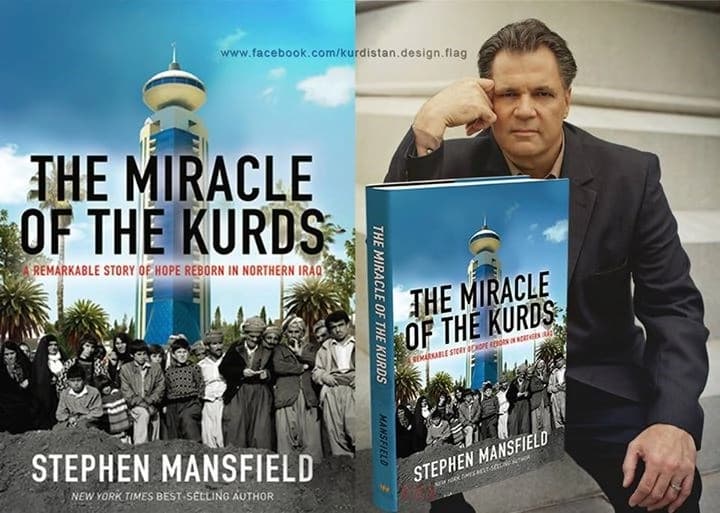

Best-selling author Stephen Mansfield makes for a strange cheerleader for the Kurdish people, with his American accent and demeanor, but there’s no doubting his enthusiasm.
Last year, his book “The Miracle of the Kurds: A Remarkable Story of Hope Reborn in Northern Iraq” came out at the perfect time, becoming a must-read as the Islamic State put the world’s focus on the Kurdistan region.
Yet, the 56-year-old Mansfield’s self-avowed love affair with all things Kurdish began much sooner. He first worked with Kurdish immigrants in his current home of Nashville and made his first trip to the region in 1994. Along the way, he became known to the world for his groundbreaking book “The Faith of George W Bush,” the first in series of widely popular books and biographies. His most recent outing, “Miracle of the Kurds,” was Rudaw’s Book of the Year for 2014.
As Mansfield has written: “I did not write this book because I am an expert on the Kurds. I wrote it because I am an admirer of the Kurds and I wanted to urge my fellow Americans to admire them, too. I believe the Kurds point a way out of the darkness in the Middle East and I feel privileged to tell a bit of their story.”
Back in Kurdistan for some speaking engagements, Mansfield spoke to Rudaw in Erbil on May 20 about his hope, hospitality and his “love letter to the Kurds.”
RUDAW: Who are the Kurds to you?
MANSFIELD: The Kurds to me are an historic people with tremendous virtues and a big role to play in the future of the region.
They are the greatest people the world has never heard of.
That’s why I wrote this book, because in some Western countries and Europe and especially in the US, the Kurds are known only for negative things – Saddam, Halabja, betrayals by the West. I wrote this book to say: here are the Kurds.
What are these ‘virtues,’ as you see them?
They are a strong, positive people with incredible hospitality. They have a tradition of moderate Islam and religious tolerance. Plus, they are fierce fighters and they are proving that right now.
The subtitle of your book says ‘hope reborn.’ This implies it was lost at some point. What did you mean?
When I first came to Kurdistan in the early 90s, the Kurds were recovering from atrocities and gassings, and there was a civil war and the Saddam regime. From that time, and during these hardships, hope was reborn through wise leadership and modern economics.
You’ve noted that the image of Kurds is at an all-time high. Why are people around the world, especially Americans, now identifying with the Kurds?
The Kurds are a proven democratic people, Americans admire that. Plus, the religious tolerance I mentioned. Also, America is pro-Israel and the Kurds are as well. I’m not saying the Kurds are radically pro-Israel, but their attitude is positive to Americans.
Most important, when you learn about the Kurds you see a people that has been brutalized and betrayed time and time again, and yet they have never slunk into bitterness.
If you could script the future for the Kurds, what would it be?
First give them enough support to defeat ISIS. Then give serious global consideration of independent status and finally reconsider Kurdistan on the will of the people and what’s viable in the region.
Finally, what is the advice you would give to the Kurdish people?
They have got to get their message out to the world: say here’s who we are. At the same time, they have to continue to improve things at home.
Most important, they need a powerful spokesman, like South Africa had Mandela. As we know the media reduces things to a single message and a single face. I think President Masoud Barzani is becoming this figure.