
ERBIL, Kurdistan Region - Iran said it retaliated against the United States in the early hours of Monday morning, targeting US military air bases in Jordan and the UAE and shooting down an American drone over the Strait of Hormuz, hours after Washington launched its first strikes on Iranian territory in a month.
The Islamic Revolutionary Guard Corps (IRGC) said its Aerospace Force carried out a combined ballistic missile and drone operation against the King Hussein and al-Azraq air bases in Jordan in response to what it called “American-Zionist aerial aggression” against Larak Island.
The IRGC also said Monday an oil tanker caught fire near the Strait of Hormuz after it hit two naval mines.
"A rogue supertanker attempting to pass through the illegal route south of the Strait of Hormuz caught fire in massive fires after striking two naval mines and was brought to a complete stop," Iran's Revolutionary Guards said in a separate statement.
It claimed the operation targeted “the technical and maintenance infrastructure and the deployment sites of enemy fighter jets at two American airbases, King Hussein and al-Azraq in Jordan,” causing “heavy damage.”
The IRGC warned that further attacks on Iran would trigger stronger retaliation.
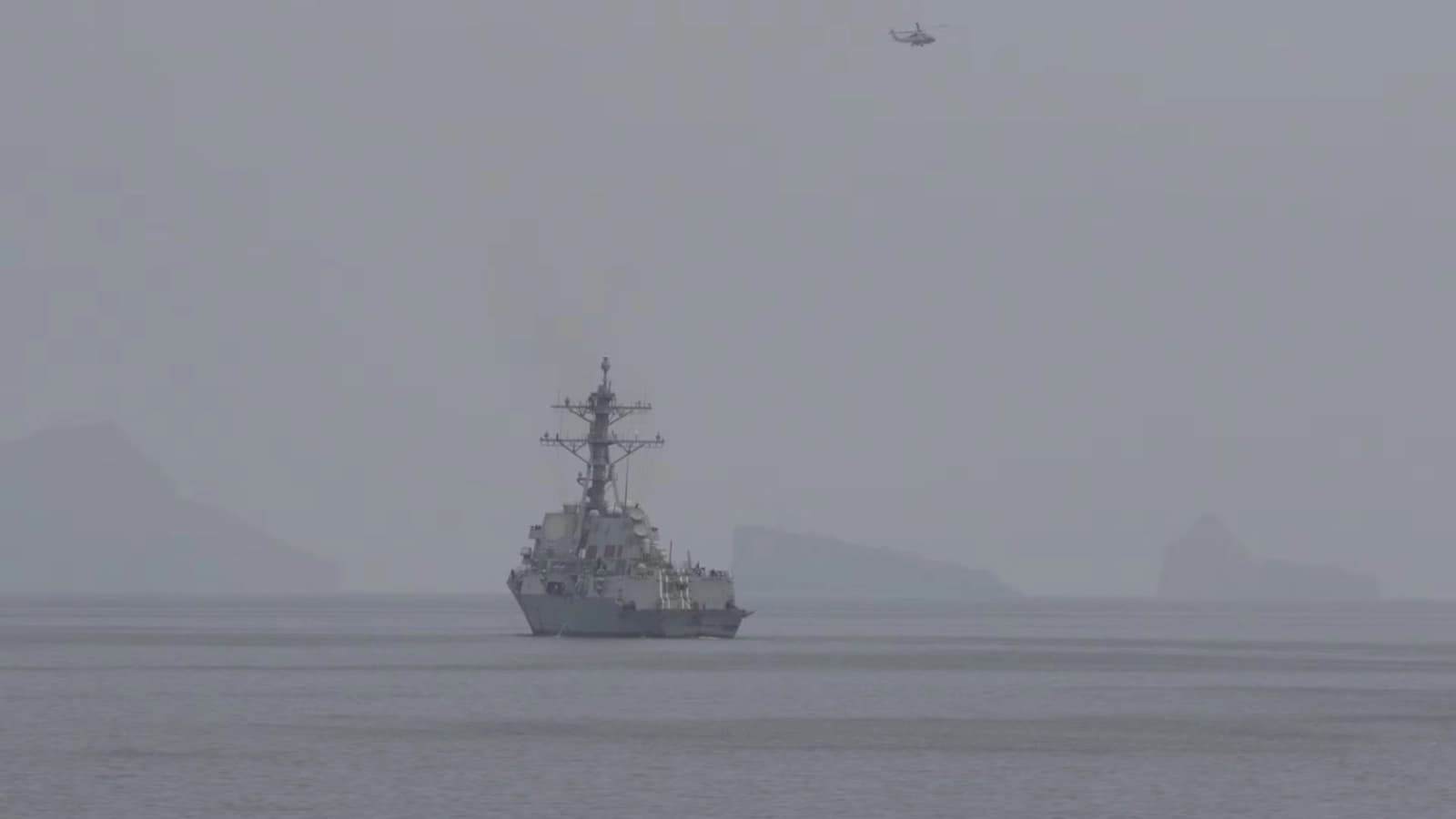
The latest escalation followed US strikes on Sunday against Iranian rocket launchers on Larak Island, a small island near the strategic Strait of Hormuz.
US Central Command (CENTCOM) rejected Iran’s characterization of the strikes as an act of aggression, saying American forces had acted to prevent the IRGC from laying mines in the waterway.
“U.S. forces took limited, precise action against IRGC minelaying forces posing an imminent threat in the Strait of Hormuz,” CENTCOM said on Monday. “In essence, Iran created the threat and the U.S. military eliminated it to protect civilian mariners, commercial shipping, and the free flow of global commerce.”
US President Donald Trump also weighed in on the escalation, posting an AI video on Truth Social showing Kharg Island being destroyed. “Kharg Island being blown to smithereens,” Trump wrote in the post.
Jordan's Armed Forces said its air defenses intercepted eight missiles that violated the kingdom’s airspace early Monday, without identifying their origin.
The Jordanian military said the missiles were destroyed before they could threaten civilians or property and pledged to take “all necessary measures” to protect the country’s sovereignty and security.
The IRGC separately claimed that its air defenses had shot down a US MQ-9 Reaper drone over the Strait of Hormuz.
The Iranian army also said Monday that it had targeted the US al-Minhad air base in the United Arab Emirates with dozens of one-way attack drones in retaliation for the killing of the members of the IRGC on Larak island.
Meanwhile, Iranian President Masoud Pezeshkian said Tehran was not seeking a wider war but would respond forcefully to attacks.
“We are not seeking war, but we will give a decisive response to aggressors,” Pezeshkian said, according to Iranian state television.
The exchange of fire comes as the US-Iran war reaches its six-month mark, after weeks in which direct hostilities had largely subsided.
The last US strike on Iran before Sunday's attack was on July 29, which Washington said came in response to an “attempted surprise attack on US forces” in the region. Earlier in July, CENTCOM conducted strikes against Iran for 13 consecutive nights.
The April ceasefire halted the most intense phase of fighting, while a Memorandum of Understanding toward a final peace agreement was signed in June. However, no final deal has been reached, and sporadic attacks, particularly around the Strait of Hormuz, have continued to undermine diplomatic efforts.
Mediators including Pakistan and Qatar have sought to revive negotiations, while the Trump administration has increasingly focused on economic pressure against Tehran.
A US naval counterblockade of Iranian ports has added pressure on Iran’s fuel supplies amid a domestic production shortfall.
Iran's effective closure of the Strait of Hormuz has also disrupted global energy markets, contributing to higher prices and shortages of fertilizer and energy. Both major crude oil benchmarks rose by at least 2 percent on Monday following the latest escalation.