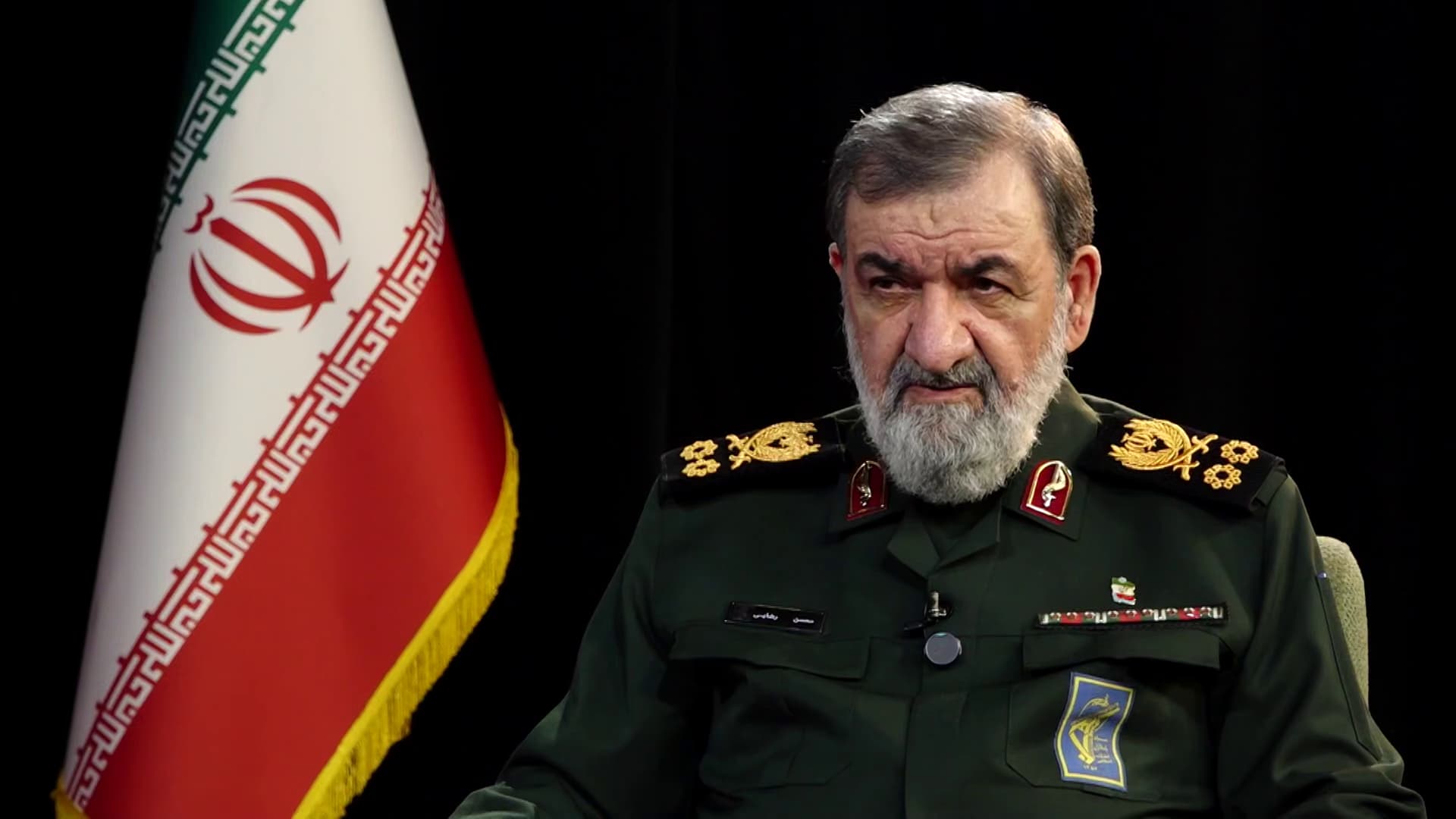

ERBIL, Kurdistan Region - Iran’s top security official Mohsen Rezaei said Saturday that Washington’s tone toward Tehran has changed significantly but that he has yet to respond to a letter from US Vice President JD Vance, as diplomatic efforts to avert renewed hostilities continue amid Iranian warnings of broader retaliation against any new American attacks.
"I have not yet responded to the letter from the US Vice President; their tone has completely changed," Rezaei, Secretary of Iran’s Supreme National Security Council, said Saturday in an interview with the state-run Islamic Republic of Iran Broadcasting (IRIB).
"Their tone has completely changed, which is a very good sign that the Iranian nation has consolidated its victory and authority," he said.
The remarks come amid intensified diplomatic efforts to prevent renewed fighting between Iran and the US, as the conflict that erupted in late February continues to disrupt shipping through the Strait of Hormuz - a vital route for global energy supplies - while the two countries have continued exchanging threats.
In his Saturday televised interview, Rezaei stated that Tehran would not enter formal talks or reopen the strategic waterway until Washington satisfies its demands, which formed the proposal foreign minister Abbas Araghchi presented to Washington on the sidelines of the United Nations General Assembly (UNGA) meeting late September.
"Until Iran's seven conditions are met, there will neither be negotiations nor will the Strait of Hormuz be opened," Rezaei said, adding that "Iran's seven conditions are completely different from the Islamabad framework."
Under the proposal, Tehran will re-open the Strait of Hormuz within seven days under the condition that the US lifts its naval blockade on Iran’s ports, ends hostilities across the region, and releases frozen Iranian funds.
Addressing questions regarding Iran's nuclear posture, following strikes on its nuclear sites and despite cooperation with International Atomic Energy Agency (IAEA) inspections, Rezaei said there were no major shifts.
"No new decision has been made regarding a change in the nuclear doctrine," Rezaei stated, noting "there is a discussion that if war breaks out again, whether we want to maintain the previous doctrine or not, but no new official or state decision has been made yet."
Earlier on Saturday, Iranian Foreign Minister Abbas Araghchi also addressed the diplomatic outreach in a televised interview with Qatari state-funded Al Jazeera Media Network, confirming that Iranian leadership had reviewed the letter sent by US Vice President JD Vance.
Islamic Revolutionary Guard Corps (IRGC)-affiliated Tasnim News Agency had previously reported on Thursday that Tehran had not yet replied to the correspondence.
“The American side’s attempt to open the door to dialogue and understanding more broadly is a positive step,” Araghchi told Al Jazeera, while cautioning that any effort by Washington to use the letter “to sow division would be another mistake.”
He also said that Tehran was far from restoring normal cooperation with the International Atomic Energy Agency (IAEA), citing US and Israeli airstrikes on nuclear facilities previously monitored by the UN watchdog.
“Iranian nuclear facilities that were under the supervision of the IAEA were attacked, and the agency has no protocol for inspecting facilities under such circumstances,” Araghchi told Al Jazeera.
He said Tehran nevertheless remained committed to its obligations under the Nuclear Non-Proliferation Treaty (NPT).
Rezaei warned of severe retaliation if the US initiates fresh military strikes, stating that “If a war starts, we will break America's horns in such a way that the world will see how this hornless bull will be incapable of defending itself.”
Speaking to reporters on the sidelines of the Group of 20 (G20) foreign ministers' meeting in Atlanta on Saturday, US Secretary of State Marco Rubio confirmed that diplomatic channels remain active while stressing that Washington is prepared to use military force if necessary.
"There are multiple talks. Talks have actually never stopped. There's been active conversations going, in some cases directly, but often through intermediaries," Rubio said.
"So I'm not going to characterize neither the progress on those talks nor any timeframe on it, other than to tell you that if there is a diplomatic solution, we would be open to it,” he said, adding that any deal must meet their “core concerns.”
Asked about the prospect of renewed US military strikes against Iran, Rubio said US President Donald Trump has not made a final decision and prefers a peaceful resolution, though the US military remains ready.
"The United States remains the most highly capable military power on earth. We can achieve military objectives if we seek to. He hasn't made a decision. I have no announcement in that regard with you today, and nor do we take any of it lightly," Rubio told reporters. "The President prefers not to do it that way. If he did, he would have done it weeks ago, months ago."
Rubio reiterated that Iran will never be permitted to acquire nuclear weapons and accused Tehran of driving regional instability through proxy groups across the Middle East.
"In Lebanon, there's instability because they support Hezbollah. In Saudi Arabia, they're under attack because Iran supports the Houthis. Iraq is a country that's feeling challenged because Iranian-backed militias are challenging the state there. So anywhere you turn, what you find is some Iranian proxy that's undermining the peace and stability of the Middle East," he said.
Addressing maritime security in the Strait of Hormuz, Rubio criticized Tehran for targeting commercial vessels and threatening regional energy infrastructure, noting that US Central Command (CENTCOM) forces are intercepting drones and missiles aimed at shipping lanes almost daily with limited international assistance.
"Iran is blowing up ships, including ships that have, for example, Indian sailors on them, including ships that have energy that's destined for countries represented at that table. We live in a world in which a country is openly—a regime is openly saying, 'We will blow up commercial ships,'" Rubio said.
Meanwhile, US Treasury Secretary Scott Bessent stated in a post on X on Saturday that global energy supplies are navigating the waterway without Iranian crude.
"The Strait of Hormuz transit levels are back to pre-conflict levels minus Iranian barrels. The world can live without Iranian oil. Iran cannot live without oil exports," Bessent wrote.
On the same day, the US Central Command (CENTCOM) posted on X that as of Saturday, its forces had “redirected 144 commercial vessels to ensure compliance” with the ongoing US maritime blockade.
Shipping through the Strait of Hormuz has remained heavily impacted since fighting began. The United Kingdom Maritime Trade Operations (UKMTO), a British maritime navy monitor, reported Friday that it had recorded 88 vessel incidents in the strait since the onset of the conflict.
According to UKMTO’s latest weekly data, the waterway recorded 122 outbound and 155 inbound vessel transits, up from 114 outbound and 127 inbound movements the prior week, though overall traffic remains roughly 70 percent below pre-war levels.