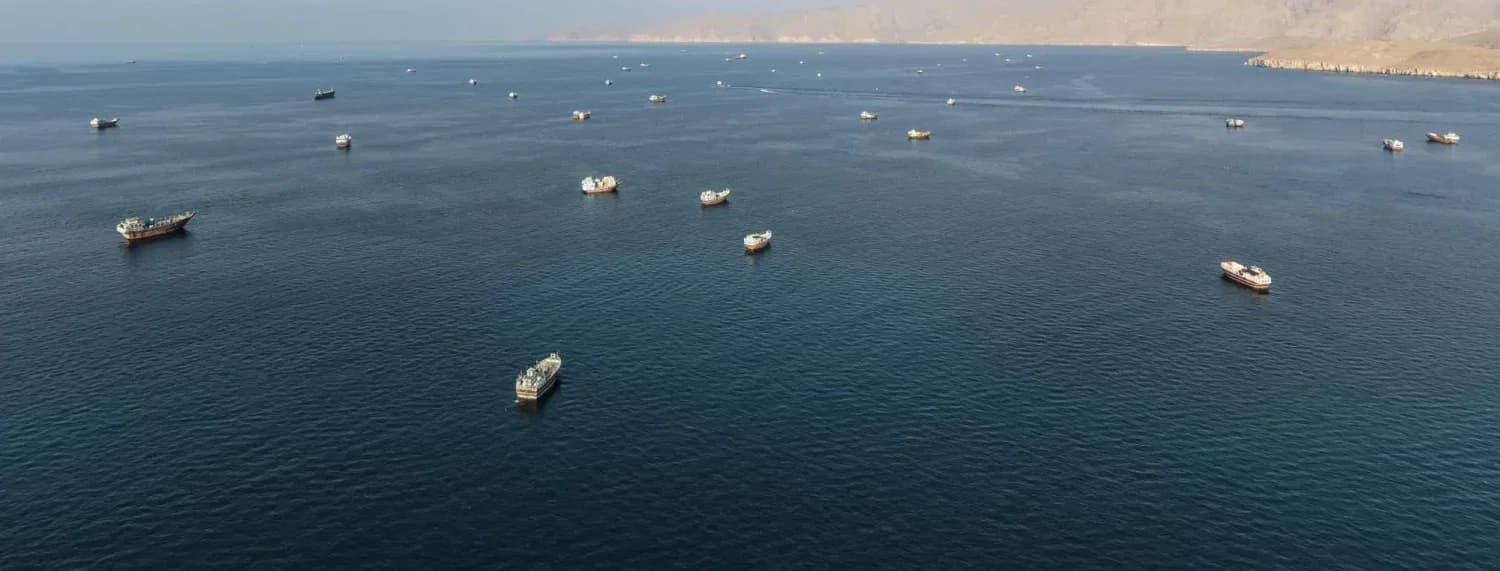

ERBIL, Kurdistan Region - Iranian foreign minister Abbas Araghchi on Friday declared that the US blockade on the Strait of Hormuz must be broken as officials float the idea of sending a naval convoy to the strategic waterway.
“We are making every effort to export oil and pursue negotiations, and the siege must be broken,” Iranian Foreign Minister Abbas Araghchi told the Iranian Labor News Agency (ILNA) on Friday.
“We won't wait for America's permission, we will open the path and make the cost of closing it high enough for the other side that its reason dictates that it leave the path open,” Fars News Agency, affiliated with the Iranian Revolutionary Guard Corps (IRGC), said late Thursday.
The US naval blockade on Iranian ports remains in effect since mid-July and has sharply curtailed the country's oil exports, with crude shipments falling to zero, according to an analyst from Kpler. US Central Command (CENTCOM) Commander Adm. Brad Cooper said in mid-September that “Iran has exported zero barrels thanks to our ironclad blockade.”
Tehran has sought to counter the restrictions by relying on alternative trade routes through neighboring countries, while Washington has expanded its pressure to target Iran's land routes and trade networks.
“Iran has been building a network of terminals and storage facilities in China for years to sell sanctioned oil without going through global banks. The port of Jask has served as an alternative route, maintaining exports to China even at the height of the blockade,” Fars news reported.
An Iranian fleet “with numerous vessels, false flags, and turned off detectors has been circling the siege wall for years,” the outlet reported, stating that Tehran should turn its ability to move oil despite sanctions into an open display of power by sending a convoy of tankers “with China as its target.”
It warned that any attack on an Iranian tanker would bring “the oil and oil terminals of the Emirates, Saudi Arabia, and Qatar” in “the response equation at that very moment.”
The agency said the proposal was intended to deter the United States from blocking the convoy.
Earlier in November the US President Donald Trump said Qatar, Saudi Arabia, the United Arab Emirates, Bahrain and Kuwait preferred maintaining the US pressure campaign against Iran, describing it as “a continuation of the Greatest Naval Blockade in History, and the new Operation Iron Gate,” in a post on Truth Social.
Scott Bessent, the United States secretary of Treasury, warned the Iranian people to stock up on gasoline and heating fuel ahead of expected shortages as he is predicting the economy would shrink by more than 25 percent by March of the next year, in an interview with Iran International.
“I would predict that from March of '26 until March of '27, the economy would contract more than 25 percent, which is more than the Soviet Union contracted after its collapse,” said Bessent.
Washington has also expanded its pressure beyond the sea.
CENTCOM announced earlier this month the formation of Task Force Iron Gate earlier in November to disrupt Iran's use of land routes and the Caspian Sea to transport weapons, sanctioned materials and other supplies.
The USS Theodore Roosevelt aircraft carrier strike group arrived in the Middle East on Monday, joining the USS George H.W. Bush and USS George Washington, according to US Central Command.
The USS Theodore Roosevelt aircraft carrier strike group arrived in the Middle East on Monday, joining the USS George H.W. Bush and USS George Washington, according to US Central Command.