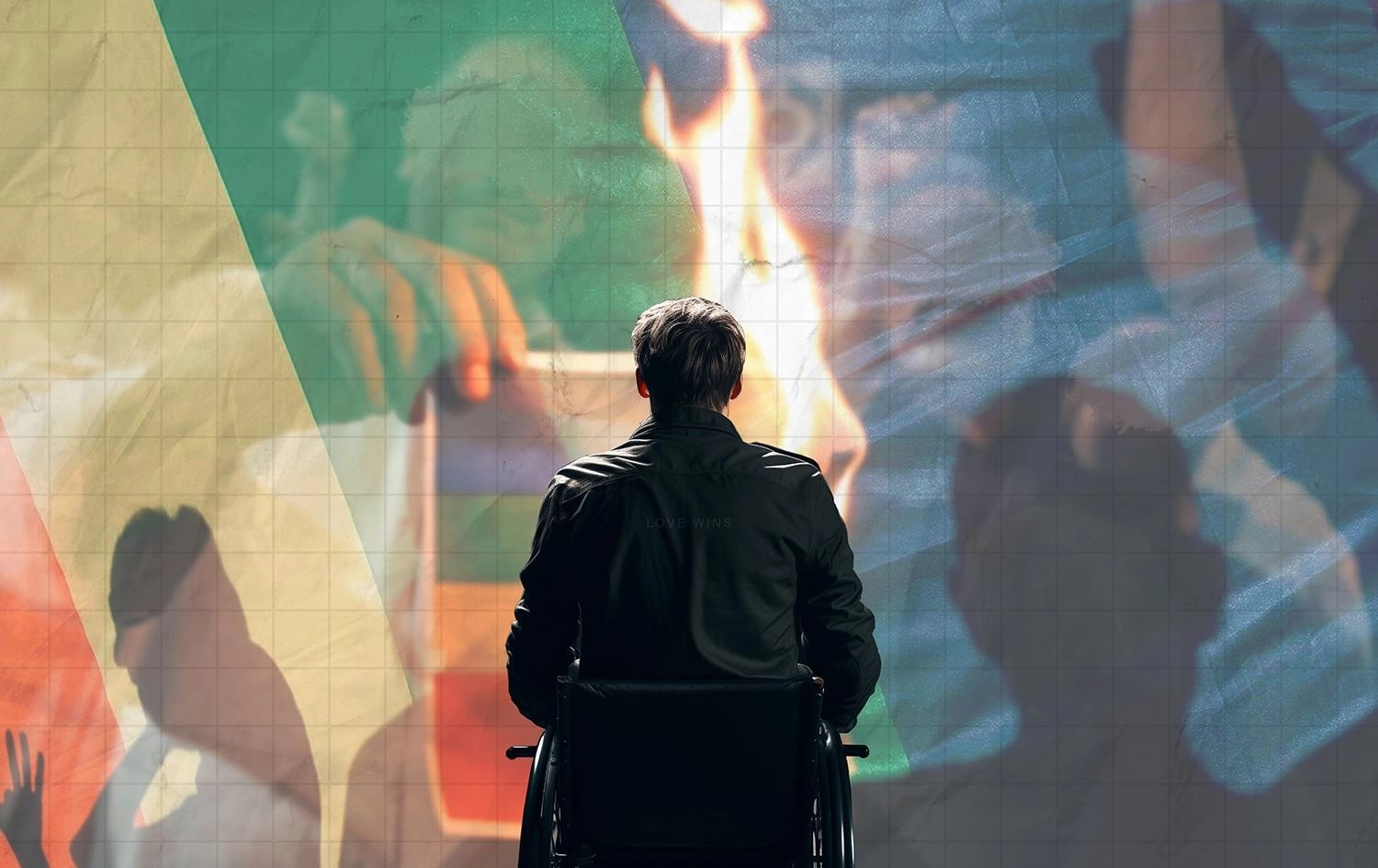

“Four years ago, during springtime, I got into a car accident near Hamadan due to speed. When I regained consciousness in the hospital days later, the doctors told me that I had been crippled,” Puria told Rudaw English earlier this month.
Similar to most of Muslim-majority countries, the LGBTQI+ community in Iran faces extreme marginalization both from the state and majority of the public, who view the queer community as a foreign plot to corrupt Islamic values.
Consenting adults in same-sex relationships could receive the death penalty in Iran. For members of the queer community who also suffer from disabilities, life seems unbearable.
Puria is a 32-year-old gay man from western Iran’s (Rojhelat) Kermanshah. His sexual orientation has brought excruciating challenges, leaving him hoping to leave Iran for safety and stability abroad.
Puria laments that his disability has made it almost impossible for him to make new connections. Most people treat him like a lesser person or pity his condition.
He is also haunted by his family’s desire for him to conform to heteronormative society by getting married to a female relative. Marrying cousins remains a common practice in much of the Middle East.
The only thing bringing Puria comfort following the accident was his lover, who promised to stay by his side despite the permanent injury. Nonetheless, the two would break up soon after, sending Puria into the deepest pits of despair.
“I attempted suicide twice, but I was unsuccessful. All that remains now is me and this living hell,” he said.
Gender-affirming surgeries are officially recognized in Iran and even subsidized. However, the state recognition does not shield the community from widespread prejudice and sexual violence.
Shawnm*, a 27-year-old transgender woman from Sanandaj who has limited movement and is yet to undergo gender-affirming procedure, also decries the doubled discrimination in Iran.
“In addition to the lack of services for people with disabilities here, whenever I want to go out, the people either give me dirty looks for the way I am dressed, or look at me with pity because of my disability, which is devastating to me,” she told Rudaw English.
Conservative communities in Iran and Rojhelat tend to be much less accepting of transgendered women than their male counterparts. Rape, sexual abuse, insults and mistreatment are constant.
Shawnm’s only income is a one million tomans ($17) monthly check from the State Welfare Organization as she is unable to make a living on account of her disability.
“I have forgotten about love. I met a few people who after a while I realized only wanted to mock me,” she lamented. “So I have chosen to forget about love because I know no one desires me in the state that I am in.
“My tears of loneliness are my lot in life.”
Data on disabilities in the Islamic Republic is limited, but according to 2015 data from the State Welfare Organization of Iran, nearly 1.9 million people with disabilities were registered with the government.
Iran is also a state party to the UN Convention on the Rights of Persons with Disabilities, yet limited services are provided to the group.
*Names have been changed to protect identities
Translated by Chenar Chalak