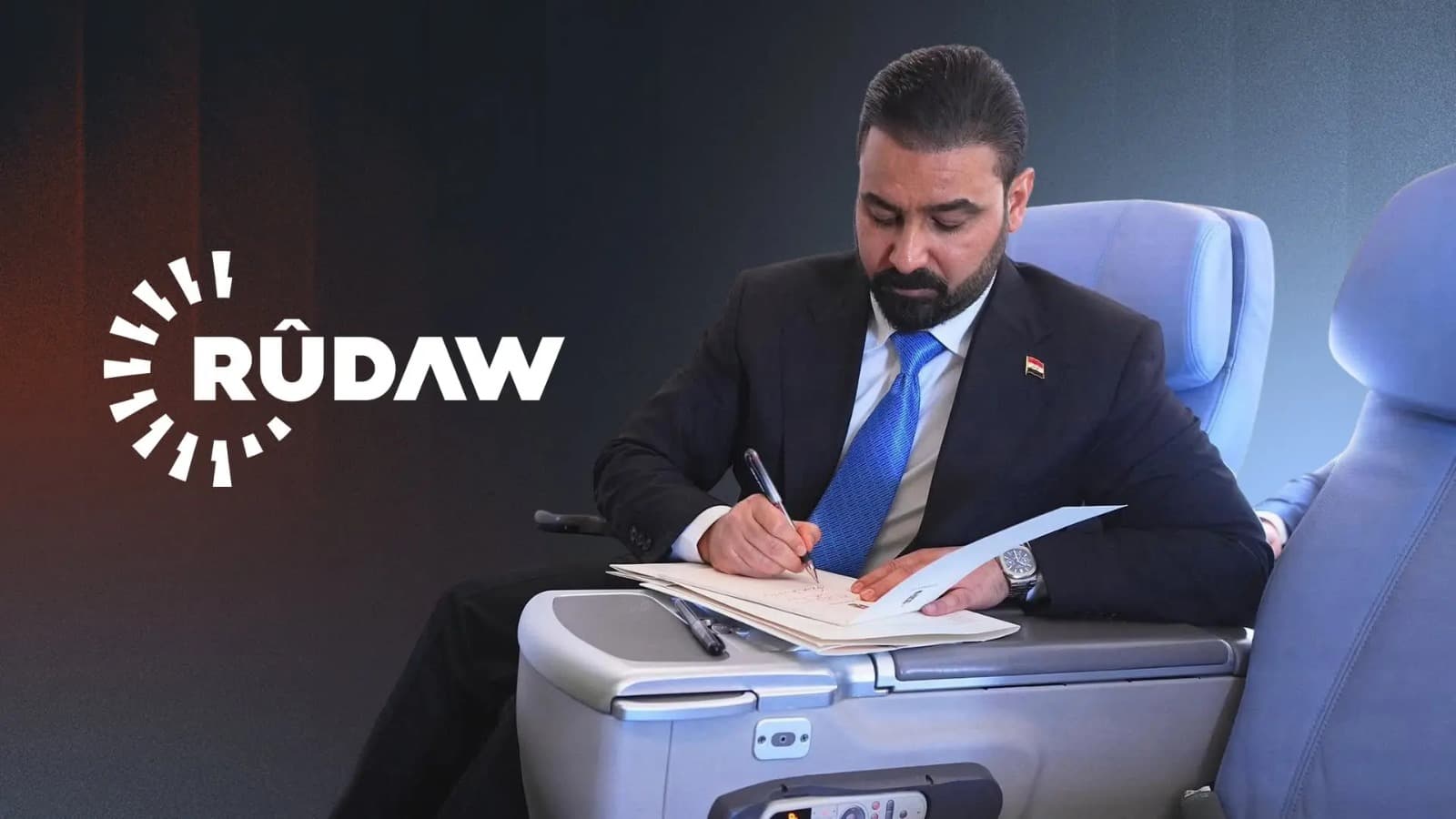

As you read this article, I, in my capacity as the Director of Public Relations for Rudaw Media Network and by official invitation from the Office of the Iraqi Prime Minister Ali al-Zaidi, am aboard the aircraft carrying the Iraqi Prime Minister and his accompanying delegation toward Washington, DC. The inclusion of major media outlets and large companies by the Iraqi prime minister is a new, statesmanlike step in Iraq, and its importance deserves appreciation.
On Monday morning, Zaidi embarked on his first international trip as the new Prime Minister of Iraq to the United States. The official Iraqi delegation includes several high-ranking Iraqi officials, prominent personalities, businessmen, and representatives of Iraq's influential institutions. Rudaw Media Network has been officially invited to accompany Zaidi and is participating in this historic visit by the Iraqi Prime Minister.
Zaid's visit to Washington not only includes discussions on political files in closed-door meetings; rather, it will define a joint roadmap for security, the economy, and investment between Iraq and the United States for the coming years. Thorough preparations have been made for the visit, and the support the United States is providing to Zaidi is unprecedented for any previous Iraqi Prime Minister.
In a visit of this magnitude, participation is only granted to those parties that have proven to be trustworthy, influential partners with significant capabilities and standing at the level of Iraq and the region.
Rudaw’s participation carries an important message: that Baghdad views Rudaw Media Network as a professional and credible media institution capable of representing the media landscape at the most important international forums and gatherings. For this reason, Baghdad has made Rudaw a traveling companion for the Prime Minister on his visit to the world's greatest power.
As the first media outlet from the Kurdistan Region to accompany an official Iraqi delegation on such a visit, Rudaw Media Network’s participation is not merely a protocol invitation. Rather, it is a reflection of the status that Rudaw has built over more than a decade in the region, the world, and the United States.
Since 2013, when Rudaw Media Network began its operations in the United States, the path has not been easy or prepared. It started from point zero; it was about building the foundation for the work of Kurdish media professionals in Washington. Rudaw’s work was based on the belief that the future of Iraq and Kurdistan is not shaped only in Baghdad and Erbil, but that Washington remains one of the most influential capitals in the world for the region.
Having a professional Kurdish media institution is a strategic investment for the future. Since 2013, questions held by the people of Kurdistan and Iraq have been posed at the White House and the United Nations by Rudaw correspondents to the US President and various world leaders and representatives.
In recent years, Rudaw's role has not been limited to news reporting; it has become part of the American media landscape. Rudaw correspondents have interviewed presidents, ministers, and members of Congress as part of their media work, directing questions that conveyed the issues and concerns of Iraq and Kurdistan to the highest levels. In some cases, this led to shedding light on issues that had not received sufficient attention within US decision-making circles.
Today, Rudaw Media Network’s relations in the United States are entering a new phase. Rudaw is moving toward continuous engagement with decision-makers, institutions, research centers, and influential American hubs.
The participation of Rudaw with the official Iraqi government delegation on this US visit holds multi-faceted importance. It demonstrates that the Kurdistan Region possesses a strong and influential institution capable of creating impact through professionalism and credibility.
Rudaw will always be at the center of important and historic events, serving as a true media participant in fundamental changes.
Ali Jaff is the Director of Public Relations at Rudaw Media Network.
The views expressed in this article are those of the author and do not necessarily reflect the position of Rudaw.