
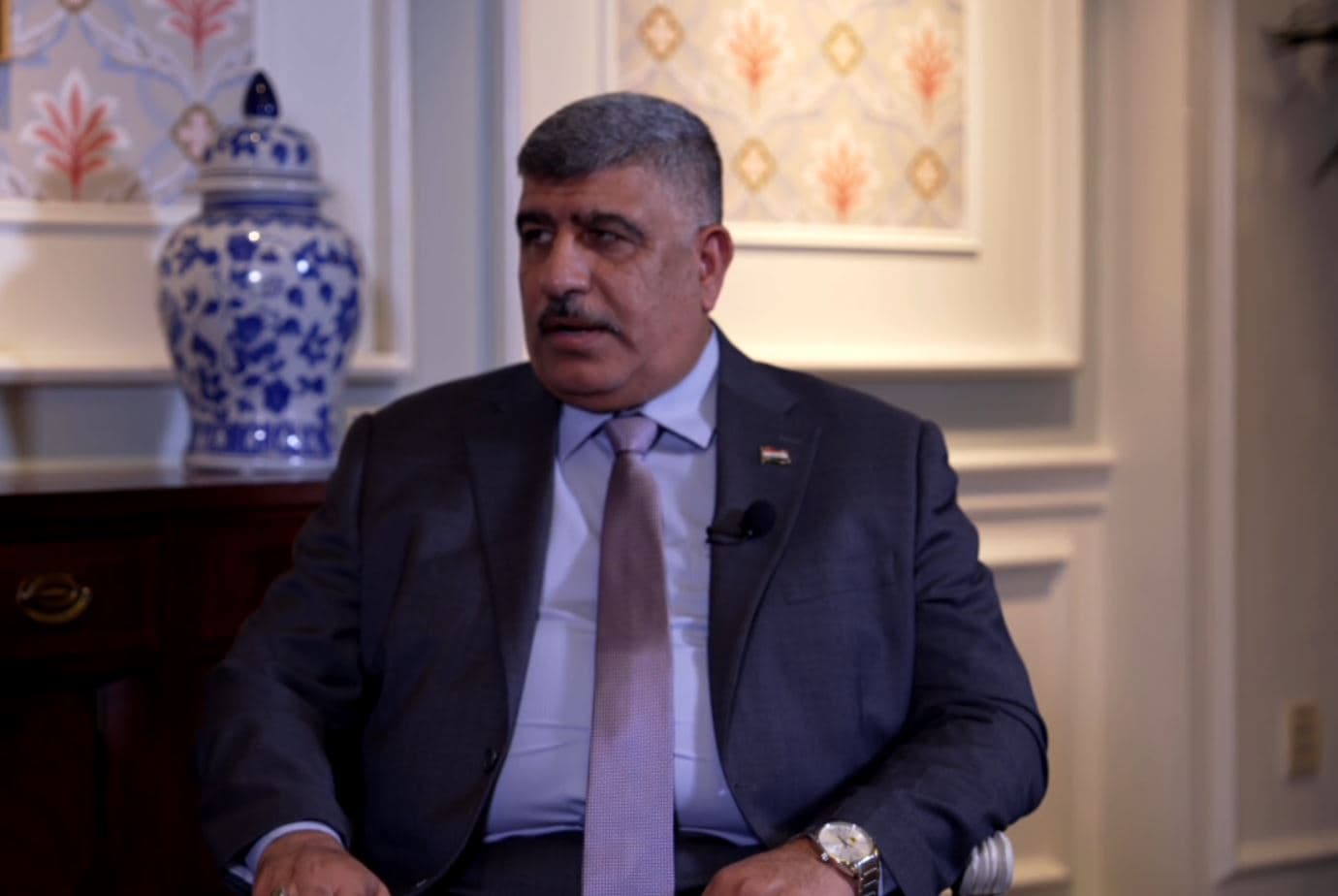

ERBIL, Kurdistan Region - The September 30 deadline to bring Iraqi armed groups' weapons under state control is "irreversible," a senior official accompanying Prime Minister Ali al-Zaidi on his landmark trip to the United States told Rudaw, adding that the issue was central to the premier's meeting with senior American officials.
Zaidi met with US President Donald Trump and Special Envoy for Iraq and Syria Tom Barrack on Tuesday, and with Secretary of War Pete Hegseth the following day, among other officials.
"The issue of placing all weapons under state control was central during the discussions" held in those meetings, government Spokesperson, Sabah al-Numan, said in a Wednesday interview, pointing to Zaidi's "commitment and determination" to conclude the file within a timeline he described as "fixed and irreversible."
Numan further noted that Iraq's "security decision, and the decision of war and peace, lie in the hands of the commander-in-chief of the Iraqi armed forces [the prime minister]," anticipating that Iraqi armed groups will comply with the push to address arms proliferation, in response to "the rule of law, the will of the people, and the principle of preserving Iraq's dignity and sovereignty."
In early June, Zaidi ordered the formation of a committee to oversee the disengagement of political parties and armed factions from the Popular Mobilization Forces (PMF), amid a wider effort by the newly appointed premier to bring paramilitary groups and their arms under state control.
The PMF was established in 2014 during the Islamic State (ISIS) emergence in Syria and Iraq in which large parts of Iraq's north and west were seized.
Created in response to a fatwa, a decree, by Iraq's highest Shiite authority, Grand Ayatollah Ali al-Sistani, the PMF was initially an umbrella organization of roughly 70 predominantly Shiite armed groups with 250,000 members.
While the PMF is a state-funded institution, it comprises factions aligned with the Iran-led ‘Axis of Resistance’ - with the core overlap including Asa'ib Ahl al-Haq, Kata'ib Hezbollah, Harakat Hezbollah al-Nujaba, and Kata'ib Sayyid al-Shuhada.
While some groups have expressed willingness to comply with Zaidi's push to restrict arms to state control, others have cited the continued presence of foreign forces - namely those of the US-led Global Coalition to Defeat the Islamic State (ISIS) - as justification for refusing to comply.
For his part, Numan told Rudaw that "after September 30, there will be no Coalition forces remaining in Iraq - not only American forces … but other nationalities as well."
Accordingly, Zaidi, during his visit to the US, directed the establishment of "a special Iraqi security technical committee to formulate the structure of the security and military relationship" with the US after the withdrawal of Coalition forces by September 30, the government spokesperson added.
"This will ensure Iraqi sovereignty while also guaranteeing increased support for the capabilities of the Iraqi security forces, as they are the only forces authorized to protect Iraq's sovereignty," Numan stressed.
RELATED: Iraqi PM Zaidi, US President Trump hold landmark meeting at White House
.png&w=3840&q=75)