.jpeg&w=3840&q=75)

How Rebin Sattar survived beatings, suffocation and electric shocks in Iraqi custody over a Kurdish shop sign — a chilling glimpse of the “new Iraq” under Prime Minister Ali al-Zaidi.
All his life, Rebin Sattar has played with fire.
A blacksmith since the age of 11, he has travelled across eastern Iraq from his hometown of Khanaqin in search of work. He is also an avid TikToker, using social media to promote his business.
But above all, he is a family man. Even after working more than 12 hours a day, he made sure to put his four-year-old daughter Avesta to bed every night.
“Oh dear baba, my beloved Avesta, the light of daddy’s life,” Sattar would repeat in Kurdish until she fell asleep.
Rebin lived in Khanaqin, a predominantly Kurdish city with a sizable Arab population in a disputed area roughly 13 kilometers from the Iranian border in Diyala province. He was widely known as Rebin Hadad, drawing from the Arabic word for blacksmith. His shop sign was in Arabic, as are many in the city.
His family, like that of his wife Nour, had been among Kurds exiled to non-Kurdish parts of Iraq under Saddam Hussein. Nour was born in Ramadi, just west of Baghdad, and spoke only Arabic. Rebin’s family returned to Kurdistan after Saddam’s regime was toppled in 2003.
Despite Khanaqin’s history of Arabization and discrimination against Kurds, Rebin mixed freely with Kurds and Arabs. He is Kaka'i, a religious minority that was repeatedly targeted by the Islamic State (ISIS). One of his cousins was killed by the group in 2018.
For Rebin, life was ordinary until a Kurdish shop sign changed everything.
The Kurdish sign
In late August, Rebin saw a TikTok video by Rudaw presenter Ranj Sangawi criticizing Kurds in Khanaqin for not displaying shop signs in Kurdish. Sangawi, a well known journalist, had traveled to the city to talk to locals about the limited presence of the Kurdish language.
“I felt offended. Why would he be more Kurdish than me?” Rebin remembered thinking.
The following day, he decided to replace his Arabic-only sign with one in both Kurdish and Arabic. He filmed the process, posted it on TikTok and encouraged other Kurds to do the same.
His video was reposted by Rudaw and quickly went viral. Kurdish businessmen offered to pay for new signs, while Rebin said he would do the blacksmithing work for free.
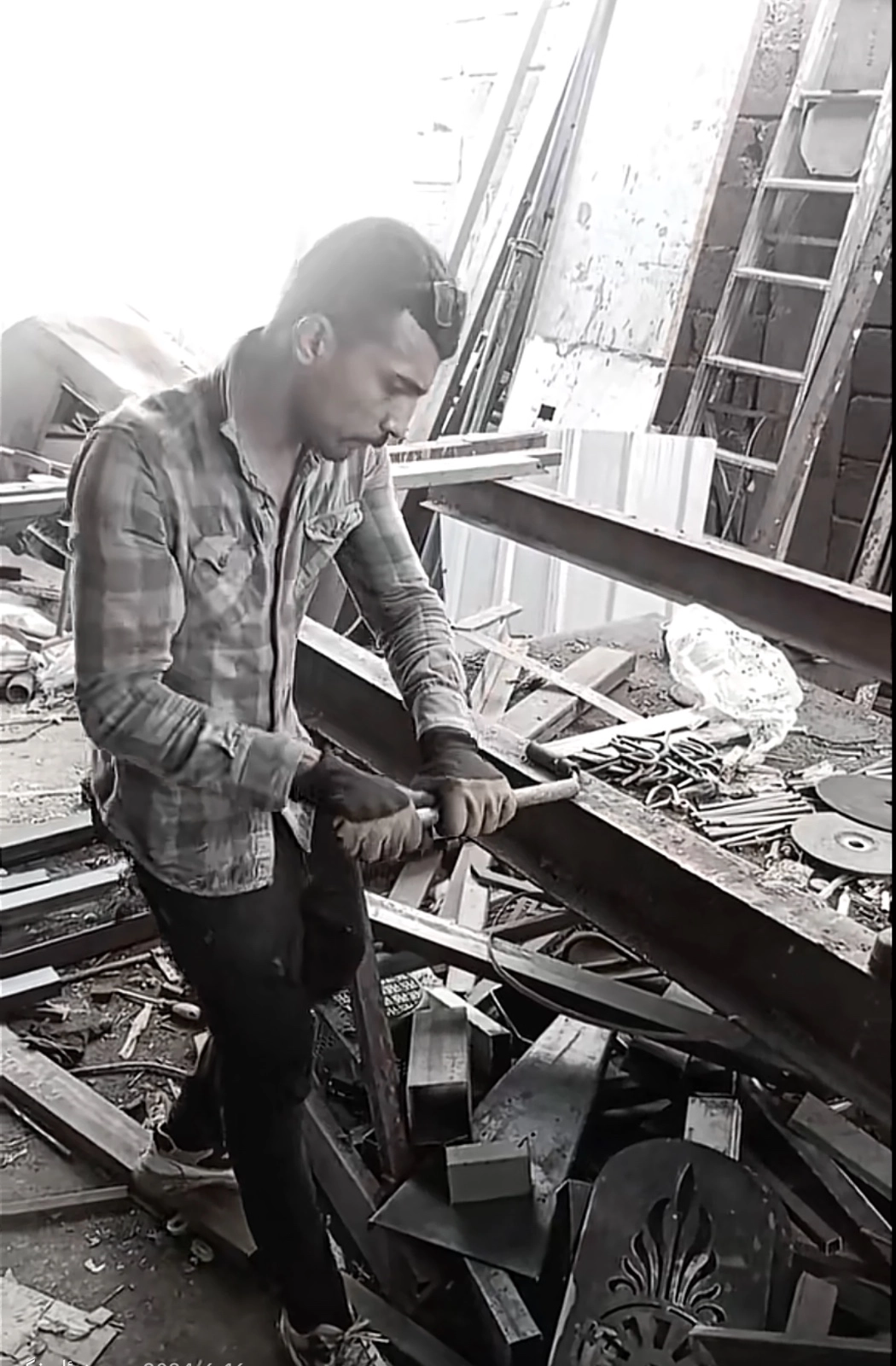 At work in his shop. Photo: Rebin Sattar
Then the calls started.
One man asked him to come to a quiet residential area on Manzariya Road for some blacksmithing work. Rebin rode there on his Iranian-made motorbike and waited outside the complex.
A police pickup pulled up beside him.
Four men jumped out, pulled his t-shirt over his head, handcuffed him and threw him into the vehicle.
“I shouted, ‘Why are you taking me?’” Rebin recalled.
He recognized one of the officers by his voice.
“You should be ashamed of yourself. We have been neighbors for 15 years.”
He was first taken to the Federal Intelligence and Investigation Agency in Khanaqin, then transferred to Baquba, the capital of Diyala governorate.
“Get him out of the city before people flood the station,” Rebin overheard the head of Khanaqin intelligence telling officers.
His videos had gone viral and news of his arrest had already begun spreading.
At Baquba intelligence, the beating began almost immediately.
“As soon as I entered the building, several officers started hitting me and calling me a son of a bitch,” Rebin recalled.
Then the interrogation became more violent.
“With a green pipe, they kept hitting the soles of my feet, as the head of intelligence placed one of his feet on my head,” Rebin recalled.
One officer screamed at him: “You dirty Kurd, I am going to f**k your mother.”
Another shouted: “You pimp, you are a terrorist.”
The beating lasted around 15 minutes, Rebin said, with more than 40 blows to the soles of his feet.
He still did not know why he had been detained.
Into solitary confinement
He was thrown into a room barely one square meter in size, still blindfolded and handcuffed.
“The sound of the doors was terrifying,” he recalled, as it could signal another round of beating.
About an hour later, officers dragged him into another room containing a gurney and a blanket.
“If you look up, I will take out your eyes,” the officer in charge told him. The others referred to him as “the colonel” but Rebin can't be sure if he was genuinely a colonel.
“They wrapped the blanket around me like a stuffed vine leaf,” Rebin remembered.
His hands were tied behind his back with rope. Then the beating resumed.
When officers called him a terrorist, Rebin protested that he was Kaka’i.
“My cousin was killed by Daesh a few years back. How could I be a terrorist?” Rebin protested referring to the Islamic State by its derogatory Arabic acronym.
“Officer, I am not Daesh. I am Kaka’i. I don’t even know how to pray.”
The officers then said he was working for Israel and identifying Popular Mobilization Forces (PMF) positions for Israeli strikes.
“I was disoriented. He was hitting me and I was screaming,” Rebin remembered.
Then came the electrotorture
“I will teach you a lesson. Bring me the electrical device,” the officer in charge ordered.
The device, known as saeqa in Arabic, was a taser.
“They tased me twice on my right foot and it was so painful that I shouted and said I would confess to anything you want,” Rebin recalled.
Then came the question that made everything clear.
“Who gave you the money to change your shop sign?” the officer asked.
Rebin realized that his arrest was connected to the Kurdish sign. Leading up to that moment, he had even contemplated that the people beating him were part of a “mafia.”
He insisted he had merely added Kurdish signage alongside Arabic.
“No, you are saboteurs and encouraging people to protest,” the officer said. “I am going to castrate you today.”
The word evoked a faint recollection of the regime of Saddam Hussein during which Kurds who were arrested by the Iraqi intelligence were referred to as “saboteurs.” The regime has changed, but the lexicon has survived, Rebin thought.
He was then tased five times on his testicles.
“That was when I broke down and started screaming as loud as I could. The pain was excruciating,” Rebin recalled.
The officers gave him the names of nine Kurdish activists and ordered him to testify that they were receiving money from a Kurdish politician to instigate unrest in Khanaqin.
They threatened to tase him in the eyes.
Then an officer brought a plastic bag.
“One officer brought a plastic bag and pressed it against my mouth and nose and the other officer kicked me hard in my belly,” Rebin recalled. “As I struggled to breathe, I fell unconscious.”
He said he lost consciousness four times and was repeatedly woken up with slaps across his face.
The officers threatened to pull out his teeth with pliers. They tased him again after he called on God in Kurdish and ordered him to shout in Arabic.
Then, with his hands cuffed behind him, he was kicked in the upper back.
Both shoulders were dislocated.
“They ordered me to sit up and I said I could not,” Rebin recalled. “He then kicked me in the chest and both my shoulders fell back into place.”
Rebin believes the officer knew exactly what he was doing.
Before being returned to solitary confinement, another officer placed his boot squarely on his head.
“This is for you to remember that an Arab can step on the head of every Kurd,” he said.
The trial
The following day, August 31, Rebin and another Kurdish detainee, Abu Muntazar, were taken to court. Abu Muntazar was wealthy and well connected. He had been part of the PMF before joining the Patriotic Union of Kurdistan (PUK) which had angered the central government authorities.
Officers warned Rebin not to withdraw his confession.
“As I entered the court, I started crying,” Rebin recounted.
The judge told him he was charged under Article 200, which relates to the criminalization of sectarian, racial, or nationalist incitement.
“Judge, if you listen to me like a father, I will tell you the truth. But if you are going to send me back to the station, then I am happy with my confession,” Rebin told him.
There was a Quran in front of the judge.
“I swear on this Quran that I am innocent,” Rebin said as he grabbed the Quran and pleaded with the judge.
He told the judge that he had been electrocuted on his testicles and pleaded not to be sent back to the intelligence station.
He also explained that he was a technical institute student and had a final exam the following day.
His only crime, he said, was changing his shop sign from Arabic-only to bilingual Kurdish and Arabic.
He was returned to the station but was not tortured again.
Outside, unbeknownst to him, a campaign for his release was growing. Kurdish politicians had begun intervening on his behalf.
That night, Rebin could not sleep.
All he could think about was Avesta.
He began hallucinating, holding the blanket and imagining it was his daughter he was trying to put to sleep.
The next morning, he was taken into another room where he was beaten and sworn at.
“Even though I am Kaka’i, I looked up and said, ‘Oh God, the same way you saved Jonah from the belly of the whale, get me out of this,’” Rebin prayed.
He was released later that afternoon.
A large crowd, including Kurdish politicians, was waiting outside.
When he finally returned home, the first thing he did was embrace Avesta and sob.
Rebin has since filed a complaint against the intelligence directorate in Baquba, but he remains deeply worried.
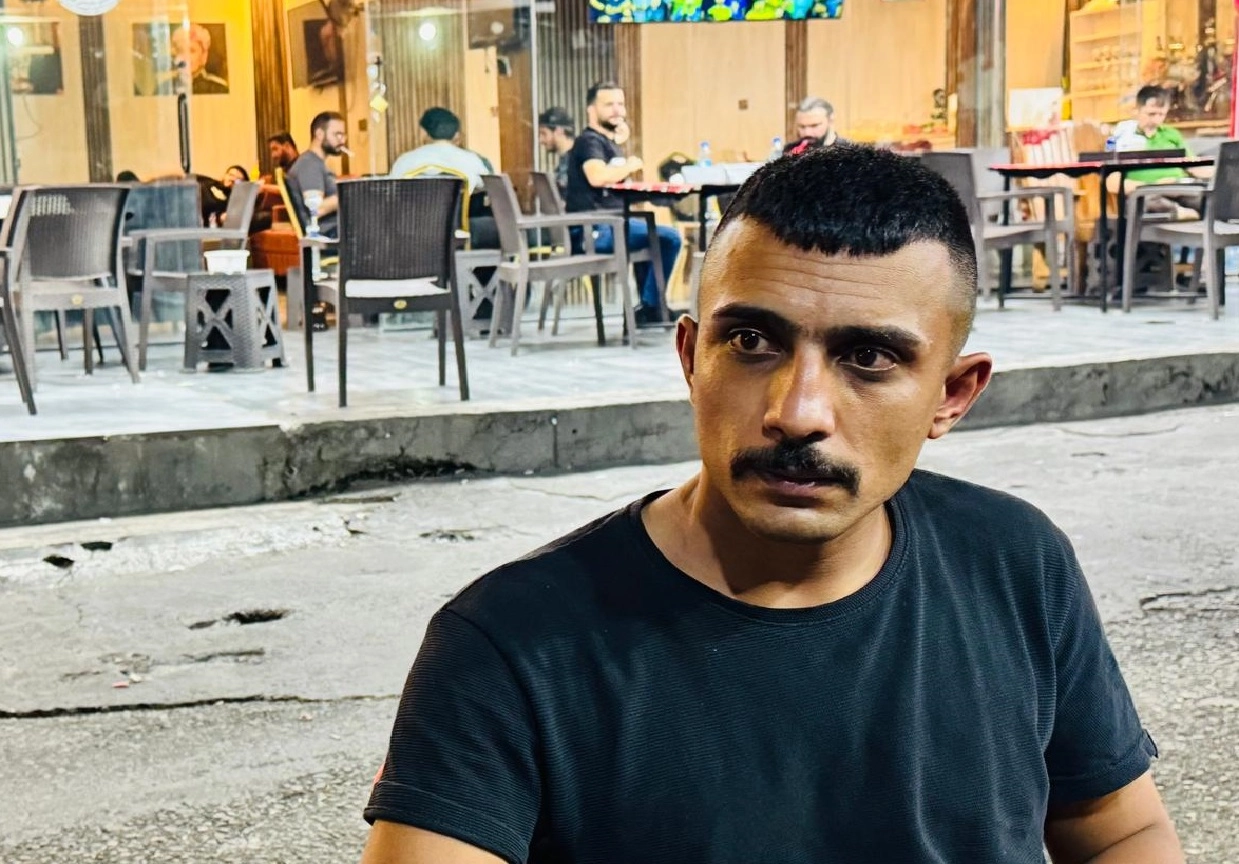 Rebin Sattar sitting with Fazel Hawramy in Erbil on September 3, 2026. Photo: Rudaw
“I never thought this kind of torture was going on in Iraq,” Rebin told me as he sipped tea during the interview for this article in Erbil.
He later learned that PUK politician Karwan Yarwais had approached senior Iraqi officials, including the minister of justice and the president, to push for his release.
Neither the Diyala governorate police spokesperson nor the Federal Intelligence and Investigation Agency were available for comments at the time of publication regarding the allegations.
Now Rebin is wondering whether he can safely remain in Khanaqin.
“Nothing can stop them from coming after me again,” he said.