
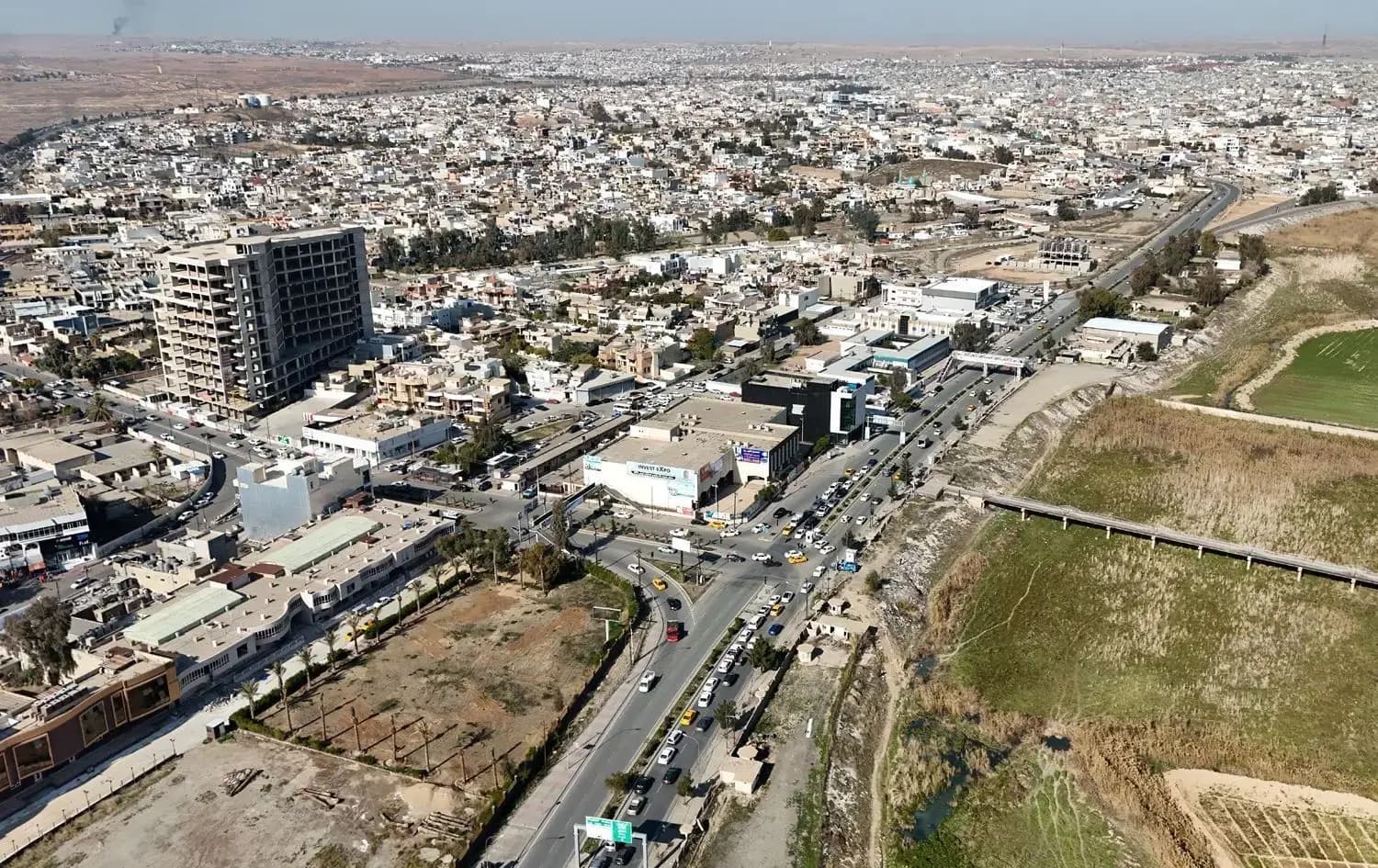

ERBIL, Kurdistan Region - The Iraqi Turkmen Front (ITF) plans to nominate a replacement for Kirkuk Governor Mohammed Samaan Agha following his appointment to Iraq’s federal cabinet, a party official told Rudaw on Sunday, as Arab factions seek an early handover of the position under a rotational power-sharing agreement.
“It is definitely the Turkmen’s share,” Ahmad Ramzi, an ITF member of the Kirkuk provincial council, told Rudaw’s Hardi Mohammed, adding that the party had yet to agree internally on a candidate to succeed Agha.
Agha, who also heads the ITF, was appointed minister of state for minority affairs on Thursday when Iraq’s parliament approved the remaining members of Prime Minister Ali al-Zaidi’s cabinet.
His departure comes at a sensitive time for the ethnically diverse and disputed province, where a power-sharing arrangement provides for the governorship to pass from Kurdish to Turkmen and then Arab representatives. Under the agreement, the TUrkmen term is scheduled to end by the beginning of January next year, but Arab factions are seeking to take over the post earlier, according to a source in the provincial council.
Speaking to Turkey’s state-run Anadolu Agency following his ministerial appointment, Agha confirmed that the ITF intended to retain the governorship for the remainder of its allotted term.
“One of our Turkmen brothers will become governor,” he said, adding that the provincial council would meet in the coming days to select his successor.
Agha acknowledged that the position would subsequently pass to an Arab representative for the remaining period before the next provincial elections, expected in 2027.
Meanwhile, Kirkuk’s first deputy governor, Rebwar Taha of the Patriotic Union of Kurdistan (PUK), declared Sunday that he was assuming the governor’s responsibilities until a replacement is appointed.
“I am the acting governor of Kirkuk now until the provincial council and the political parties agree on appointing another person to the post,” Taha said at a press conference attended by Rudaw.
He said he was acting in accordance with the law to ensure the province’s administration continued functioning.
Agha was seen at his office in Kirkuk on Sunday despite his appointment to the federal government, according to Rudaw’s reporting.
A source within the provincial council told Rudaw that Agha could no longer legally perform the governor’s duties after becoming a federal minister, maintaining that Taha, as first deputy governor, should assume the responsibilities until a replacement is chosen.
The source also said Arab factions were pressing to nominate their own candidate before the agreed rotation date.
Rudaw English has contacted representatives of the Arab factions for comment but had not received a response.
Agha's appointment has drawn praise from Turkey, which maintains close ties with Iraq's Turkmen community.
Turkish Foreign Minister Hakan Fidan met Agha and a Turkmen delegation in Baghdad on Saturday, on the sidelines of a meeting of the Organization of Islamic Cooperation.
Speaking to journalists afterward, Fidan said he had congratulated Agha on his new position.
“It was important for a minister to come from the Iraqi Turkmen Front,” Fidan said, according to Turkish public broadcaster TRT Haber.
He added that he had conveyed President Recep Tayyip Erdogan's thanks to Prime Minister Zaidi and Iraqi parliament speaker Haibat al-Halbousi for the appointment.
Fidan said Ankara had long followed the challenges facing Iraq's Turkmen population, arguing that addressing their concerns required progress on the country's broader political and social problems.
The Turkish foreign ministry also welcomed Agha's appointment in a statement Friday, describing it as a positive step toward political stability, social cohesion and fair representation of Turkmens in Iraq.
Agha, meanwhile, told Anadolu that he intended to use his new position to strengthen relations between Baghdad and Ankara while representing all of Iraq's communities.
“We will work in cooperation with other Iraqi ministers on issues of common interest to both countries, particularly the Development Road project, as well as water, energy, trade and security,” he said.
He stressed that his ministry would serve all Iraqis, rather than the ITF or the Turkmen community alone.
The 16-member Kirkuk provincial council is divided among Kurdish parties, which hold seven seats, Arab parties with six, the ITF with two, and a Christian quota representative politically aligned with the PUK.
Following months of political deadlock after the December 2023 provincial elections, the PUK secured enough support to appoint Taha as governor in August 2024, with backing from Arab representatives and the Christian quota member.
The appointment was contested by the Kurdistan Democratic Party (KDP), the ITF and other council members who boycotted the session, challenging the legality of the process.
Subsequent political negotiations established arrangements to rotate the governorship among Kirkuk's principal communities.
In April, Taha resigned and was succeeded by Agha, who became Kirkuk's first Turkmen governor in approximately a century.
Taha subsequently assumed the position of first deputy governor.
The KDP, which holds two seats on the provincial council, had opposed the arrangements and boycotted council sessions until July this year.
Last week, PUK leader Bafel Talabani met Agha in Sulaimani to discuss Kirkuk's political and security situation, reconstruction and public services.
According to a statement issued by Talabani's office, the two emphasized the importance of “maintaining balance and cooperation among the province's political parties and ethnic communities.”


_0.jpg.webp&w=3840&q=75)