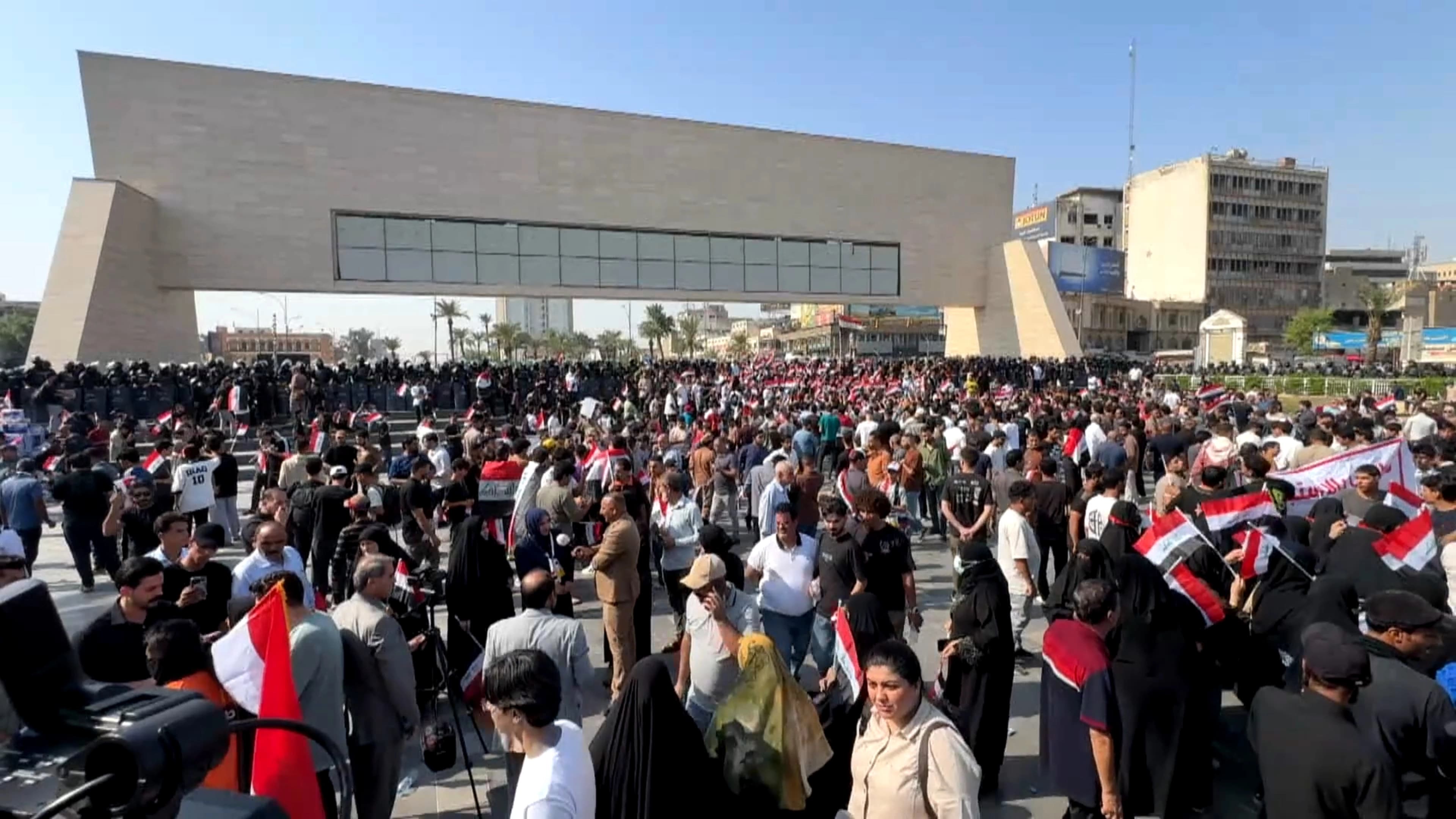

ERBIL, Kurdistan Region - Thousands of protesters marched Sunday to commemorate the seventh anniversary of the landmark anti-establishment Tishreen movement in Baghdad on Sunday, demanding accountability and the release of protestors still held by security services.
"We demand the fight against corruption and the elimination of the negative practices prevalent among politicians,” Ali Akram, one of the protesters, told Rudaw’s Shko Omer during the demonstrations that amassed in Baghdad’s Tahrir square.
The Tishreen protests are named after the Arabic name for October, having started in the beginning of October 2019 and lasting about 18 months.
A grassroots movement primarily led by Shiite youth in Baghdad and Basra, the Tishreen movement was one of the largest domestic threats to Iraq’s political order since 2003.
The most pressing demands of the protesters included the elimination of the ethno-sectarian quota system, known in Arabic as Muhasasa. Established by Iraqi politicians with US blessing after its invasion, the system characterizes the post-2003 Iraqi political system, dictating the distribution of political posts and resources among the country’s three major groups; the Shiites, Sunnis, and Kurds.
The system has promoted factionalism within Iraq over a merit-based political order.
In its place, protests raised demands for a secular, democratic state based on equal citizenship and rule of law. They also called for drastic institutional reforms.
Rights groups say more than 600 protesters were killed, around 20,000 injured, and around 3,000 were arrested during the movement. No party was held accountable.
Hadi al-Amri, the head of the pro-Iran Badr Organization and a senior figure in the ruling Shiite-led Coordination Framework, accused the movement of “sedition” and credited the pro-Iran armed groups within the Islamic Resistance in Iraq for suppressing it.
“The [Islamic] resistance [in Iraq] stood courageously against the Fitna [sedition] of Tishreen, maintaining the state and political order in the process," said Amiri at an event in late August.
The protestors on Sunday demanded the release of remaining prisoners. The government has not released an official number nor improved prison conditions for those that continue to be detained.
"We are the families of prisoners. Our children have been destroyed, exhausted, fallen ill, and afflicted with scabies and hunger,” a woman by the name of Karrar's mother told Rudaw.
“We cannot reach them, and they do not allow us to bring them medicine, nor do they provide them with treatment,” she added.
Injured protesters also raised demands to receive treatment abroad.
Kamel Mohammed, a protester whose eyesight impaired during the protests in 2019, said his children call him “father” but he cannot see them.
"I want [the Iraqi Prime Minister] Ali Zaidi to arrange a trip for me to receive treatment for my eyes. I am married and have three children,” he said.
Unlike 2019, Sunday’s demonstrations did not descend into violence. According to Iraqi media, protesters left Tahrir Square in Baghdad before sunset. The National House, a political party affiliated with the Tishreen protests’s organizers, asked on Sunday for people to gather “peacefully and consciously."
Also, the National House said it “reaffirms its adherence to the authentic principles of Tishreen,” which, it noted, includes ending the muhasasa system and corruption as well as promoting accountability for crimes committed during the protests and confining arms under state control.
Meanwhile, the head of the Security Media Cell who was seen amongst protesters, Saad Maan, said that the Iraqi premier Zaidi has received the demands and will work to address them.
“His Excellency [Zaidi] also affirmed that the demands of the demonstrators have reached him, and they will be reviewed and efforts will be made to fulfill them,” he said in a statement on X.