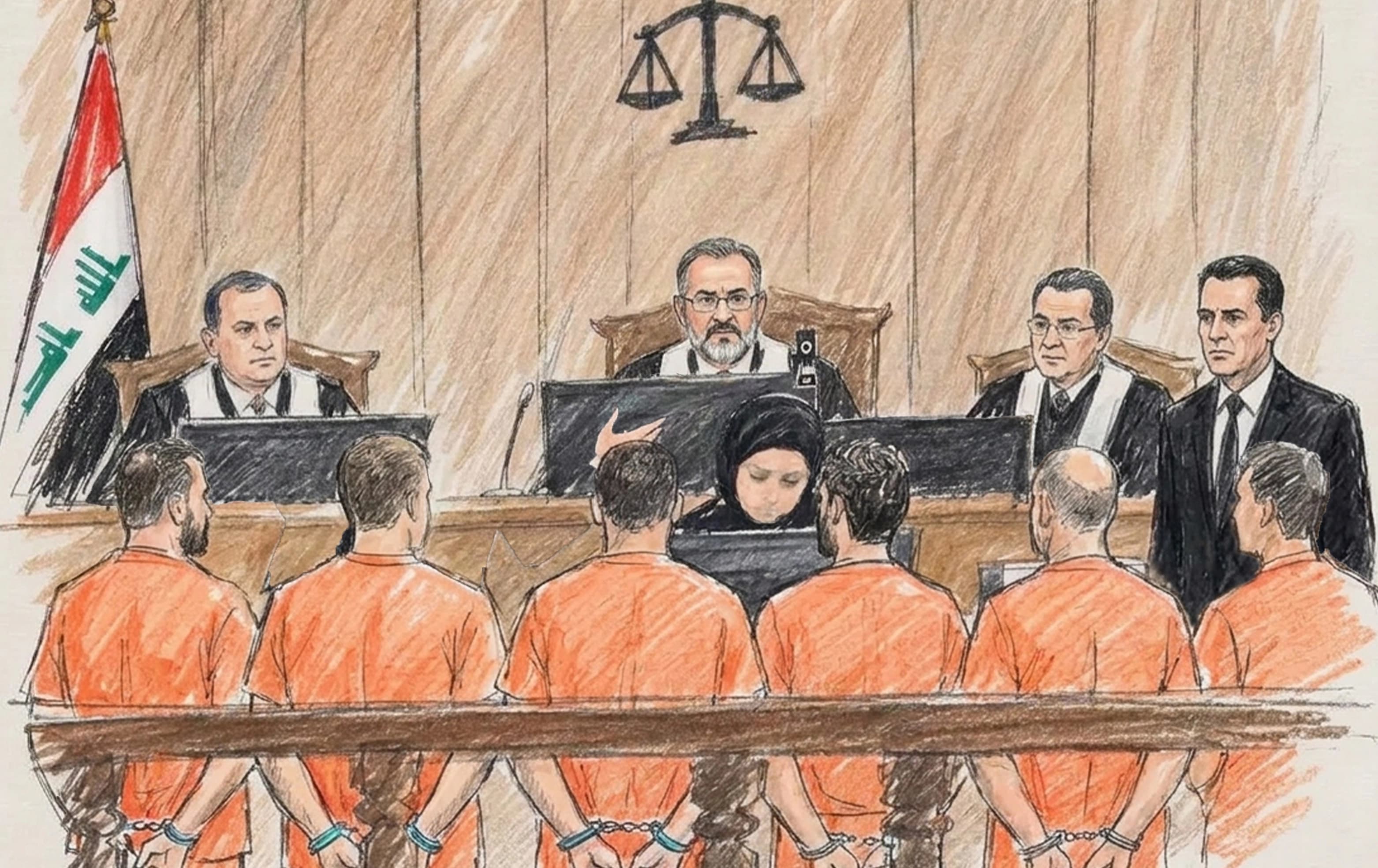

ERBIL, Kurdistan Region – A French medical student who joined Islamic State (ISIS) stood trial in a Baghdad criminal court on Wednesday alongside five other French nationals, including a father of four daughters, before a judge who adjourned the hearings over their lack of access to legal counsel. The court has recently sentenced 10 other French nationals for their membership in the group.
The hearings come amid a series of ongoing prosecutions of foreign ISIS suspects in recent weeks following the transfer of around 5,704 detainees from facilities in neighboring Syria during a US-led coalition mission between January and February.
An Iraqi court in late October sentenced nine French nationals to life imprisonment and another to 15 years in separate trials after convicting them of ISIS membership in the presence of their defense lawyers and representatives from the French Embassy in Iraq.
On Wednesday’s trial stood Sofiane Ahmed Issa, 32, in a yellow prison uniform.
"Your Honor, I was forced under torture [in Iraqi prison] to make those statements,” Issa said during the hearing attended by French diplomats and journalists, including those from Rudaw.
Born in 1995 to an Algerian family in Lille, France, Issa studied general medicine before joining ISIS. He was part of the 47-member group of French nationals who were handed over to Iraqi authorities in 2025.
The judge ruled that Issa would be allowed to write down his statement in his own hand during the second session.
The judge addressed the suspect and stated: "Sofiane, aside from your statements, numerous pieces of incriminating evidence have been recorded against you, including being wanted by Interpol and subject to an arrest warrant issued by a French court."
The evidence was then displayed on screen, showing that Issa held security and military roles within ISIS in Raqqa, the self-proclaimed capital of the caliphate. According to his confessions read out by the judge, his monthly salary was a meager $50.
As the evidence was presented, Issa stared at the screen. His Arabic was insufficient to fully understand the judge, prompting him to frequently request the interpreter beside him to translate the judge's remarks into French.
The judge ultimately postponed his trial to November 23.
‘Why haven't you spoken to them?’ Judge rebukes defense lawyers
The second suspect brought before the judge in a yellow jumpsuit was Romain Garnier, a tall, lean man of French origin with a fair complexion.
When asked if he had spoken to his lawyer prior to the hearing, Garnier replied, "no." The judge turned angrily toward the court-appointed attorneys, rebuking them: "Why haven’t you spoken to him?"
The attorneys offered little defense, promising only to see him as soon as possible.
Consequently, Garnier’s trial was also immediately postponed.
Following him, suspects Muhammad Salim, Sofiane Abdelhamid, and Thomas Jean-Marc were brought inside. After it was found that they had also been deprived of the opportunity to consult with their attorneys, the judge adjourned their hearings to November 23 to safeguard their right to a defense.
The final suspect brought before the judge – for whom the court also assigned legal counsel – was Ben Younes Yehiaoui, born in 1991. He is a father of four daughters and a son and is of Moroccan origin.
Like most of his co-defendants, Ben Younes was listed on Interpol’s wanted database.
According to evidence presented in court, he joined ISIS in 2014, though he withdrew from combat for a period of time after 2015 to work as a regular employee at the Omar oil field in Deir ez-Zor province in Syria
Ben Younes later rejoined ISIS's military sector, becoming a member of the group’s "Islamic Police." According to his own testimony, his monthly salary was $150.
Another group from the 47-member cohort is scheduled to stand trial at Baghdad’s Karkh criminal court on the 18th of this month, while hearings for these six suspects are set to resume on the 23rd.
The same court sentenced three suspects to life imprisonment on October 29, only two days after it handed down the same ruling for another six French nationals and an additional convict among them for 15 years in prison.
Approximately 5,704 suspects representing 67 nationalities were transferred from Syria to Iraq earlier in the year. Iraqi authorities said in early September that investigating the suspects had concluded and would be followed by judicial proceedings.
The detainees included 3,543 Syrians, 467 Iraqis, 710 nationals of other Arab countries and 983 foreigners from Europe, Asia, Australia and the United States.
Iraq prosecutes most ISIS suspects under Article 4 of its 2005 Anti-Terrorism Law, which provides for the death penalty or life imprisonment for those who commit, incite, plan, finance or assist terrorist acts.
However, the proceedings have drawn scrutiny from international rights organizations.
In February, Human Rights Watch accused Iraqi authorities of conducting rushed trials of ISIS detainees, raising concerns about due process and alleging that some convictions relied on confessions obtained through torture. The organization also estimated that approximately 8,000 detainees were on death row.
France in late October acknowledged that Iraqi law provides for the sentences imposed on seven French nationals convicted of membership in the Islamic State (ISIS), while emphasizing its respect for Iraq’s sovereignty and judicial independence.
A diplomatic source from the French foreign ministry said in a written response to Rudaw that it does not comment on judicial decisions in other countries or interfere in ongoing legal proceedings.
“We note that the sentences handed down (life imprisonment and a 15-year prison sentence) are stipulated under Iraqi criminal law for the offenses of which these French nationals are accused,” the source said.