
Qamishli, Northeast Syria (Rojava) - The first sign that things have shifted in northeast Syria comes immediately after crossing the Semalka border from the Kurdistan Region.
Inside border control, two Damascus-appointed officials demand permits issued by the Ministry of Information before journalists can work in the region. Photographs that once lined the forlorn walls depicting Kurdish fighters who paid the ultimate price during 15 years of war against jihadist groups have completely disappeared.
In their place are pictures of European landscapes and horses galloping through green fields. Almost all the signage is in Arabic, except for a calendar hanging in a corner marking the beginning of the Kurdish New Year.
The man in charge refuses to give his name. He travels around 14 hours from Damascus and works at the crossing for two weeks at a time. He is the representative of the central government and, ultimately, has the final say.
It is a small scene that captures the much larger transformation underway across northeast Syria a mere six months after bloody clashes between Kurdish forces and Damascus fundamentally altered the balance of power.
“They [Kurds of Syria] are still in shock,” an official in the Kurdistan Region told me about the state of affairs in northeast Syria (Rojava). “When we were fighting Baghdad, the whole world was against Saddam Hussein. Now, everyone in the world is with Ahmad al-Sharaa. They are in a difficult position.”
For nearly 15 years, Syria’s Kurds fought a succession of jihadist groups, most notably the Islamic State (ISIS) and the Nusra Front, once headed by Syria’s current president, Ahmad al-Sharaa, then known as Abu Mohammed al-Jolani.
Bashar al-Assad fled Syria in late 2024, ending more than a half a century of authoritarian rule in what could be best described, even by the most conservative accounts, as a ‘torture chamber.’ The scenes from the infamous Sednaya and other prisoners bore witness to decades of state terror, sending shockwaves throughout the free world.
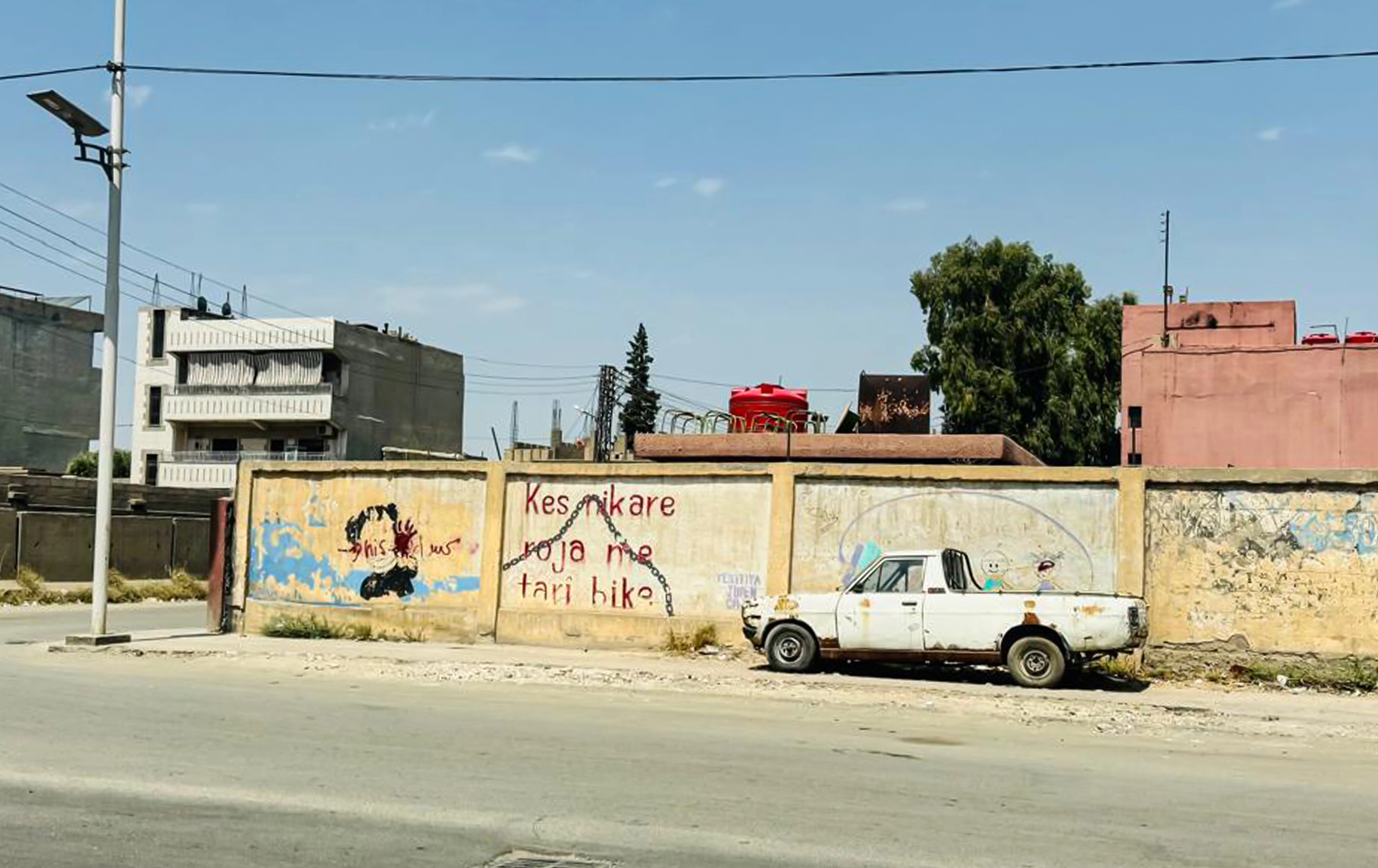 Graffiti in Qamishli reads "No one can darken our destiny," August 16, 2026. Photo: Fazel Hawramy
Sharaa’s forces captured Damascus, and the Kurdish-led administration spent almost a year negotiating with the new authorities. Those talks failed to prevent several weeks of clashes in the middle of winter earlier this year. Kurdish forces lost most of the non-Kurdish territory spanning Raqqa to Baghouz in the lower Euphrates, which they had controlled with the backing of the US-led coalition against ISIS.
A ceasefire in late January ended the major fighting. Since then, the region has remained largely calm.
But calm is not a certainty.
On the road from Semalka to Qamishli, Kurdish security forces, known locally as Asayish, still man the checkpoints, though in smaller numbers than before. The road, once notorious for its potholes, has even been repaired in places. Towns along the route appear busy and bazaars are open.
There are also new arrivals. Before reaching Qamishli, we tried to book one of the city’s better hotels, only to be told that American oilmen had taken most of the rooms.
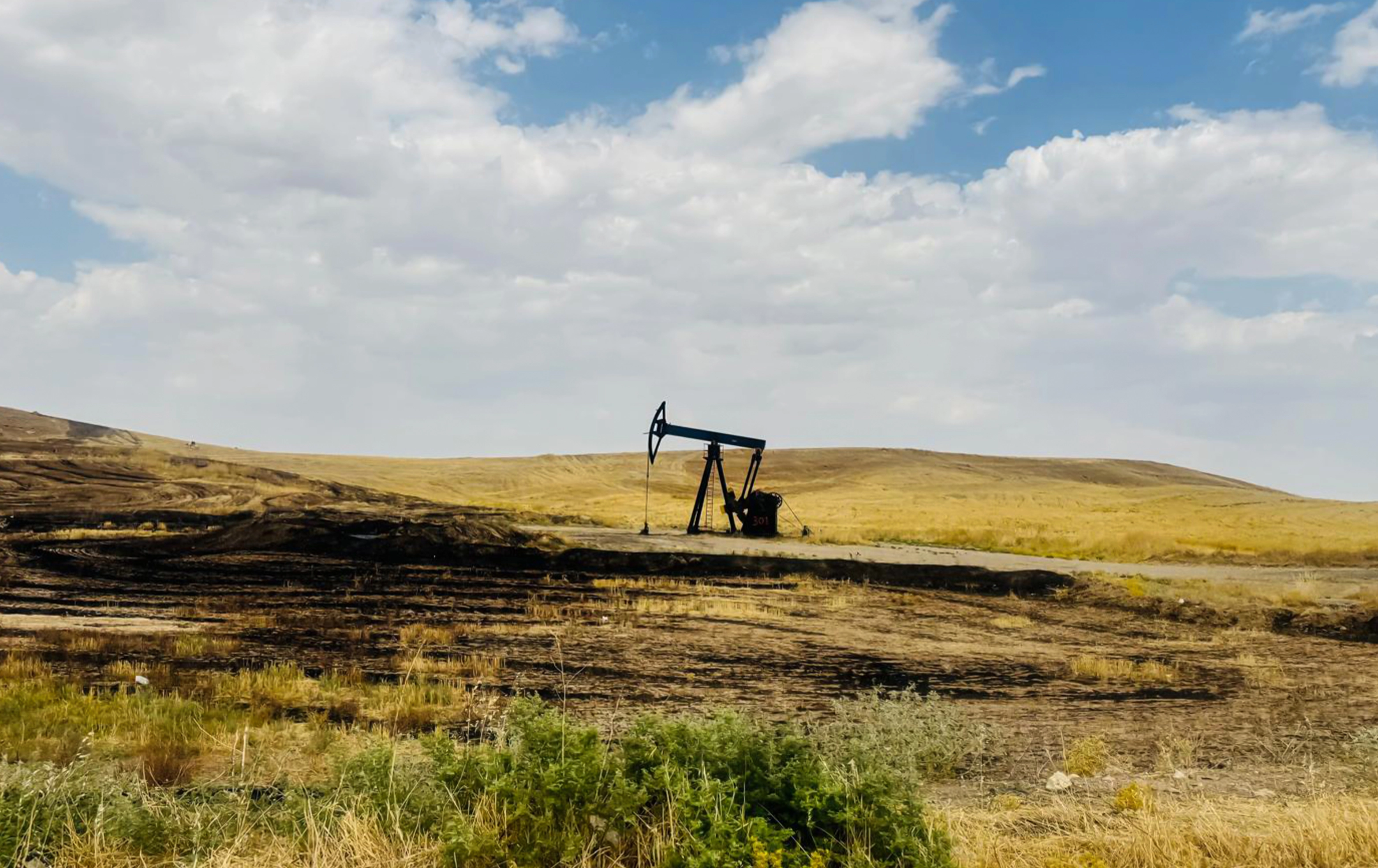 A oil well pumpjack in operation in northeast Syria. August, 16, 2026. Photo: Fazel Hawramy
Damascus now controls the region’s oil facilities, border crossings and airport, as well as the potentially vital commercial crossing linking Qamishli with Nusaybin in the Kurdish region in southeast Turkey. The crossing has yet to fully reopen, but preparations are underway and many residents hope trade with Turkey might finally inject some life into Qamishli’s stagnant economy.
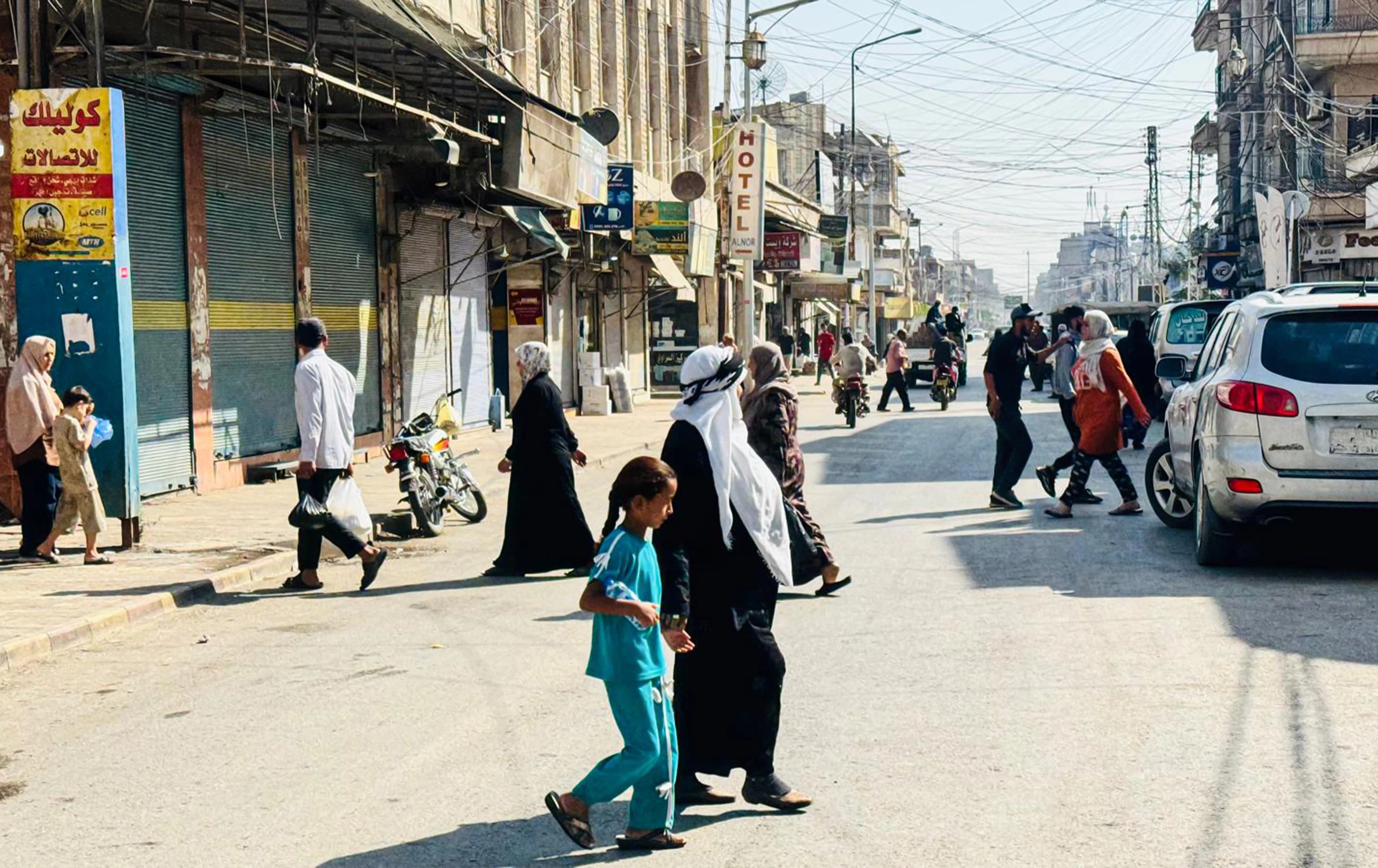
On the surface, however, much of the city looks as it did before.
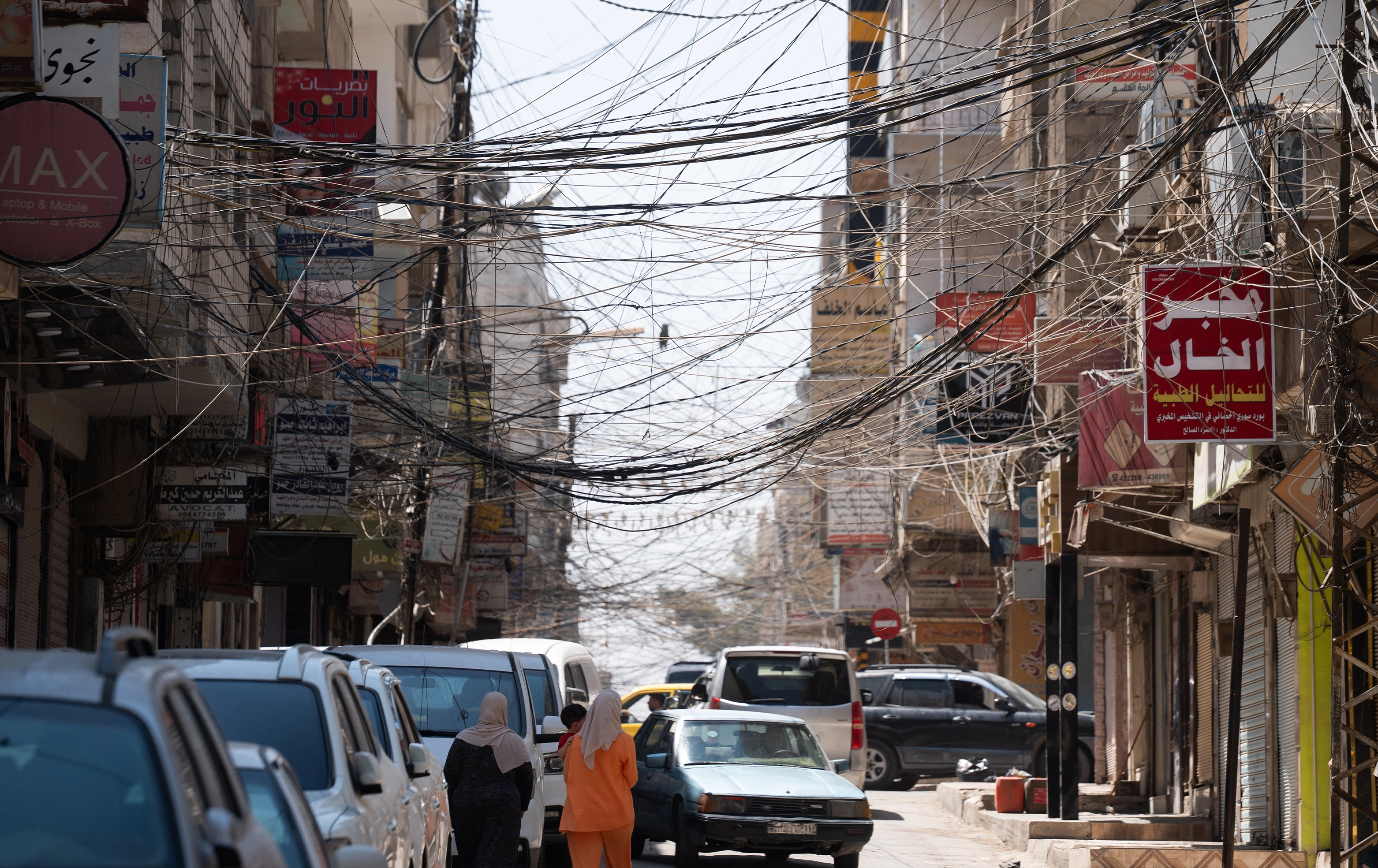 Electrical wires hanging over a street in Qamishli on August 14, 2026. Photo: Bilind Taher
Assad’s forces in Qamishli’s Security Square have been replaced by a small contingent loyal to Damascus. They do not patrol the wider city. Kurdish Asayish still drive their pickup trucks through the streets and appear at impromptu checkpoints.
There is defiance, too.
“The Kurds,” Hoger, the 28-year-old owner of a mobile phone shop, replied when I asked who was now in charge.
“The central government forces are just guests,” he added, sweating inside his tiny shop during yet another power cut.
Qamishli remains a city of dust, rubbish and wires. Tangled electricity cables hang above streets where people have endured war since 2011. The national grid is unreliable, and privately operated generators provide only limited electricity. Solar panels cover rooftops with increasing frequency.
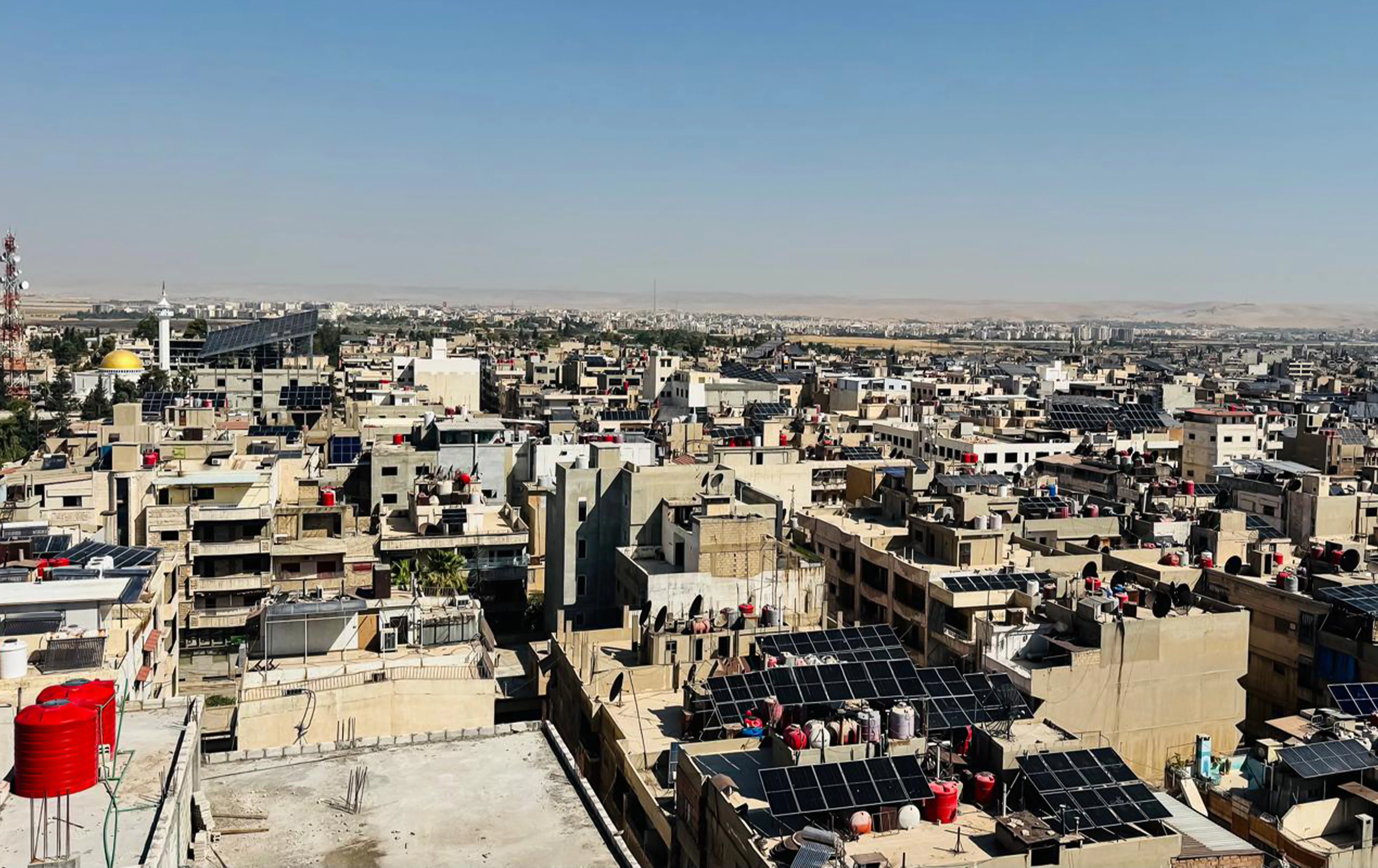 A view of solar panels on rooftops in the city of Qamishli. August, 14, 2026. Photo: Fazel Hawramy
A few buildings are under construction. Much of the rest of the city appears to be holding its breath.
An accountant anticipates answers
Manal Mohammed, a 48-year-old accountant and father of three, has spent most of his life waiting for governments to change and life to improve.
“There is security now, but the future is uncertain,” he said from the money exchange booth where he works. “We are all just waiting to see what happens next.”
Before working with numbers and exchange rates, Manal worked at Qamishli airport.
He remembers the absurdities and brutality of the old bureaucracy under the Hafez Assad regime. In 1998, he lost his identity card. It took three years to replace it, he said, and intelligence officers interrogated him about why he had lost it.
Today, he worries less about intelligence officers and more about how families can survive.
A police officer, he said, might earn only $100 to $150 a month.
“Everyone here has a second job,” he said. “They either have agricultural land or a relative who sends money from Europe.”
Manal has managed to send his three children, aged between 12 and 20, to private schools, but he is unsure what future Syria can offer them.
“This country has no leader,” he said.
His criticism is not reserved to Damascus. The money exchange where he works used to contribute between $2,500 and $3,000 a year in taxes to the Kurdish administration, he said, yet received little in services.
“The Kurds made a mistake by turning to socialism for the past 15 years,” he said. “They should have left the market to dictate prices.”
Yet, the alternative worries him too. Manal doubts whether Sharaa can recognize Kurdish rights while overcoming the nationalist attitudes deeply entrenched in the bureaucracy of Damascus.
“We are mentally exhausted,” he said. “But this will pass, too.”
People in this part of Kurdistan have learned resilience after 15 years of war and more than half a century of discriminatory policies imposed by the central government. Tens of thousands of Kurds were stripped of citizenship documents under measures introduced in 1962, leaving them effectively invisible within society. Without identity papers, many could not enroll their children in school, access healthcare or register basic aspects of daily life.
That history has also bred a deep suspicion of central government authority - less a political reflex than a survival mechanism shaped over generations.
President Ahmed al-Sharaa has taken some positive steps, but rebuilding Kurdish trust in Damascus will take far longer.
Still, the city itself is calm. The Kurdish administration is secular and places enormous emphasis on women participation in daily life and running the region.
Despite the appalling state of the roads, there is remarkably little honking. Men and women mingle easily in cafés and bars. Daily life often feels entirely ordinary, until the power goes out.
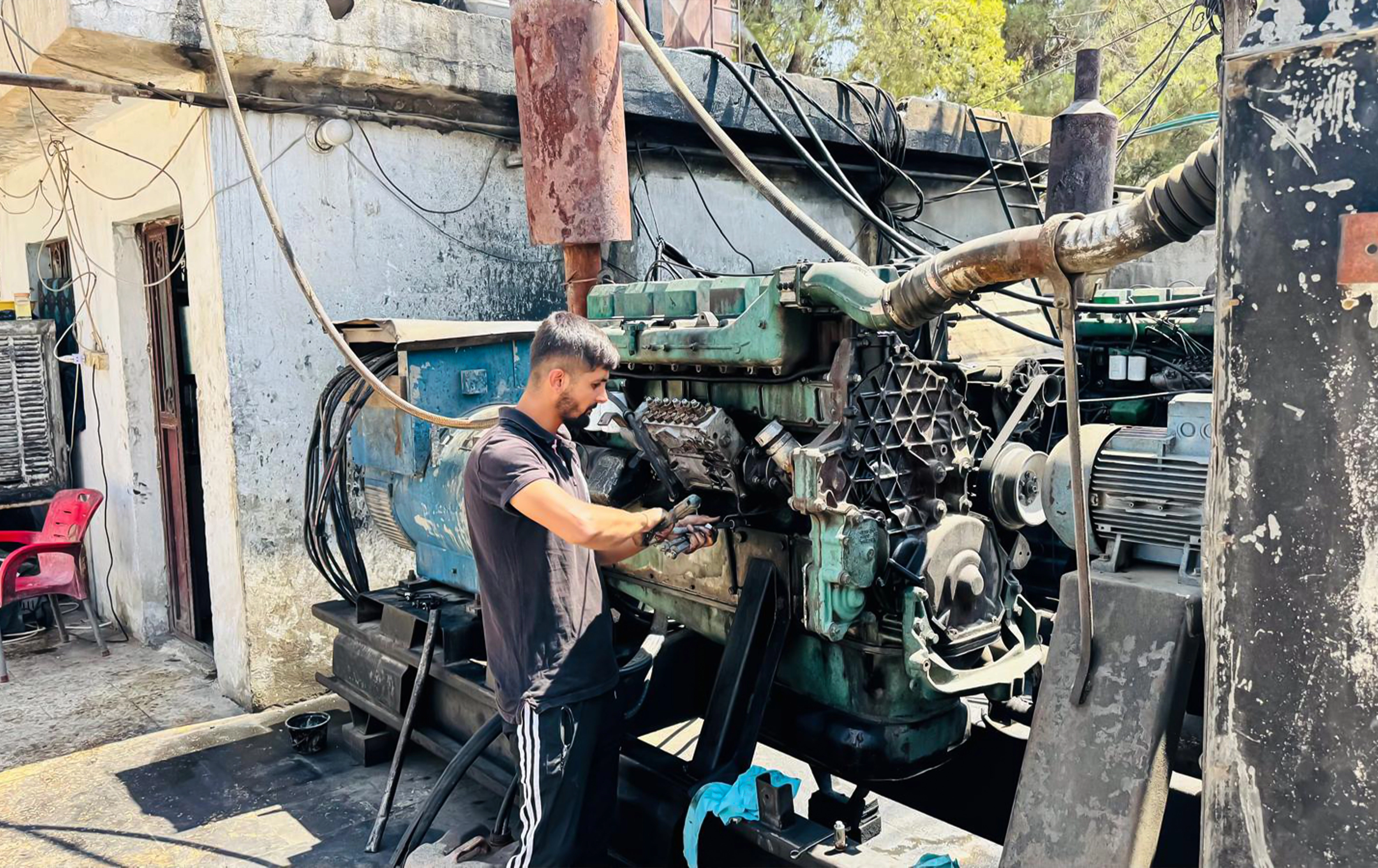 A generator in Qamishli co-owned by Mohammed Marwan and Khalid Sigh, August 14, 2026. Photo: Fazel Hawramy
Eight hours of electricity
A few minutes away, next to an Assyrian cemetery, two men run to provide part of the city with electricity when the national grid fails.
Khalid Sigh, a father of three, and Mohammed Marwan, co-own a neighborhood generator that supplies electricity to around 250 homes.
The machine is deafening. Two young employees operate the generator for around $140 a month each.
To provide subscribers with eight hours of electricity a day, Khalid says he needs about 13,000 liters of fuel every month. During the fighting in January, demand surged as tens of thousands of displaced people crammed into Qamishli, with many sheltering in schools.
Now the displaced have largely gone, but business has not recovered.
“Our life has got worse since the agreement in January,” Mohammed shouted over the generator.
Solar panels are steadily replacing neighborhood generators. Families who cannot afford them outright buy them on credit, often paying around $100 in installments.
“We used to provide 1,300 amps,” Mohammed said. “Now, we provide only 300.”
Even among their remaining customers, poverty is visible.
“Twenty families are struggling to pay their fees,” Khalid said. “They are simply too poor.”
A construction worker, he added, earns around $8 a day. In the corner of the room sits a plaque with a photo of a commander named Dijwar Kobane from the Syrian Democratic Forces (SDF).
“He was a good friend," Mohammad said, adding that he placed the plaque there to remember the sacrifices that were made for the security of the Kurdish region. Veteran commander Kobane was killed with another fighter from the SDF in a Turkish drone strike in August 2022.
The SDF and other security forces in Rojava lost more than 10,000 fighters over 15 years of fighting various groups including ISIS. There are no signs of the force anymore as it is being integrated within the wider Syrian security apparatus to include several brigades for the Kurdish areas.
Among Qamishli’s dead
Across from the generator, Bashar Yaghoob George spends his days in a quieter place.
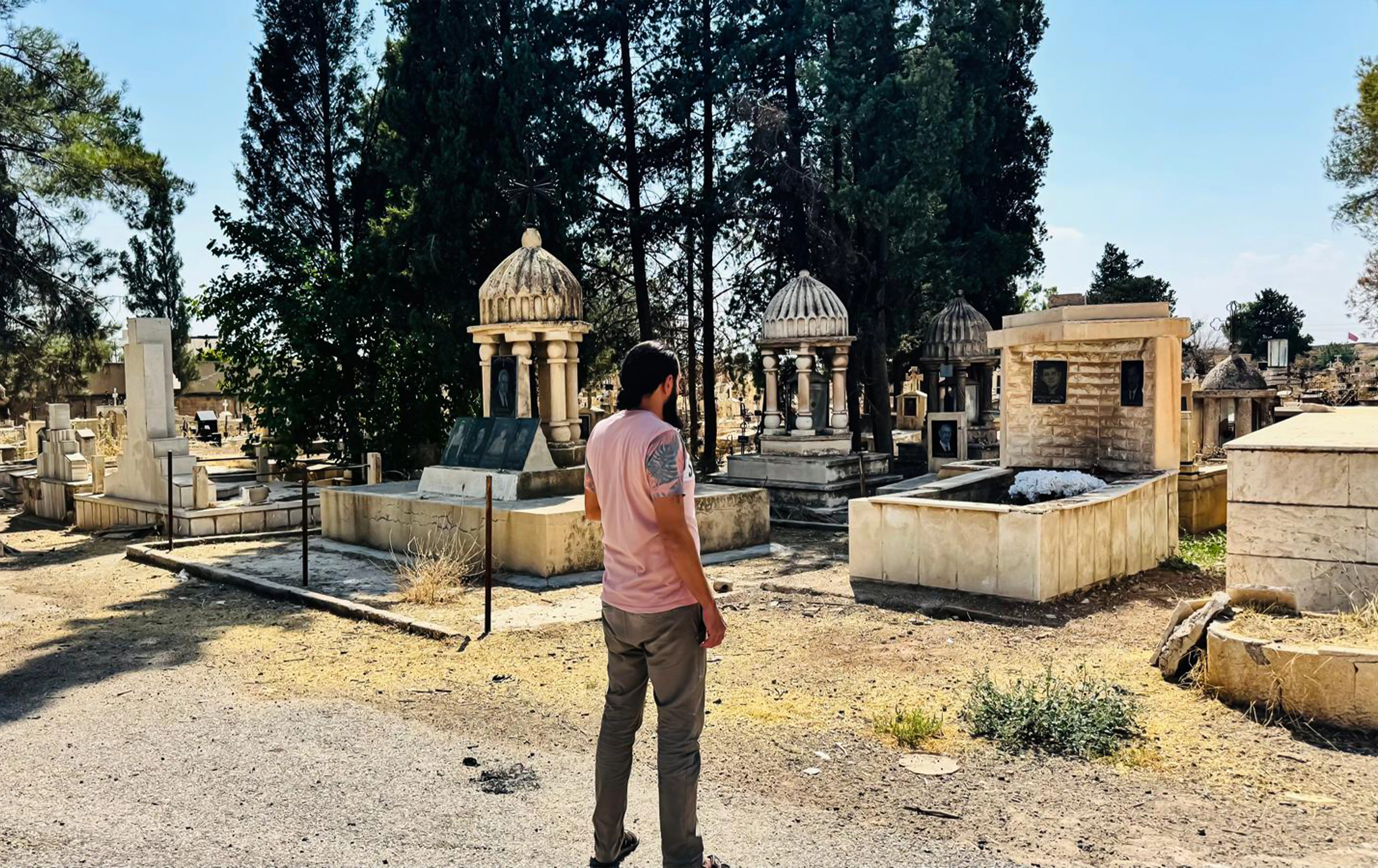 Bashar Yaghoob George at the Assyrian cemetery in Qamishli, August 14, 2026. Photo: Fazel Hawramy
Born in 1978, Bashar is the caretaker of an Assyrian Christian cemetery. Tall and long-bearded, he lives much of his life among graves, cigarettes and the birds he raises inside the cemetery.
His chickens and turkeys wander between the tombstones.
“I don’t really collect their eggs,” he said. “Each one lays its egg next to a grave and it is difficult to find them.”
His mother, father and a brother who died in a car accident are buried here.
The cemetery itself tells another story about Qamishli. The city’s once substantial Christian population - Assyrians, Chaldeans, Armenians and Syriacs - has dwindled after years of war and migration. Some graves have even begun to collapse.
Bashar earns money when families ask him to repair a grave.
“Not that many want to fix them,” he said. “They have forgotten about their dead.”
One grave he has not forgotten belongs to his close friend, Michael Shelmon, a member of the SDF who was killed during ISIS’s massive 2022 assault on Ghweiran prison in Hasaka.
“I was with Michael the night before he went to Ghweiran,” Bashar recalled. “He told me to bury him in this spot if he fell in battle.”
Bashar believes Christians remain secure under Kurdish rule and is fond of commander Mazlum Abdi who led the SDF for more than a decade.
But he fears what might follow if Damascus extends its authority further.
“The way they think has not changed since coming to power,” he said. “They still have their extremist mentality.”
Such fears have been reinforced by abuses carried out by the central government forces against minorities in Druze and Alawite areas.
There are disturbing reports of activities taking place inside what has been widely dubbed as the ‘torture chambers’ that the Assad regime left behind.
Syrians for Truth and Justice said in a report this week that testimonies from former detainees and relatives documented severe beatings, electric shocks, humiliation and deaths in custody, warning that elements of Syria’s old “machinery of violence” were being rebuilt.
For Bashar, political arguments about Syria’s future feel distant next to the tombstones.
I asked him what it was like to come here every day and spend so much time among the dead.
“I feel more at peace with the dead than the living,” he said.
The taxi driver
Back in the city, Fawaz Diab, 43, spends his days behind the wheel of a yellow Iranian-made taxi.
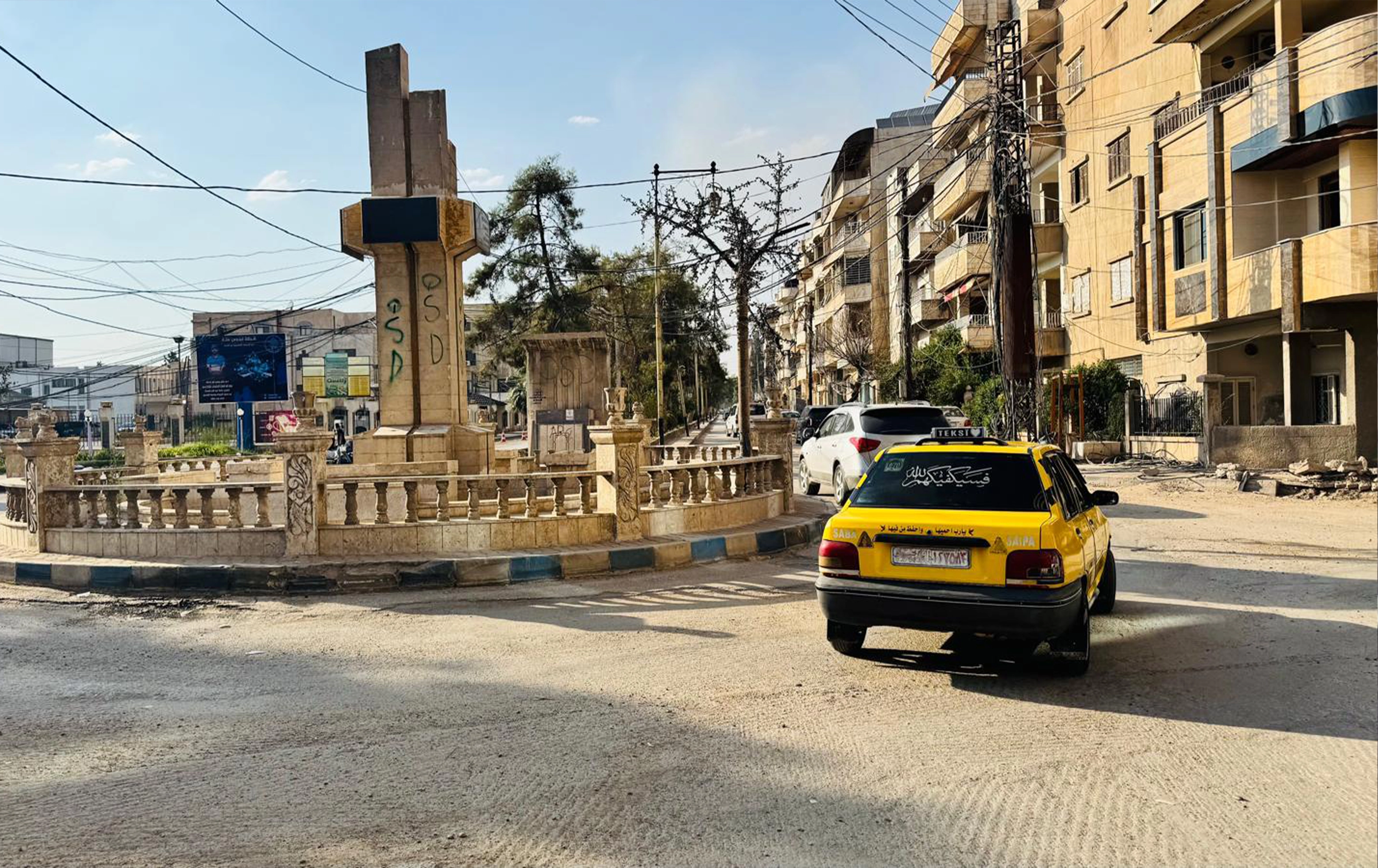 An Iranian-made taxi in Qamishli, August, 14, 2026. Photo: Fazel Hawramy
There is no air conditioning. Under Qamishli’s 40 degree heat, the inside of the car feels like a sauna.
Fawaz purchased the vehicle for about $5,000 several years ago. The Iranian car itself is a relic of the Assad era, when Tehran’s economic and political influence seeped into almost every corner of Syria. Ironically the SAIPA Pride vehicle exported to Syria is known in Iran as the “carriage of death” due to its low quality engineering and high casualty rates in road accidents.
But Fawaz has little time for geopolitics; he has five children to feed.
“People have been violated for so long,” he says as we drive through the city. “I swear, I left my home today and there was no money in the house.”
His words capture the contradiction of Qamishli six months after fighting has ended. There is security. The checkpoints are quieter. Turkish drones no longer routinely hunt Kurdish commanders. Damascus and the Kurdish authorities are meeting at the negotiating table rather than fighting.
“We are hoping for the best and calling on God to help us,” Fawaz said.
But peace has yet to produce prosperity. Young people continue to leave.
Recently, authorities in Sulaimani detained a group of young Kurds from Kobane and Aleppo who had been smuggled into the Kurdistan Region from Iran without documents.
Among them was Abdu Ahmad, 17, who said he sold his mother’s gold to finance his journey in search of work. He was detained and sent back toward Semalka by Sulaimani police.
Abdu and others went from Kobane to Damascus and then flew to Dubai, and from Dubai to Iran before being smuggled into the Kurdistan region.
“As soon as I arrive back in Kobane, I will plan another journey,” he said. “Many young men are leaving because there is no work.”
In contrast, Mazlum Abdi, the towering figure in Kurdish politics in Rojava who commanded tens of thousands of fighters from SDF for many years in the fight against ISIS, is cautiously positive about the prospect of a permanent truce with Damascus.
He praised the Kurdish youths for taking up arms and protecting their land for many years but believes the timing for war is over. “I will do whatever is good for our people,” Abdi said in an extensive interview with Rudaw’s Dilbixwin Dara from his fortified base near Hasaka.
The interview is scheduled to be broadcast later on Thursday. He admits that the Kurdish authorities made mistakes during the 15 year rule in the region.
Abdi rejected the suggestion that the United States and European countries had betrayed the Kurds in Rojava during the fighting earlier this year, saying Washington had been clear from the onset that its mission in northeast Syria was focused on fighting terrorism.
He paused before adding quietly, “I was hoping they would do more.”
With American oilmen contracted by the central government of President al-Sharaa to extract the riches of the land, many who remain in the city of Qamishli and the region feel there is little choice but to wait.
At the money exchange, Manal remains slightly more optimistic.
“In Syria today, you have two classes of people: poor and wealthy, with almost no one in between,” he said.
He then returned to the long view of Kurdish history - decades of governments, wars, uprisings, disappointments and survival.
“We have seen a lot in our history as Kurds,” Manal said. “This time will pass too.”
He paused.
“I hope we learn from our mistakes.”

.png&w=3840&q=75)