
The US State Department on Monday announced sanctions on numerous “entities, individuals, and vessels” linked to Iran, while the Treasury Department said it is designating “nearly 60 known entities, individuals, and vessels as blocked property” connected to Tehran as well. The measures are part of a new economic pressure campaign called Operation Economic Outcast, which Washington is urging international partners to support.
The announcement raises pressing questions, particularly for Iraq, which imports between $10 billion and $12 billion worth of goods, petroleum products, and natural gas from Iran each year. Baghdad is Tehran's fourth-largest trading partner overall and its second-largest importer of goods and petroleum products.
Notably, the latest sanctions coincided with visits by Iranian officials to Baghdad, where talks focused primarily on debt recovery and establishing new payment mechanisms for the roughly 4,000 goods and products that Iraq and the Kurdistan Region import from Iran.
Many questions now surround the future of this trade between Tehran, Baghdad, and Erbil under this new phase of American economic pressure, the most pressing among them are whether the new US sanctions will allow the continuation of trade between Iran, Iraq and the Kurdistan Region, and how Washington intends to handle the payment of outstanding Iranian debts, dollar transfers and gas imports. The answers will determine whether Baghdad and Erbil face distinct new pressures of their own.
A $10 billion dilemma
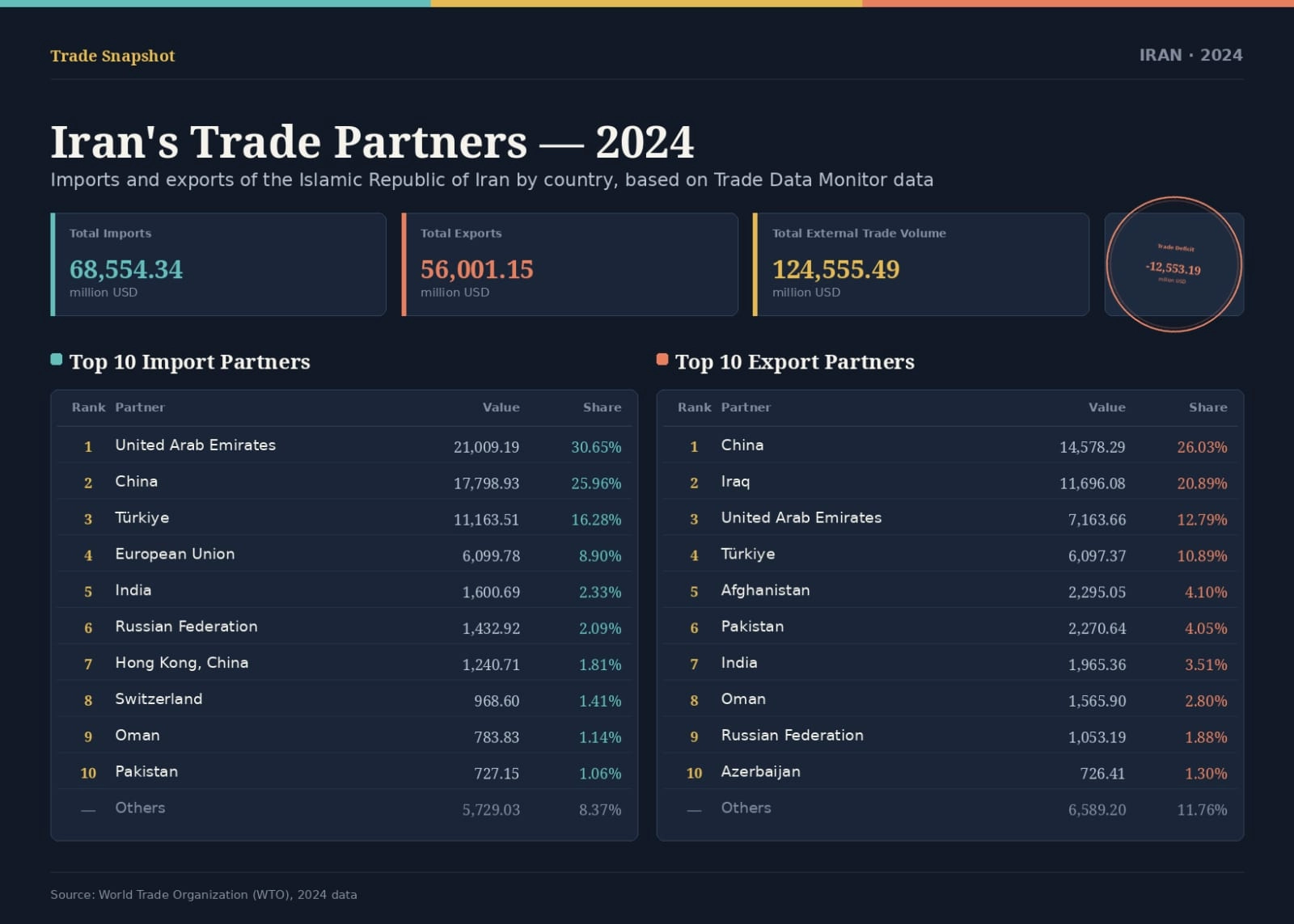
World Trade Organization (WTO) data shows that in 2024, Iraq was Iran's fourth-largest trading partner - behind the United Arab Emirates (UAE), China and Turkey - accounting for 20.9 percent of total Iranian exports, valued at $11.69 billion. The trade relationship, however, is heavily lopsided as Baghdad exports only a fraction of what it imports, driving its dependence on Iranian non-oil and oil goods to exceptionally high levels.
Iran's total exports in 2024 reached $56 billion, with China, Iraq, and the UAE together accounting for more than half - China received $14.57 billion, Iraq $11.69 billion, and the UAE $7.16 billion.
On the import side, Iran brought in $68.55 billion worth of goods in 2024. The UAE led at 30.6 percent ($21 billion), followed by China at 26 percent ($17.8 billion) and Turkey at 16.3 percent ($11.16 billion). Iraq's exports to Iran, by contrast, amounted to just 0.88 percent of that total - $602 million.
More than just energy
While the trade imbalance between Iran and Iraq is staggering - with Iranian exports accounting for over 95 percent of bilateral trade - the nature of those goods matters as much as the volume. According to Baghdad’s trade ministry, Iran was Iraq's second-largest exporter of non-oil materials and petroleum products after China in 2024, providing more than 3,970 distinct goods valued at $3.15 billion.
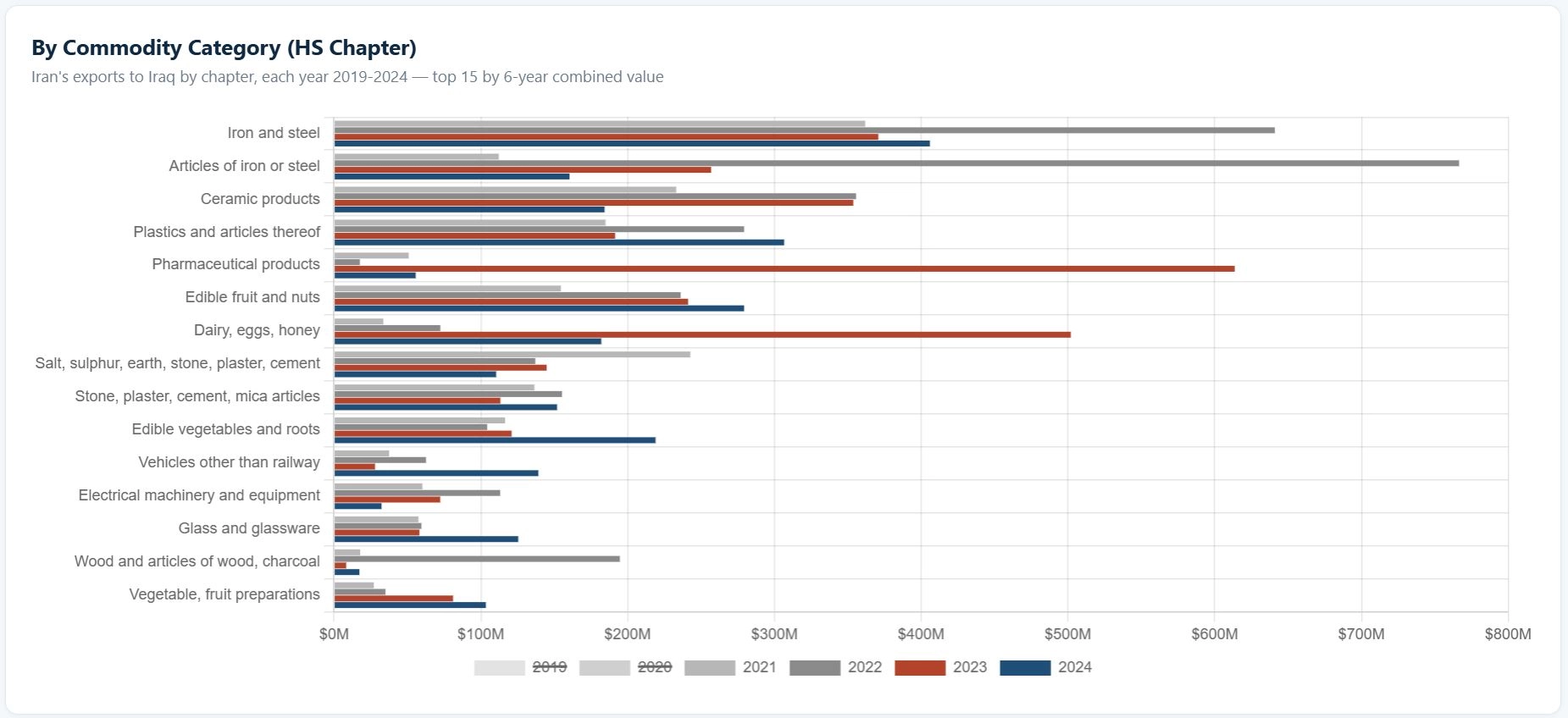
Raw iron and steel topped the list in 2024 at $405 million, followed by plastic products ($306 million), fruits, vegetables, and nuts ($279 million), and dairy, eggs, and honey ($182 million). The granular data further shows that Baghdad imported $79 million worth of apples and $89 million worth of watermelons from Tehran in 2024 alone, underscoring how deeply Iraqi households depend on Iranian goods for basic daily needs.
The Kurdistan Region faces the same exposure. Shared official and unofficial border crossings and direct reliance on Iranian goods mean a significant portion of the 4,000 daily commodities imported from Iran flow into the Region's markets. Consequently, any tightening of conditions or new payment mechanisms imposed by Washington will place severe economic pressure on both Baghdad's and Erbil's commercial and financial dealings with Tehran.
The pressure point
According to the US State Department, the latest sanctions aim “to further expose individuals and entities that have facilitated attacks on United States coalition forces, and to restrict the revenues the Iranian regime uses to attack its neighbors, support terrorism abroad, brutally repress its own people, and hold the global economy hostage.”
The Treasury Department, for its part, says it designated nearly 60 entities, individuals, and vessels as blocked property, targeting those facilitating illicit procurement networks, cyber activities, and revenue generation within Iran's petroleum and petrochemical sectors.
At the core of both measures is control of Iranian oil and petroleum exports. WTO and Observatory of Economic Complexity (OEC) data show these commodities make up the largest share of Iran's global exports. In 2024, over 40 percent consisted of oil, mineral products, and chemicals - with mineral fuels, refinery products, and bituminous materials alone accounting for 34 percent, and chemicals a further 7.13 percent.
Setting non-oil goods aside, roughly one-third - or approximately $8 billion - of Iran's $11.69 billion in exports to Iraq in 2024 consisted of natural gas, petroleum products, and chemicals.
Iraq had previously imported 50 million cubic feet of gas daily from Iran. As of last month, however, Iraqi electricity ministry spokesperson Ahmed Turki Jiyad said Baghdad "currently imports 25 million cubic meters of gas daily from Iran, and debts are deposited in the Trade Bank of Iraq [TBI]."
On the debt question, Iranian Central Bank Governor Abdolnasser Hemmati traveled to Baghdad in mid-August to meet his Iraqi counterpart Nizar Nassir Hussein and Prime Minister Ali Falih al-Zaidi to discuss a new repayment mechanism for roughly $11 billion in accumulated debt - comprising $7 billion frozen in an Iranian Central Bank account at the TBI and a further $4 billion owed by the Iraqi government to Tehran's oil ministry.
The halving of gas flows reflects both Iranian and Iraqi factors, compounded by US President Donald Trump's decision in March 2025 not to renew the 120-day waiver permitting Iraqi imports of Iranian gas.
No clear way out
Unlike past iterations that targeted specific personalities, institutions, and companies, the new phase of US sanctions demands that countries and corporations actively participate in Operation Economic Outcast against Iran.
Among Tehran's top four trading partners, only one had officially announced limits on its trade with Iran before these sanctions were imposed. China and Turkey's positions remain unclear - though their decisions will carry considerable weight. Beijing is Tehran’s primary trade partner, which alone accounted for over $32 billion, roughly 25 percent, of Iran's $124 billion in global trade in 2024.
Ultimately, if Washington again grants Baghdad waivers on gas and sanctions, the harder questions remain: how will it manage the $11 billion debt, and what becomes of the continued flow of oil and commercial goods from Iran to Iraq?
Further reductions, set against Iraq's current economic pressures, risk pushing prices higher and stoking instability across the country. That uncertainty, deepened by sanctions imposed in the wake of direct conflict, leaves the future of this partnership unresolved. Accurately answering these questions requires waiting for Washington's formal and practical stance toward Baghdad.

.png&w=3840&q=75)