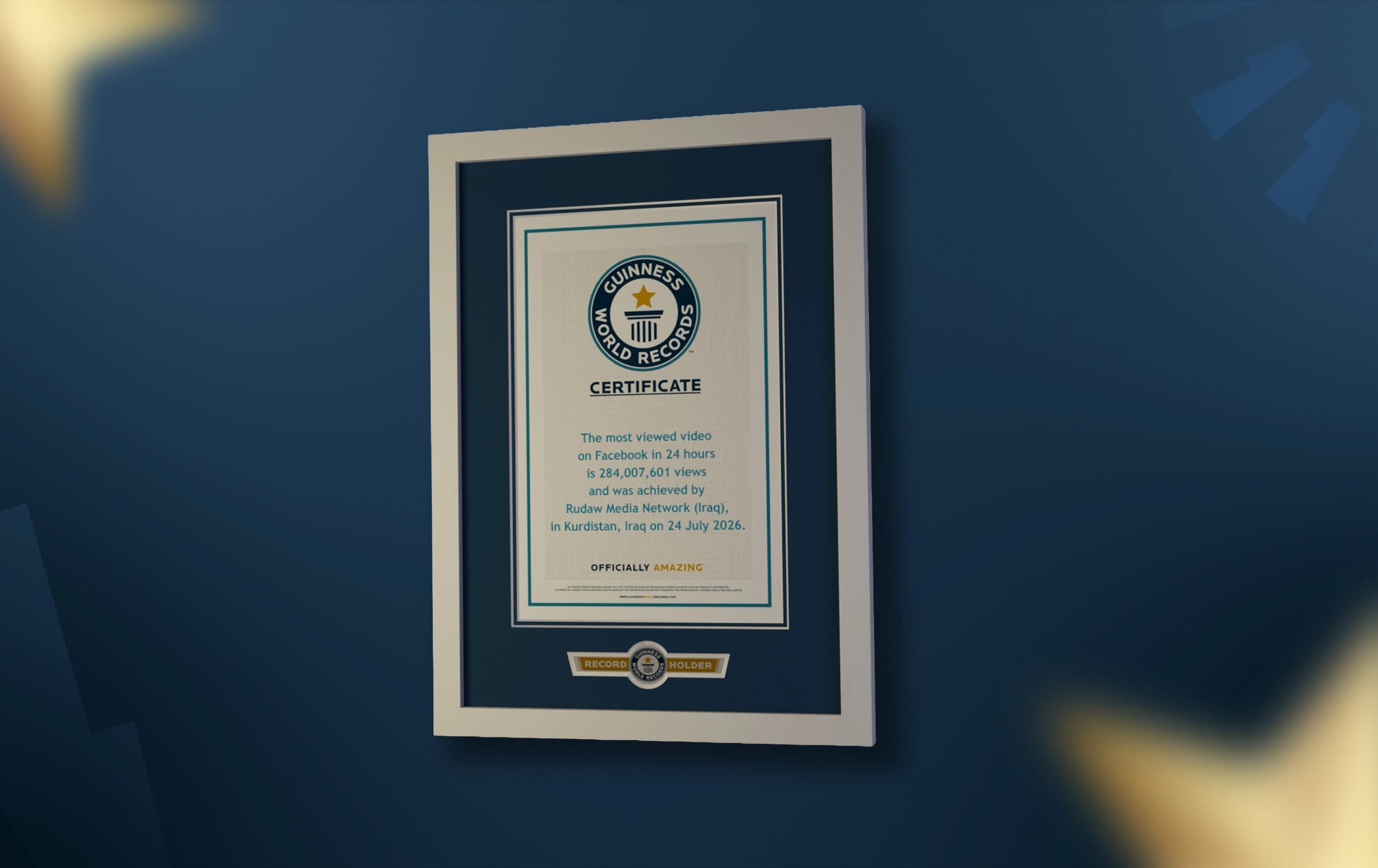

ERBIL, Kurdistan Region - In a global milestone for Kurdish media, Rudaw Media Network has entered the Guinness World Records for the most viewed video on Facebook within 24 hours, accumulating over 284 million views on a deepfake debunking clip.
The deepfake video at the center of the record had gone viral in July after appearing to show a terrifying highway near-miss in Egypt, in which a truck's tires suddenly blew out mid-drive. The vehicle is seen tilting and careening out of control through steady traffic, before a second truck driver races in to brace the crippled truck, keeping it upright and averting what could have been a fatal crash.
The one-minute, eight-second clip spread rapidly across social media, with millions sharing it as a convincing act of heroism.
What happened
Rudaw's investigation team grew suspicious after noticing that the writing on the back of the truck was incoherent and shifted shape rather than remaining static. Early in the clip, a CAT logo on the right-hand truck abruptly changed into a ONE logo. After the blowout, two perfectly intact tires appeared on the road - unlike the original footage, which shows only debris.
Moreover, license plates were also distorted, lacking readable letters or numbers, while fine details shifted slightly between frames and surfaces such as the truck body and road showed a telltale jitter. These flaws reflect a known limitation of current AI video generators: convincing overall motion, but an inability to render static text and fine detail accurately.
Therefore, Rudaw’s team produced a deepfake debunk video to explain to the audience that the story is only half true. The dramatic tire blowout and the truck's tilting were generated by artificial intelligence, while the second half - showing another driver stepping in to brace the wobbling truck and avert disaster - actually happened.
The record
Rudaw's deepfake debunking video on Facebook garnered 284,007,601 views within 24 hours of posting.
A Guinness World Records official extended congratulations to Rudaw in a video message, stating, “On behalf of Guinness World Records, I am delighted to present you with this record title. You are officially amazing.”
A second official added, “We are thrilled that you were able to participate in this Guinness World Records title and hope to see you attempt and break more Guinness World Records titles in the future.”
Rudaw’s deepfake debunking video has since surpassed 471 million views, placing it among the five most viewed videos in Facebook history. It has received 14.4 million likes, 179,000 comments, and more than 311,000 shares.
In their words
Brwa Kyani, head of Rudaw Digital, commented on the achievement, stating, “Truth is not found by accident, it is an engineering discipline. You must follow the source, verify times and seconds, isolate the data, compare AI-generated images month by month and dig into sources until the margin of error reaches zero."
“This requires discipline, freedom, and above all, a team that places the value of long-term trust above short-term dopamine," Kyani added.
Dilzar Zubair, the Rudaw Digital editor who published the record-breaking video, remarked, “This achievement is the fruit of the efforts of the entire Rudaw Digital staff. It also confirms that Rudaw is among the leading outlets not just regionally, but globally.”
For her part, Sahira Sadiq, head of Rudaw's technical department, called it “a great honor for Rudaw to be the first Kurdish media outlet to enter the Guinness World Records.”
“This achievement is not the end of the road for us, it is rather the beginning of a new phase of continued innovation and building an even more advanced experience for Rudaw Digital users,” she said, adding that “the award belongs to every person whose work and dedication brought Rudaw Digital to this point.”
Why this matters
When a video goes viral and reaches millions of views, few take the time to verify its authenticity. In many cases, media outlets focus on maximizing view counts without first confirming whether a video is fabricated, edited, or even recycled from an earlier event. This challenge has grown even more pressing in the age of AI.
Amid this noise, Rudaw Media Network, including its online platform Rudaw Digital, has made it a top priority to look beyond the surface of trending videos and uncover their hidden context, presenting the full picture its audience deserves to see.
As AI continues to reshape how content is created and consumed, the line between authentic footage and synthetic media grows increasingly difficult to distinguish - and the standards for how newsrooms should handle this shift remain far from settled.
Amid this uncertainty, Rudaw sees verification not as an occasional service but as a core editorial responsibility, one that will only grow more essential as AI-generated content becomes harder to detect and more deeply woven into the information people consume every day.