
ERBIL, Kurdistan Region - Any forces operating outside the auspices of the Kurdistan Regional Government (KRG) Ministry of Peshmerga Affairs (MoPA) will be deemed illegal, the Kurdistan Region's vice president said Monday about an hour after announcing the unification of the Kurdish force.
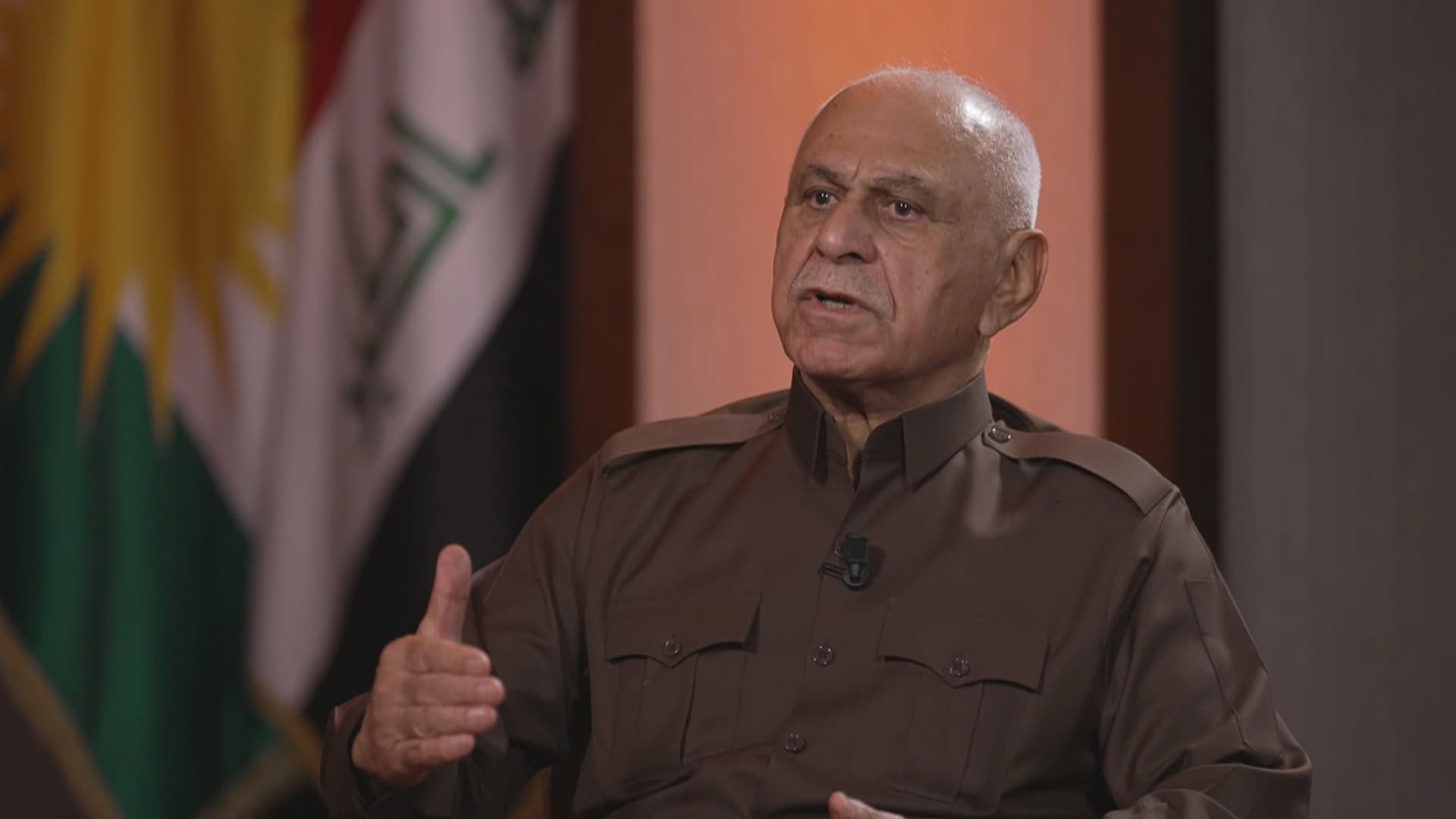
“Any force not under the umbrella” of the MoPA “and non-compliant with its legal directives is considered a militia,” Jaafar Sheikh Mustafa told Rudaw’s Sangar Abdulrahman.
He further noted that partisan affiliations within the ranks “must cease entirely” and that “partisan organization and political displays are strictly banned within the military.”
His statement comes as Kurdish leaders in a ceremony on Monday declared the end of partisan-based lines of command at the MoPA, marking a significant shift in the 10-year-long reform process that was expedited in 2022 following a memorandum of understanding with the US Department of War.
Speaking at the ceremony, Kurdistan Region President Nechirvan Barzani hailed the unification as “a major national step in the journey of building the institutions of the Kurdistan Region.”
“From today onward, this unity must be reflected in everything: in command and leadership, in decisions and orders, in training and organization, in rights and duties, in promotions, and in military doctrine and discipline,” he added.
Vice President Mustafa noted that the US and its led-Global Coalition are “fully satisfied” with the progress made in reforming the MoPA.
“It aligns with reform roadmaps and memorandums established with American and international military advisors to consolidate forces” under the ministry, he noted.
The ruling Kurdistan Democratic Party (KDP) and the Patriotic Union of Kurdistan (PUK) have maintained around 100,000 infantry troops in their respective Unit 80 and Unit 70. Both units were linked to their own payrolls and largely operated under partisan commands.
Under the newly-cemented reforms, the entire troops - in addition to around 42,000 others who came under the MoPA between 2010 and 2013 - are organized across Regional Command 1 and Regional Command 2. Both commands comprise 11 divisions, 33 brigades, and 99 battalions.
Confirming the institutional unification of the Peshmerga forces, Kurdistan Region’s Prime Minister Masrour Barzani said during Monday’s event that the MoPA has become “a unified force across operations, training, command and control, media, and accounting.”
“We want the Peshmerga to be a national Kurdistani force that stands above all party and personal interests, never to be used to resolve internal or party disputes,” he added.
Meanwhile, the MoPA Minister Shoresh Ismail during Monday’s ceremony praised the “decisive role” played by the Global Coalition partners, while proposing to them to sustain their assistance after the scheduled deadline for their departure on September 30.
“We reaffirm the necessity of continuing this strategic partnership and call on our allies in this new phase to maintain their support for the unified army of Kurdistan on a broader scale so that together we can protect the security, peace, and stability of the region, Iraq, and the Kurdistan Region,” he stated.