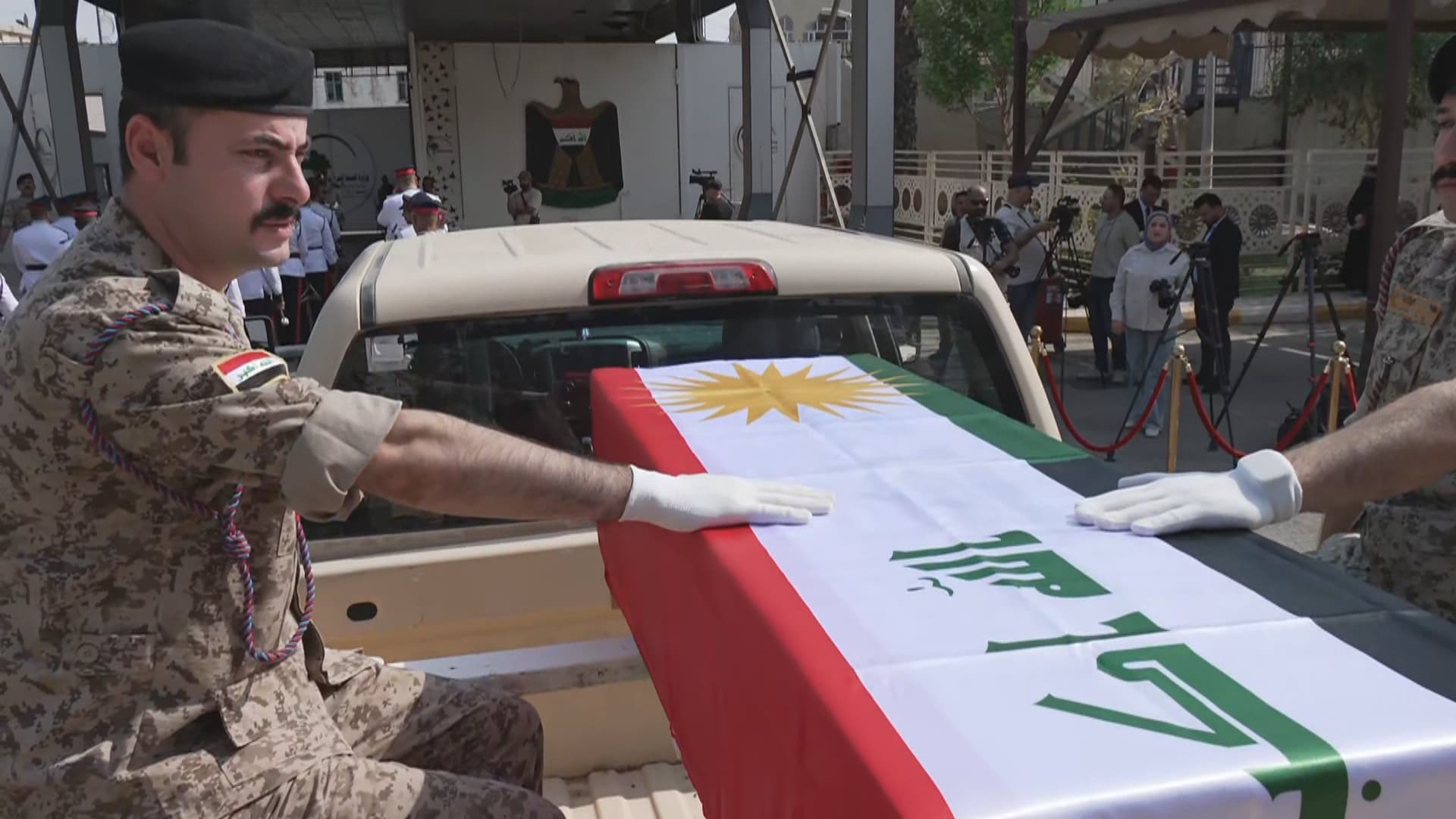

ERBIL, Kurdistan Region - The remains of more than 150 Kurds, mostly women and children, killed during the former Iraqi Baath regime’s Anfal campaign were being returned to the Kurdistan Region on Saturday two years after being recovered from a mass grave in southern Iraq.
“The remains of 153 Anfal victims were discovered in a mass grave in the deserts of Samawah and will be returned to Sulaimani today, Saturday,” Adib Latif, head of Sulaimani’s Directorate of Martyrs and Anfal Affairs, told Rudaw’s Zhina Star.
“Blood samples have been taken from the remains and will be compared with blood samples from the families of the Anfal victims; they will be returned to their respective places and be buried,” he added.
The remains were discovered in 2024, with the identification process taking two years.
A number of mass graves believed to contain victims of the Anfal campaign have yet to be excavated in the deserts around Samawah because of complex legal procedures and the limited number of technical teams available to carry out excavations, according to Latif.
The Anfal campaign was a series of eight military operations carried out by former Iraqi dictator Saddam Hussein’s Baathist regime against the Kurdish population in 1988.
The campaign involved mass executions and disappearances, chemical attacks, forced displacement and the destruction of thousands of Kurdish villages. Human Rights Watch concluded after extensive investigations that the campaign constituted genocide against the Kurds.
Kurdistan Region President Nechirvan Barzani said in an August 25 statement commemorating the final stage of the campaign in Badinan that Anfal was a “grave crime.”
He also called for continued efforts to secure international recognition of Anfal as genocide, saying the crimes of the past must serve as “a lasting lesson and a warning for Iraq.”
Kurdish authorities say around 182,000 people were killed or forcibly disappeared during the Anfal campaign.
Iraqi authorities have identified hundreds of mass graves containing victims of atrocities committed during successive periods of conflict and repression.
Human Rights Watch said in 2024 that the bodies of hundreds of thousands of victims remain buried in mass graves across Iraq. It cited an estimate by Iraq’s Strategic Center for Human Rights that the country’s mass graves contain the remains of around 400,000 people.