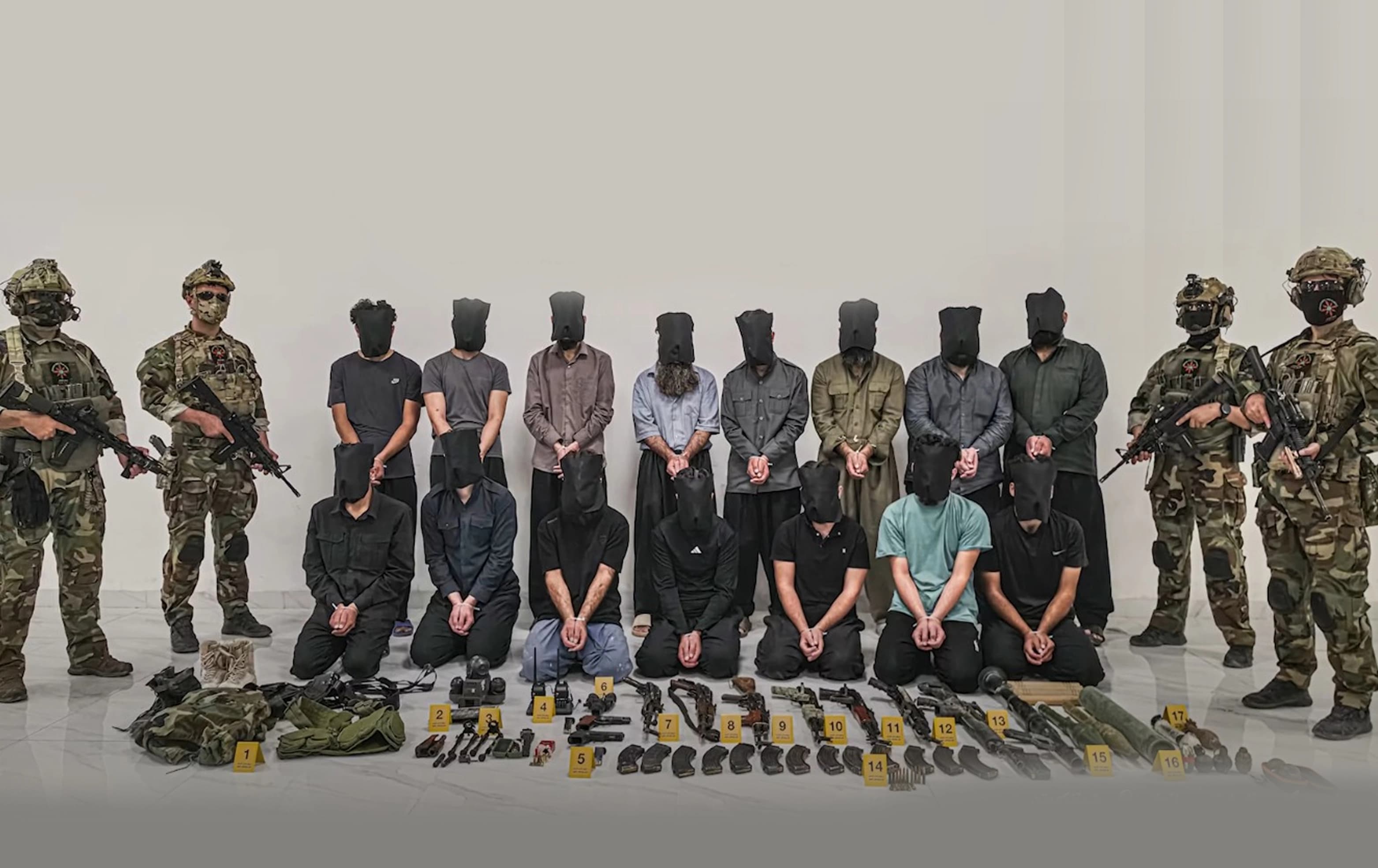

ERBIL, Kurdistan Region - The Kurdistan Region's security agency (Asayish) dismantled armed cells belonging to the Islamic State (ISIS), arresting nearly two dozen members, the agency said in a statement on Monday, noting that the arrests took place in the Region's eastern areas.
"Based on intelligence and investigations conducted between September 8 and 12, 2026, over a period of 96 hours, and on the order of an Asayish investigative judge, the General Directorate of Asayish Operations, in coordination with the Halabja Province Asayish Directorate, arrested 22 suspects in several operations in [the Kurdistan Region's eastern] Sulaimani and Halabja [provinces], including Penjwen [district in Sulaimani] and the Khurmal and Sirwan [subdistricts in Halabja]," the statement read.
According to the statement, the arrested militants belong to “the fifth battalion” of ISIS's so-called “Wilayat Kurdistan” - Arabic for Kurdistan jurisdiction - and were planning to “reorganize and receive pledges of allegiance from group members, plant explosive devices and carry out bombings inside Halabja province, and monitor [Kurdish] security forces and open fire on them during training and exercises with heavy and medium weapons.”
The captured militants further sought to “establish an emirate” in the Kurdistan Region’s Hawraman or Sharazur areas, “link ISIS sleeper cells in Kurdistan and Iraq with terrorists abroad, and raise funds to purchase weapons,” the Asayish added.
The Kurdistan Region's Asayish also seized a large cache of "weapons and military equipment" during the operations, including RPG launchers, rockets and propellant charges, a mortar round, hand grenades, AK-47 rifles with magazines and hundreds of rounds, two pistols, a surveillance camera, military binoculars, and military uniforms and gear.
“The suspects were detained under Article 2 of the Anti-Terrorism Law, and the investigation is ongoing,” the statement added. Of note, the aforementioned provision serves as a catalog for crimes, including vandalism, staging insurgencies, stirring up sectarian strife, and armed rebellion.
Consequently, Article 4 of the law establishes either the death penalty or life sentence depending on the degree and nature of the charged crime.
Of relevant note, extremist groups established what they called the “Islamic Emirate” in the Hawraman area. Established in 2001 by Ansar al-Islam and its offshoots like Jund al-Islam, the micro-state was affiliated with al-Qaeda, hosting Afghani and other foreign militants.
It was ousted in a US-led Operation Viking Hammer in March 2003 during the invasion of Iraq. Kurdish forces affiliated with the Patriotic Union of Kurdistan spearheaded the ground operations.
[Updated at 10:19 pm]