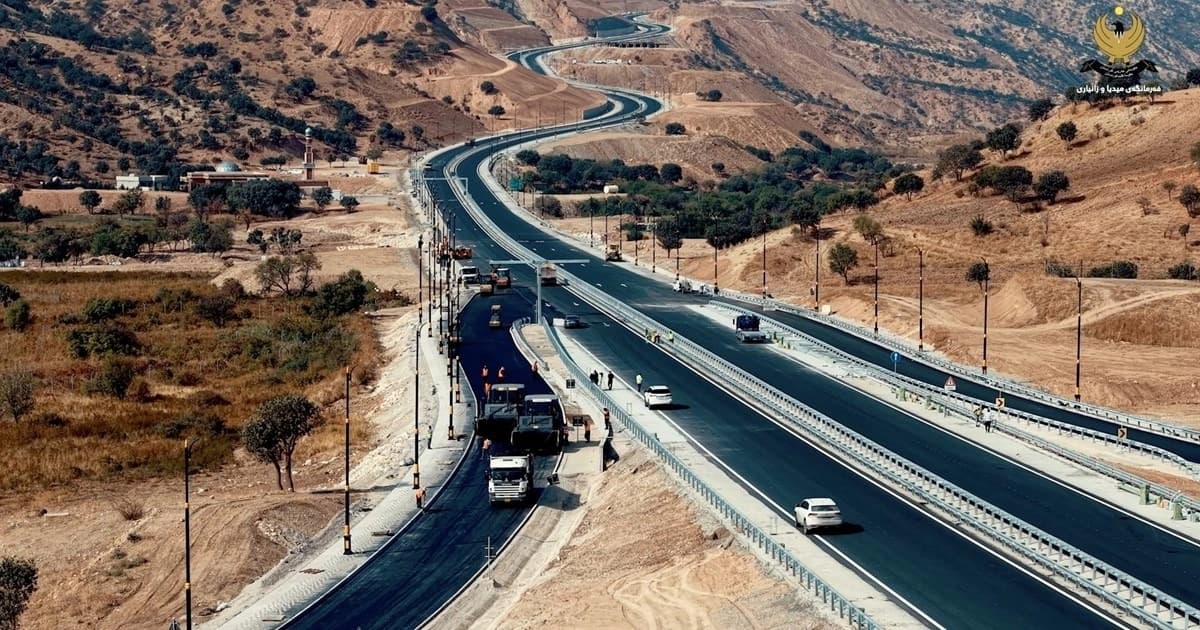

ERBIL, Kurdistan Region - Kurdistan Region Prime Minister Masrour Barzani on Thursday inaugurated the strategic Korre-Shaqlawa-Qandil road and two tunnels, a major infrastructure project expected to reduce travel time between Erbil and Soran by around 30 minutes, as the government continues efforts to improve transportation across the Region.
The 10-kilometer dual roadway, built at a cost of around 90 billion Iraqi dinars ($69 million), includes the Mirawa and Mawaran tunnels and three intersections, connecting several communities in northeastern Erbil province.
"I am pleased to be here with you today to inaugurate this dual carriageway, connecting Pirmam with Shaqlawa, Mawaran and Kawanyan, and bringing these areas together," Barzani said during the opening ceremony.
"It is a very beautiful and well-organized road, although its construction was very difficult, considering the amount of mountain excavation and filling required," he said. "Nevertheless, it has been built beautifully, properly and to international standards.”
The opening comes amid a wider push by the Kurdistan Regional Government (KRG) to expand dual carriageways and improve connections between major cities and districts, particularly in mountainous areas where difficult terrain and narrow roads have long posed challenges for motorists.
The new highway features modern safety measures, including an emergency escape ramp designed to stop vehicles experiencing brake failure.
The Kurdish premier thanked North Light, the company responsible for implementing the project and expressed hope that similar roads would be built across the Kurdistan Region, highlighting their importance for residents, tourists and commercial activity.
"I hope we can build all the roads of Kurdistan to this high standard and connect our cities," Barzani said.
He detailed that such projects are designed to make travel “much easier for citizens and tourists visiting Kurdistan, facilitate trade, reduce travel time and improve connections between cities.”
Barzani drew attention to one of the project's more unusual features; a section of road designed to play the melody of the Kurdish national anthem, "Ey Reqib," when vehicles travel over specially designed grooves at approximately 80 kilometers per hour.
"The national anthem, Ey Reqib, has been incorporated into the road," he said, describing it as “something truly beautiful" while encouraging motorists to experience it while driving carefully.
The prime minister also urged drivers to respect traffic regulations, stressing the importance of “observing traffic regulations” in the interest of public safety “for all.”
Road safety remains a major concern in the Kurdistan Region despite improvements in recent years. According to interior ministry figures previously obtained by Rudaw, 779 traffic accidents were recorded across the Region in 2024, killing 98 people and injuring 1,437 others.
The figures marked a sharp decline from 2022, when 3,706 accidents claimed 445 lives and injured 7,250 people. Officials have attributed the decline partly to road improvements and the introduction of new traffic monitoring systems.
In January 2026, Hemin Mirany, chief of staff at the KRG's interior ministry, told Rudaw that traffic deaths and injuries had fallen by 60 percent over the previous five years, crediting the introduction of point-to-point speed cameras.
The Korre-Shaqlawa-Qandil road is among a series of major infrastructure projects undertaken by the KRG's ninth cabinet. By July 2025, more than 700 road and bridge projects had been completed, covering 2,681 kilometers of roads built or rehabilitated, according to government figures previously reported by Rudaw.
Those projects include the Erbil-Duhok dual carriageway, the Erbil-Koya highway, the Smaquli-Gomaspan road and Sulaimani's 100-meter road.
In February, Barzani inaugurated the 16-kilometer Erbil-Gomaspan highway, another project aimed at improving road safety and reducing travel times.
The latest opening is also expected to support economic activity and tourism in northeastern Erbil province. The KRG has highlighted improved trade, shorter journeys and easier access to the Soran district among the project's anticipated benefits in an early November press release.
The road expansion program forms part of a longer-term KRG plan introduced in 2010 to convert major roads into dual carriageways over a 20-year period.