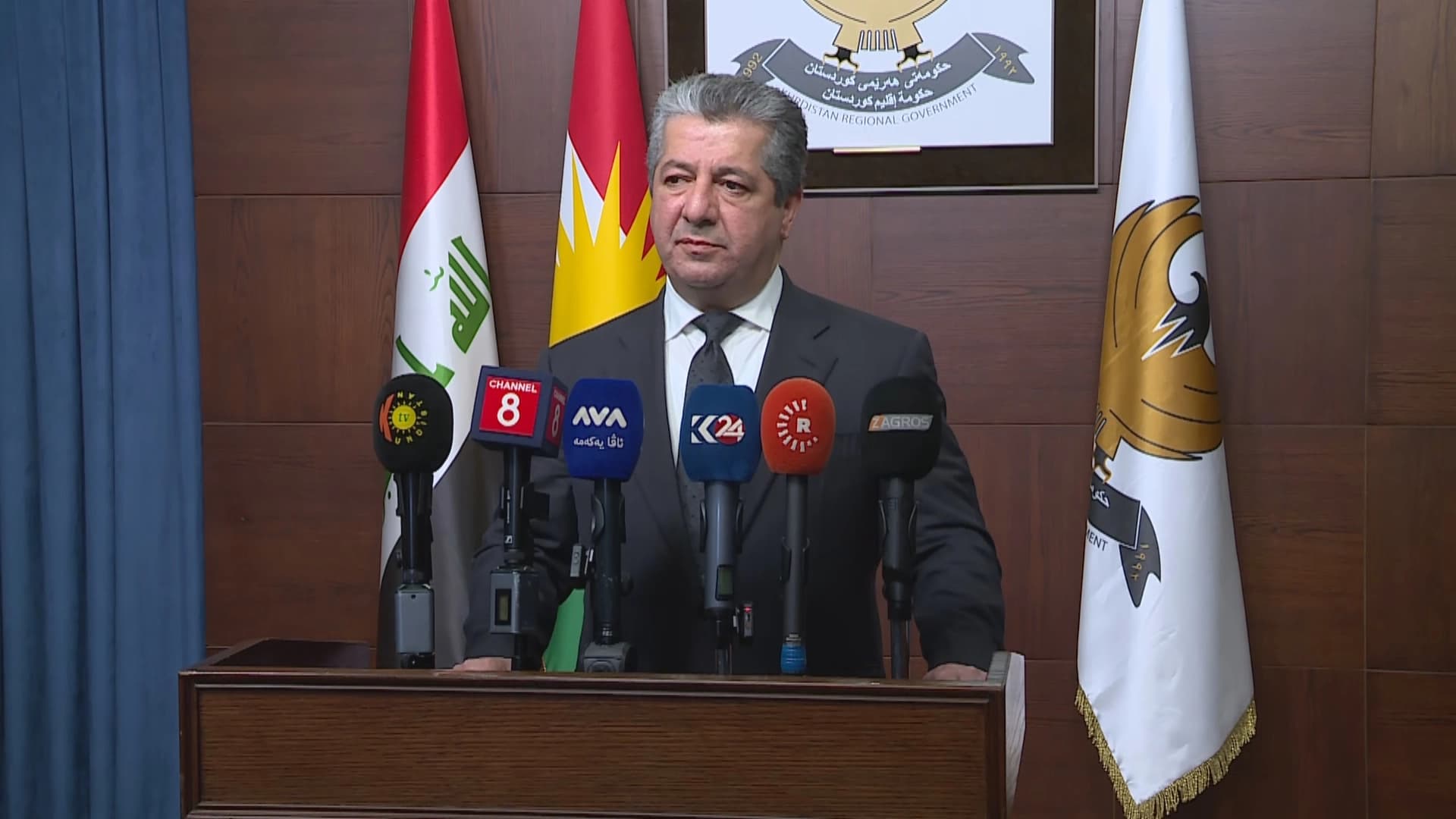

ERBIL, Kurdistan Region - Kurdistan Region Prime Minister Masrour Barzani said Tuesday that negotiations with Baghdad over the Region’s financial entitlements have shown “positive” signs, but cautioned that disagreements over oil and other outstanding issues remain unresolved, stressing that any settlement must respect the Iraqi constitution.
Speaking at a press conference after visiting Erbil Governor Omed Xoshnaw to assess damage caused by deadly flooding over the weekend, Barzani said his discussions with Iraqi Prime Minister Ali al-Zaidi in Baghdad on Monday had been “serious,” expressing hope that they would produce a favorable outcome.
“Let’s not get ahead of events. Let’s first see what the results of the negotiations and promises will be,” Barzani said. “We have spoken about oil at length, and there are differing opinions within the federal government itself. Some of them want centralized control, which is contrary to the constitution.”
“All of our efforts are geared towards a lasting solution to the budget issue with Baghdad,” he added, noting that federal allocations were also dependent on Iraq’s revenues, which have been affected by the country's economic crisis. “We have tried to guarantee the flow of the budget, and they have made that promise to us. We hope they will stay true to their promise.”
The remarks come amid intensified negotiations over Iraq’s draft 2027 federal budget, which allocates the Kurdistan Region approximately 12.7 percent of federal funds, subject to conditions, including the handover of oil and non-oil revenues to Baghdad.
Erbil is seeking to raise its share to 14.14 percent based on the latest population census. The two sides also disagree over oil deliveries, with Baghdad seeking at least 400,000 barrels per day starting in 2027, while the KRG has proposed between 250,000 and 280,000 barrels.
Iraq's state-run al-Sabah newspaper reported Tuesday that the federal cabinet's discussion and approval of the draft budget had been postponed from Tuesday to Saturday, November 14, following Monday's negotiations between Zaidi and Barzani.
Abdulzahra al-Hindawi, director of the Iraqi prime minister’s media office, told al-Sabah that the discussions had produced "advanced understandings" on five key issues: management of oilfields, oil and non-oil revenues, salaries of Kurdistan Region public employees, the Region's allocation in the 2027 budget, and the long-delayed federal oil and gas law.
Hindawi said the talks reflected a mutual commitment to dialogue and shared constitutional principles, adding that joint committees would be established to address specific outstanding issues.
Following Monday's meeting, Barzani said the two sides had reached an understanding on mechanisms to secure the Kurdistan Region's financial entitlements and ensure the continued payment of public sector salaries.
In a joint statement, the federal government and KRG emphasized the need to resolve disagreements in accordance with the Iraqi constitution and existing laws, including arrangements for administering oilfields and coordinating revenues between their respective finance ministries.
Barzani reiterated Tuesday that the Region's outstanding disputes with Baghdad extend beyond salaries and the budget.
“Our talks with Baghdad have been grounded in the Constitution to establish the constitutional rights of the people of Kurdistan,” he said. “It is true that our issue isn’t restricted to the budget. There are other issues along with the budget, such as the disputed territories and oil and gas. We have said what we had to say about these.”
The prime minister also linked the Region's longstanding financial difficulties to its ability to provide essential public services, including infrastructure needed to prevent and respond to natural disasters.
Barzani made the remarks after inspecting Erbil province's Operations Room on Tuesday following Saturday's torrential rainfall and flash floods, which killed two people and caused extensive damage to homes, businesses, vehicles and public infrastructure.
“I felt that some of the issues were because of the financial crisis,” Barzani said, explaining that the KRG was under severe financial pressure over the transfer of revenues to Baghdad to secure salary payments.
“This is a clear example that salaries aren’t the only thing that we need to provide. We need an appropriate budget for suitable machinery and services to provide to the people at the right time,” he added.
Barzani said the unusually heavy rainfall over a short period was the principal cause of the disaster, but acknowledged the need to investigate potential shortcomings and improve preventive measures.
“No one can prevent a natural disaster, but we will spare no effort to decrease the damage,” he said.