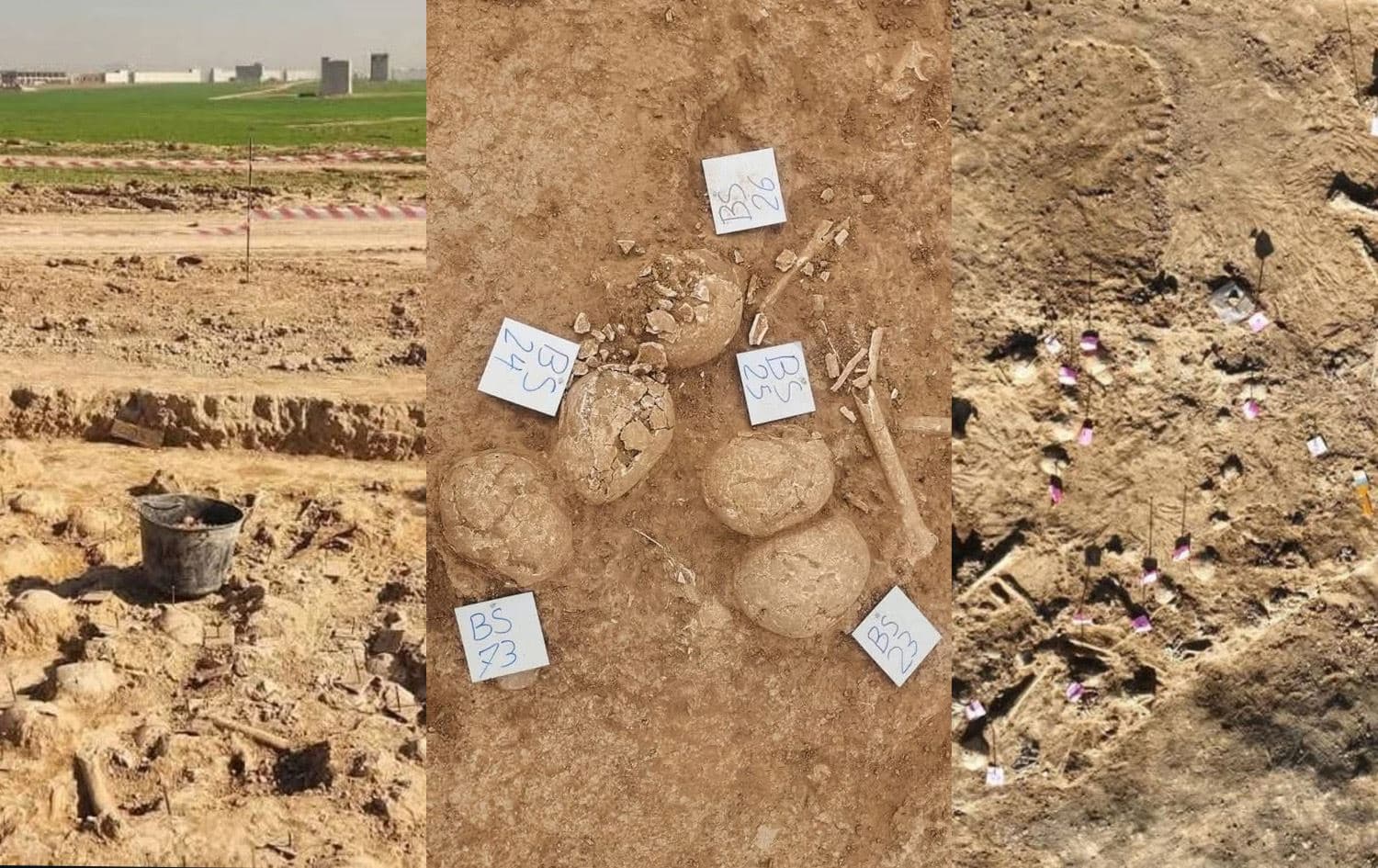

ERBIL, Kurdistan Region - An archaeological site containing a mass grave with more than 100 human skulls and several historical artifacts has been discovered in Erbil city, local officials said on Wednesday.
The site was uncovered on February 7 during work on a service project in the Baghlumnara quarter of Erbil. Workers noticed human skeletons while excavating and alerted authorities.
“After investigation, it turned out to be an important archaeological site,” Erbil Governor Omed Xoshnaw told Rudaw.
Xoshnaw said preliminary estimates suggest the mass grave and associated artifacts date back more than 1,400 years. Items recovered at the site include old coins, two bronze bracelets, two pearl necklaces, an iron ring, and four pieces of pottery jars.
Mohammed Lashkri, head of the Kurdistan Region’s Antiquities and Heritage Affairs, said excavation work was initially delayed due to rain but resumed on February 13.
“Work is still ongoing, and 103 skulls have been found so far,” he said, noting that four skulls were damaged by excavator blades before the site was identified.
"That area is known as the Kingdom of Adiabene. The kingdom is mentioned in the Chronicle of Arbil [Erbil] and dates back to the fourth and fifth centuries AD. A priest mentioned the lives of priests before him, and with the coming of the Jewish religion to the area, they may have been subjected to genocide,” he said.
He added that “it may also have been during the Sassanid period when their religion was Zoroastrianism. Or we think the army that came and overthrew the Kingdom of Adiabene may have committed genocide against these people. It is also possible that these people suffered from a disease or illness.”
He stressed that investigations remain preliminary, noting that no visible signs of strikes or violent trauma have been found on the skulls. However, two jars were discovered alongside the remains, raising the possibility of poisoning.
“There is a coin and some bracelets in the mass grave. They may be the people of the Kingdom of Adiabene,” he said.
DNA samples from the remains have been sent to the interior ministry for detailed scientific examination.
Lashkri expressed hope that the Kurdistan Regional Government (KRG) would preserve the site.
“We hope the Kurdistan Regional Government will turn the site into a monument as a symbol of Erbil's archaeology and heritage and the area itself.”