

The continuation of the war between the US and Iran has posed a serious threat to oil and gas infrastructure, transport routes, and foreign investment and has simultaneously placed the global energy market and energy security under severe pressure. Nevertheless, Iran's oil production and export levels have remained higher and experienced fewer disruptions compared to Iraq and the Kurdistan Region.
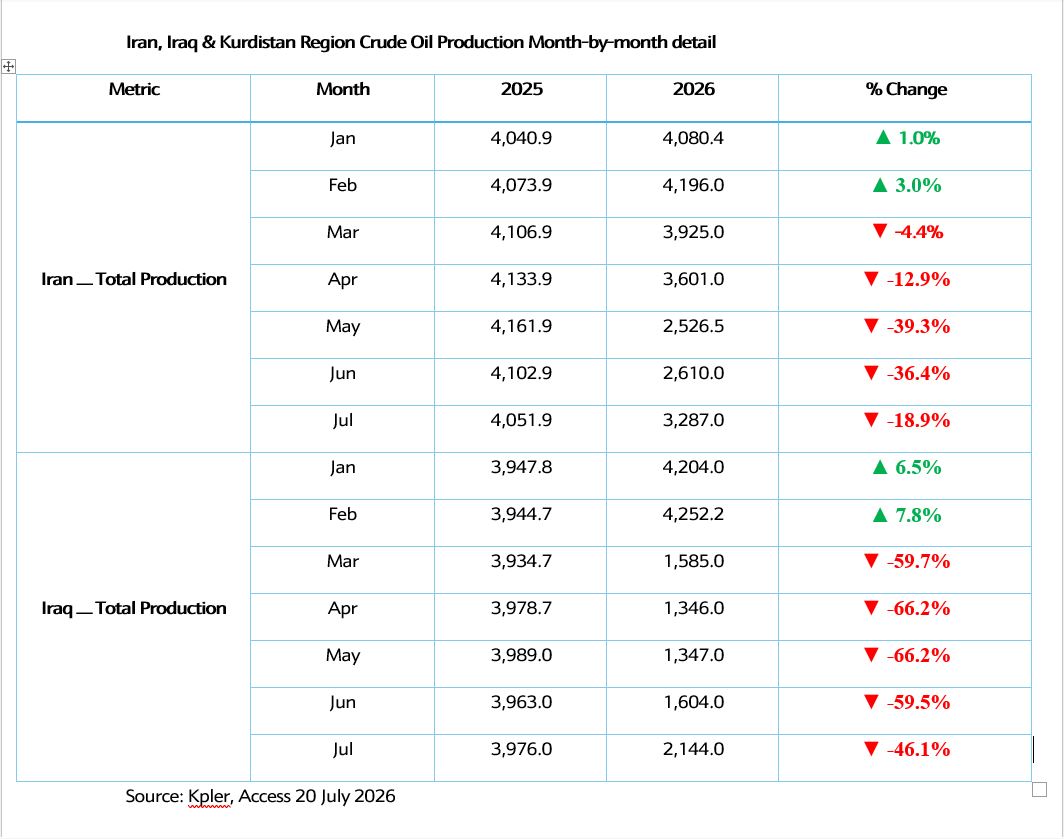
According to data from Kpler, between March and July 2026, production in Iraq and the Kurdistan Region dropped significantly by 66% to 46%, respectively, compared to the same months in 2025. In contrast, Iran's production and export decline during the same period ranged between 4% and 39%.
In terms of production: In June 2026, Iran produced 2,610,000 barrels of oil per day (bpd). Conversely, Iraq and the Kurdistan Region produced a combined 1,604,000 bpd - nearly 1 million bpd less than Iran. The main reasons for this disruption in Iraq and the Region were (1) The continued halt of foreign company operations in the Kurdistan Region's fields due to security risks and (2) the closure or obstruction of export hubs in southern Iraq and the risk to vessel transit through the Strait of Hormuz.
In terms of exports: In June 2026, Iran's daily exports stood at 766,000 barrels, whereas exports from Iraq and the Kurdistan Region reached 700,000 barrels. In the Chinese market - the main buyer for both sides - the volume of Iranian oil delivered was double that of Iraq and the Region combined.
Monthly Production Details (Up to July 2026)
Iran's daily production level varied across the year; it produced more oil per day during the active war period than during the fragile ceasefire that lasted from April 8 until the beginning of July.
Iran's steepest declines were recorded in May (-39%) and June (-36%) in comparison with the previous year. Iran's production average up to July 20th stood at 3.28 million bpd (19% lower than last year). This occurs in contrast to July 2025, following the 12-day war, when its production stood above 4 million bpd.
Iraq and Kurdistan Region levels
In January and February 2026, due to the resumption of production in the Region's fields and pipeline exports to Turkey, production grew by 6.5% to 7.8%, reaching 4.2 million bpd. However, with the onset of the 40-day war in April and May, production dropped by 66%, falling from 4 million to 1.3 million bpd.
Kurdistan Region Contribution
Pre-war daily production was above 270,000 barrels. In early March, following suspension in the Tawke, Peshkabur, Sheikhan, Sarsang, and Atrush fields, production dropped below 70,000 barrels. Although it recovered in early July when foreign companies resumed work, the recent suspension by HKN and Gulf Keystone over the past two weeks keeps current production above 100,000 barrels per day.
Notably, during the first 20 days of July 2026, production in Iraq and the Region recovered to 2.14 million bpd (nearly half a million bpd higher than in June), signaling increased ease in the transit of oil tankers through the Strait of Hormuz.
Monthly Export Details (Up to July 2026)
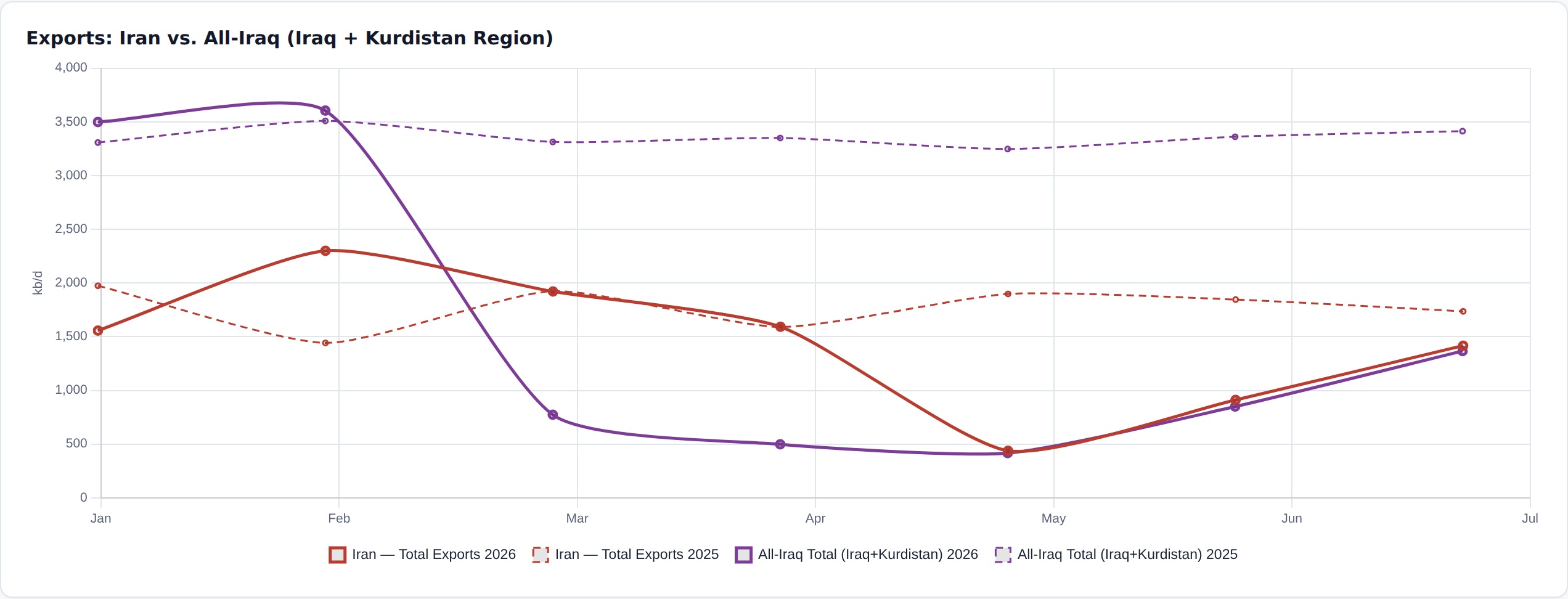
Daily oil exports from Iran remained normal until April 2026, but dropped to 271,000 bpd in May (during the ceasefire period), marking a 84% decline. Exports later rebounded in June to 766,000 bpd (over 90% of which went to China) and reached 1.3 million bpd in the first 20 days of July, all dispatched toward China.
In mid-2026, oil exports from Iraq and the Kurdistan Region experienced severe downturns, with June exports standing at just 700,000 barrels - a stark 79% decline compared to the previous year - following a dramatic low in May 2026 when exports plummeted by 92.3%. Data from the State Organization for Marketing of Oil (SOMO) illustrates a steep collapse in Kurdistan's daily exports, which dropped sharply from 208,000 barrels per day in January and 198,000 in February down to 41,000 in March, 11,000 in April, and a mere 15,000 in May. Official export figures for the subsequent two months remain pending publication by SOMO and the Ministry of Finance following the inauguration of the new government.
In early July, exports reached over 1.2 million bpd. Furthermore, Iraq has begun rehabilitating the Kirkuk - Ceyhan pipeline and signed a contract to transport 700,000 to 750,000 bpd of Basra oil to Kirkuk to cover the export deficit through that route.
Comparing the First Half of 2026 to the First Half of 2025
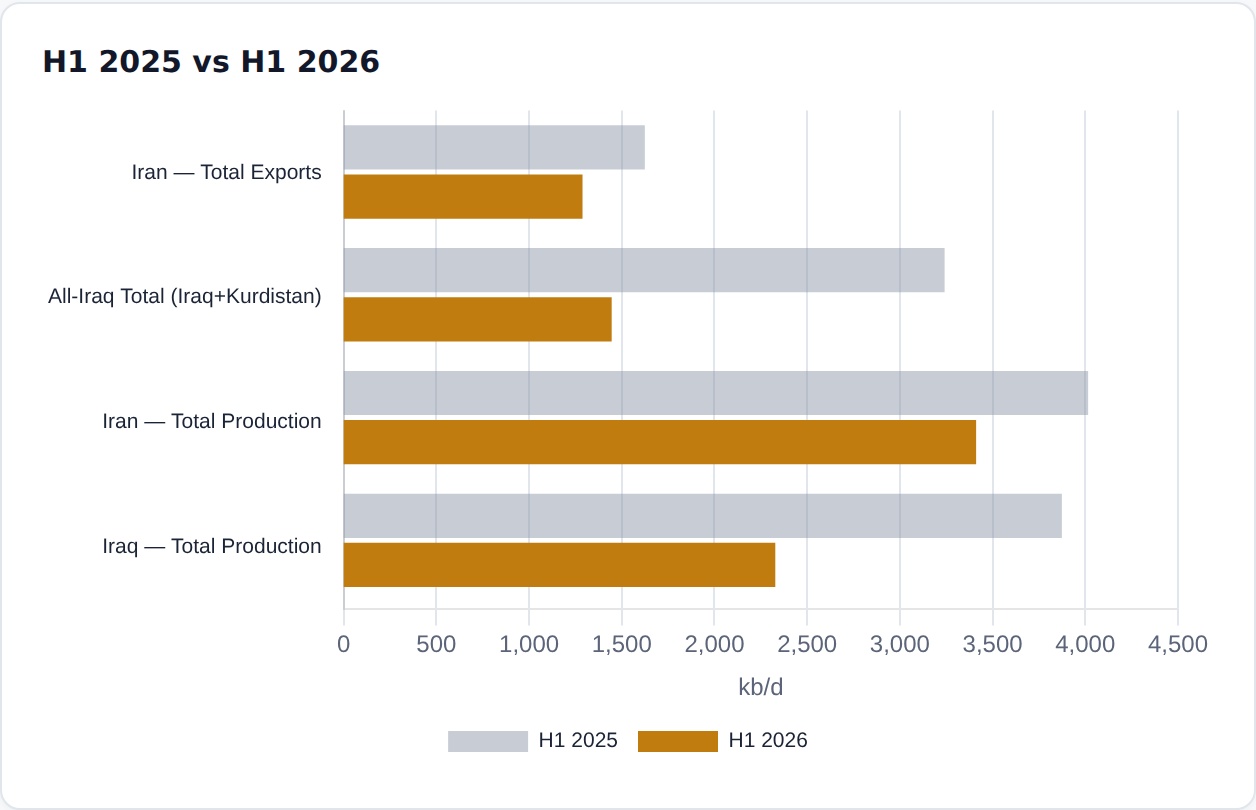
A comparison of averages between the first half of 2026 and the same period in 2025 reveals a significant disparity in export and production levels: Iranian oil exports decreased by 20%; in the first six months of 2025, exports averaged 1.67 million bpd, but fell to 1.33 million bpd in H1 2026 (a reduction of 341,000 bpd delivered to markets).
Iraq and Kurdistan Region Oil Exports: In H1 2025, daily exports were nearly 3.3 million bpd, but dropped to 1.49 million bpd in H1 2026 (including the Region's share) - a decrease of 55% (or 1.8 million bpd).
Iran's Total Production stood at 4.1 million bpd before the war, but fell to an average of 3.48 million bpd in H1 2026 - a reduction of 15% (approximately 613,000 bpd).
Iraq and Kurdistan Region total production stood at 3.96 million bpd in H1 2025, but fell to 2.38 million bpd in H1 2026 - a decrease of 39.6% (or 1.57 million bpd).
The sharp decline experienced by Iraq and the Kurdistan Region compared to Iran stems from security threats to foreign companies, obstacles in the Strait of Hormuz, and the lack of any strategic alternative for exporting southern Iraqi oil outside of the Port of Basra.
Factors Behind the Resilience of Iran's Oil Industry vs. Iraq and Kurdistan
National Control: Iran's oil and gas sector is entirely nationalized and does not rely on foreign companies, due to US and European sanctions. All fields are managed by the National Iranian Oil Company (NIOC). Consequently, operations do not cease during security crises, nor do employees withdraw. In contrast, the Region's oil sector and part of southern Iraq's fields depend on International Oil Companies (IOCs), which quickly suspend operations or evacuate personnel during security escalations.
Independence of Export Routes: By investing in the Goreh - Jask pipeline project, Iran can load a portion of its oil outside the Strait of Hormuz - in the Sea of Oman. Furthermore, due to its military dominance over the Strait of Hormuz, its oil tankers pass through with lower security risks compared to international vessels carrying Iraqi oil.
The Shadow Fleet Network: Iran possesses an extensive shadow shipping network and complex financial systems built during years of sanctions. This experience enables it to easily transfer ships during wartime without relying on Automatic Identification System (AIS) tracking or Western corporate insurance.
A Stable and Guaranteed Market: More than 90% of Iran's exported oil goes to China's independent refineries ("Teapot Refineries"). These refineries utilize a specialized financial system independent of the US dollar or Western financial networks, providing a continuous and guaranteed demand for Iranian oil.
Conclusion
Data from the first half of 2026 demonstrates that the impact of conflict and security instability on the oil sectors of Iraq and the Kurdistan Region has been far heavier than on Iran's. Through diversified infrastructure, direct exports to China, and control over the Strait of Hormuz, Tehran has managed to keep production and export levels relatively stable.
In contrast, southern Iraq's complete reliance on the Strait of Hormuz and the suspension of foreign company operations in the Region have led to severe financial losses. According to data from the Iraqi Ministry of Finance, the deficit reached nearly 13 trillion Iraqi dinars (approximately $10 billion) in the first five months of this year.
Ultimately, Baghdad's recent decisions to sustain oil exports by rehabilitating the Kirkuk - Ceyhan pipeline and routing Basra oil northward - alongside understandings regarding the Basra - Baniyas and Basra - Aqaba pipelines - are strategic steps toward reducing reliance on the Strait of Hormuz and saving the country from economic suffocation in the shadow of ongoing regional wars.


