
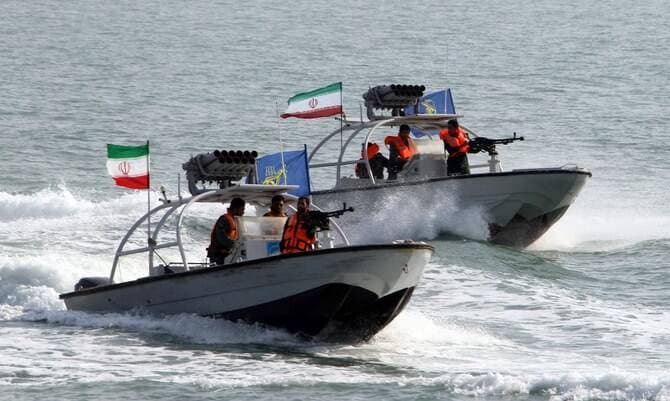
ERBIL, Kurdistan Region - The Islamic Revolutionary Guard Corps (IRGC) said Saturday that it had targeted two US bases in Kuwait, following earlier strikes that included targets in Jordan. The strikes come amid the latest escalation in the US-Iran war.
The IRGC said that in the 18th wave of its operation, code-named Nasr-2, it had attacked "the deployment and gathering site of the aggressor forces at their Land Forces Support Center in Arifjan, neutralizing a number of them," as well as "the radar at the US Ali al-Salem airbase" in Kuwait.
"The Ground Force warriors pulverized a weapons maintenance hangar and a drone facility," it added, claiming that "the retaliation by the warriors continues."
The statement was followed by an immediate announcement from Kuwait's Defense Ministry, which reported "confronting hostile missile and drone attacks" after the "sinful Iranian aggression."
Earlier in the day, Jordan announced that it had intercepted 10 Iranian missiles "aimed at the kingdom."
Regional tensions have entered a new phase, with the United States beginning to target multiple bridges and transportation infrastructure in southern Iran. The attacks have been concentrated in the port city of Bandar Abbas, in Hormozgan province, aiming to sever the strategic naval hub on the Strait of Hormuz from mainland supplies.
The IRGC accused the US of attempting to "conceal its defeat in the military confrontation" and "maintain its position through cruelty and cowardice rather than actual fighting."
Meanwhile, US Central Command (CENTCOM) announced a new round of strikes against Iran late Friday, saying that the strikes are "designed to continue degrading Iranian military capabilities."
CENTCOM said it "hit surveillance sites, military logistics infrastructure, underground weapons storage, and maritime capabilities. U.S. forces employed fighter aircraft, aerial drones, and warships in addition to other assets."
Washington has reinstated a naval blockade on Iran's southern ports since Tuesday, limiting the country's ability to import and export oil through the Strait of Hormuz, through which Iran markets the overwhelming majority of its oil. The blockade was lifted on June 18 after more than two months of enforcement.
Despite signing a preliminary framework for a lasting peace agreement in mid-June, conflict has steadily flared up between the US and Iran in recent days over control of the Strait of Hormuz.
The latest escalation began after the US, in coordination with the International Maritime Organization, opened a two-way corridor along the Omani coastline to facilitate navigation for vessels stranded in the waterway, while offering an alternative route away from Iranian shores.
Claiming that ships must obtain its "permission" to pass and that it controls the strait, the IRGC began attacking ships using the new corridor, prompting retaliation from the U.S., which has emphasized that the waterway should be "toll-free" and open to international shipping.

.jpeg&w=3840&q=75)