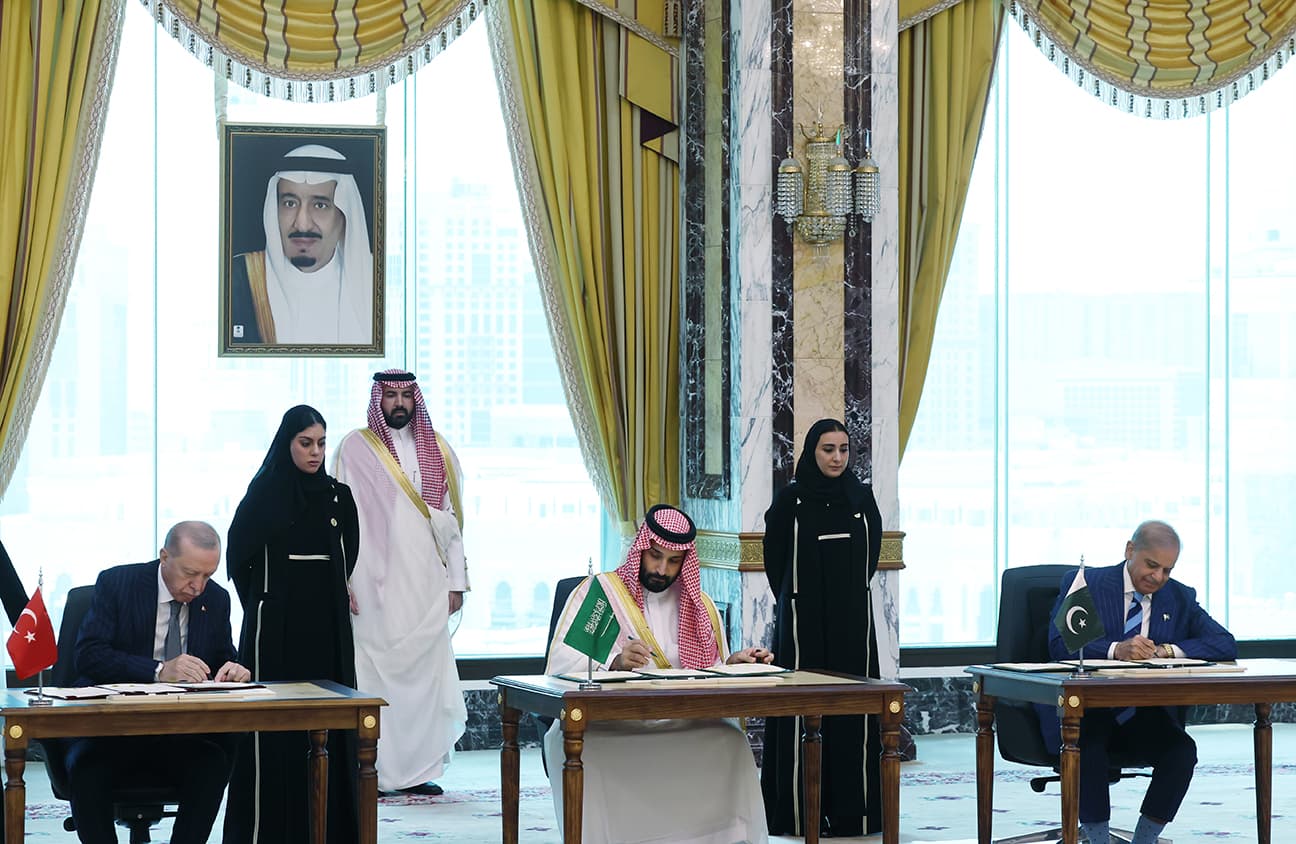

ERBIL, Kurdistan Region - Turkey announced Friday it has signed a mutual defense agreement with Pakistan and Saudi Arabia, a move aimed at bolstering regional security amid increasing geopolitical tensions.
According to a trilateral joint statement, the three heads of state “signed the Joint Defense Agreement, reflecting the three States’ shared commitment to further strengthening their collective security and to promoting peace, security, and stability in the region and beyond, in pursuit of a secure and prosperous future.”
The announcement follows the "Mecca Summit" in Saudi Arabia, in which Saudi Crown Prince and Premier Mohammed Bin Salman hosted Turkish President Recep Tayyip Erdogan and Pakistani Premier Shehbaz Sharif.
The meeting comes amid heightened tensions in the Middle East following the US-Israeli war with Iran that began in late February, which triggered a series of strikes and counter-strikes between the US and its allies and Iran and its backed armed groups. Both sides targeted each other’s assets and infrastructure, with the Strait of Hormuz emerging as the spotlight of the conflict.
The Strategic Mutual Defense Agreement (SMDA) was established in mid-September by Saudi Arabia and Pakistan, underlining the commitment of both countries to a collective security agreement in which any hostility against either nation is treated as an attack on both.
“The Agreement is intended to strengthen collective deterrence against any act of aggression,” the trilateral statement outlined, noting that “any armed attack against any one of the three States shall be regarded as an attack against them all.”
Eleven civilians were injured in the Saudi province of Najran Thursday following Houthi attacks, Saudi-led coalition backing Yemen's internationally recognized government (IRG) spokesperson Turki al-Malki told the Saudi Press Agency on Friday. The casualties include seven Saudis, two Egyptians, one Yemeni, and one Pakistani. A woman and a 4-year-old child were among those hurt, suffering second-degree burns.
Malki condemned the strikes on civilian targets as violations of international humanitarian law. He affirmed that the coalition's Joint Forces Command will continue taking deterrent measures to protect citizens.
The remarks came shortly after the Houthis said they had "conducted a large-scale and precise military operation," using "ballistic missiles and drones" to target the al-Wadi'ah border region, which includes the main crossing connecting Saudi's Najran to Yemen's eastern Hadhramaut province.
Iran-backed group's military Spokesperson Yahya Saree claimed additional Houthi strikes on alleged Saudi positions in Hadhramaut's al-Abr district, as well as the al-Ruwaik and al-Thaniyah areas near Yemen's central Marib province.
Saree claimed the attacks resulted in "the death and injury of hundreds" of Saudi-affiliated forces, as well as "the destruction of a large number" of Saudi positions and vehicles. He warned against "the consequences of any escalation" while vowing to continue what he called "the siege for siege equation, until the embargo on our country is lifted."
The latest attacks are part of a broader escalation that began in mid-July, when the Houthis launched a "ballistic" missile attack on Abha International Airport in southern Saudi Arabia, claiming it was in response to the Aden-based IRG's airstrikes on Sanaa International Airport's runway - reportedly aimed at preventing a flight from Iran carrying a Houthi delegation from landing.
The Houthis, in the same period, declared a "maritime embargo" against Saudi shipping in the Red Sea, in response to what they described as a 12-year siege by Riyadh "on our ports and airports by land, sea, and air" since the onset of the Yemen war - a claim Saudi Arabia has categorically denied.
With the Iran-backed group controlling Yemen's western coastline, the blockade primarily targets the Bab el-Mandeb Strait, which connects the Gulf of Aden to the Red Sea.
Concurrently, Riyadh's alternative Gulf routes are also facing disruptions near the Strait of Hormuz due to maritime restrictions imposed by the Houthis' Iranian allies, the Islamic Revolutionary Guard Corps (IRGC).
Of note, Saudi Arabia hosted military officials from 43 countries and the European Union delegation in late July to discuss the establishment of a multinational defense coalition aimed at protecting three key maritime trade routes, of which a total of 14 countries issued a joint statement supporting the initiative, including Saudi Arabia, Kuwait, Bahrain, Qatar, Pakistan, Turkey, Egypt, and Jordan.
RELATED: Saudi Arabia hosts multinational meeting to establish maritime coalition