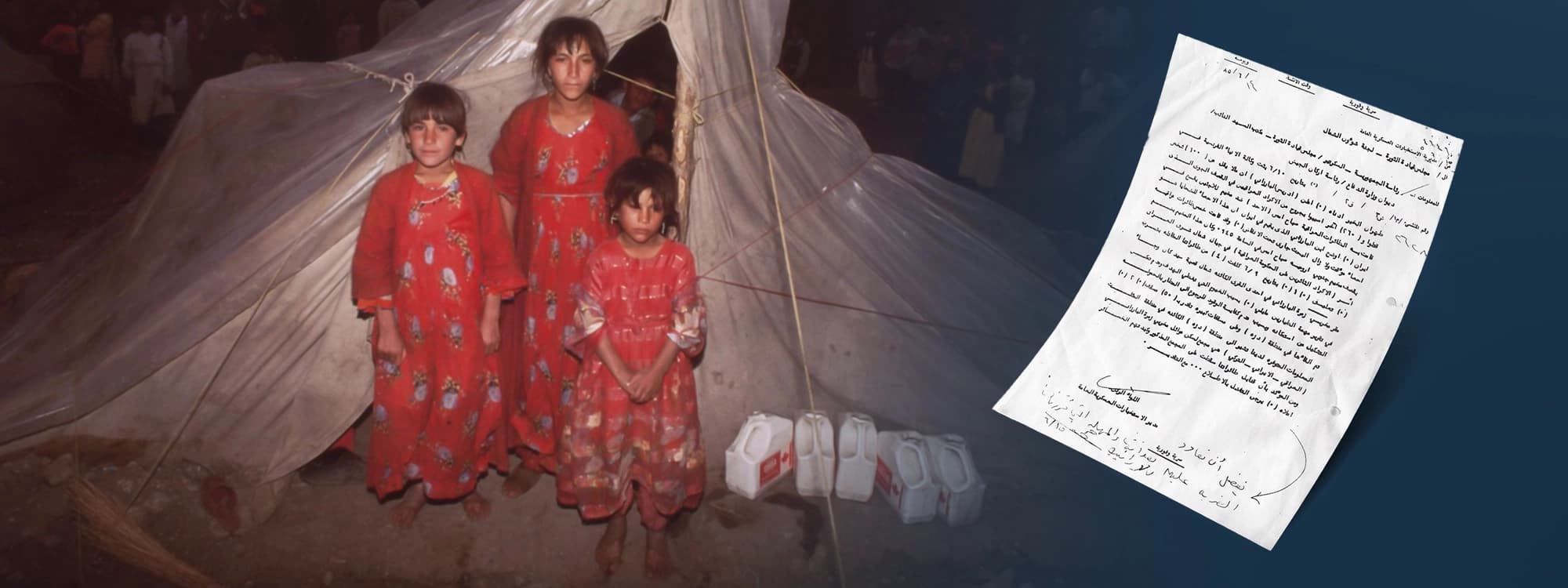

ERBIL, Kurdistan Region - Iraq's Supreme National Commission for Accountability and Justice on Friday published a secret military intelligence document from 1985 acknowledging that Iraqi warplanes bombed a camp housing Kurdish civilians in neighboring Iran, killing more than 100 people and wounding hundreds of others during Saddam Hussein's rule.
The document, dated June 14, 1985, and signed by the director of Iraq's General Military Intelligence Directorate the next day, confirms that Iraqi aircraft dropped bombs on a residential compound housing families associated with the Kurdistan Democratic Party (KDP) near the border between Iraq, Iran and Turkey on June 9 that year.
The commission, tasked with addressing the legacy of Hussein's Baath Party, published the document on Facebook on Friday, describing it as evidence of the former regime's disregard for civilian lives.
"A document of condemnation: this was the mentality of the fallen regime," the commission said, accusing the former Iraqi leadership of treating the killing of civilians as a routine military matter rather than a crime requiring investigation.
The document refers to an Agence France-Presse (AFP) report citing Idris Barzani, a senior KDP leader, who said at least 100 Iraqi Kurdish refugees had been killed and another 260 wounded when Iraqi aircraft bombed a refugee camp near Urmia in Iran's West Azerbaijan province.
In its assessment of the incident, Iraqi military intelligence acknowledged that four fighter aircraft had been assigned to bomb a headquarters belonging to the Barzani-led Kurdish movement in a village north of Sidakan, a mountainous town in what is now Kurdistan Region near the Iranian border.
However, the aircraft failed to locate their intended target because of poor weather conditions, according to the document.
“Due to cloud cover over the target and the formation's inability to locate it, and because there was insufficient fuel to return to the airbase while carrying the bomb load, the bombs were dropped in the Daza area, onto a large number of roofed structures, estimated at 50.”
The intelligence directorate identified the area as a residential compound housing families of Kurdish fighters affiliated with the Kurdish movement in Iraq led by Barzanis.
“It is certain that the bombs dropped by our aircraft fell on the aforementioned compound and inflicted the casualties mentioned above.”
The document was addressed to the Northern Affairs Committee of Iraq's Revolutionary Command Council, the country's highest governing authority under Saddam Hussein.
Conflicting casualty figures
The June 9, 1985, bombing targeted the Ziveh refugee camp, also known as Zewa, Ziwa or Zewe, near Urmia in northwestern Iran, where Iraqi Kurdish families had sought refuge following the collapse of the Kurdish Aylul (September) revolution against Baghdad in 1975, led by Mullah Mustafa Barzani.
Contemporary reports provided differing casualty figures.
AFP reported that Idris Barzani said at least 100 people had been killed and 260 wounded, according to a report published by Spanish newspaper El País on June 10, 1985.
The Los Angeles Times reported the same day that Iran had announced 78 Kurdish refugees killed and 120 wounded in the Iraqi airstrike.
However, the United Nations' 1985 Yearbook recorded a higher toll, citing an Iranian complaint submitted on June 10.
“Iran charged, on 10 June, (47) that Iraq, on 9 June, had bombarded the Ziveh refugee camp, which housed Iraqi Kurdish refugees, killing 142 people, including 79 children, and wounding 300 others.”
The Kurdistan Genocide National Archives (KGNA), an Erbil-based organization documenting atrocities committed against Kurds, has published the names of 150 people it says were killed in the attack.
The bombing took place during the 1980-1988 Iran-Iraq War, when Baghdad and Tehran carried out repeated attacks across their shared border, while Kurdish opposition groups opposed to Hussein’s regime operated in mountainous areas along the frontier.
Three years later, the Iraqi government launched the Anfal campaign against Kurds, killing tens of thousands of civilians, destroying thousands of villages and forcibly displacing large sections of the Kurdish population.
Hussein's regime was overthrown in the US-led invasion of Iraq in 2003. He was executed in December 2006 after being convicted of crimes against humanity.
The Iraqi commission said the newly published document serves as further evidence of the former regime's treatment of civilians.
"These documents are not merely relics of the past. They are enduring evidence of the crimes committed by a regime that devastated Iraq and its people," it said.