
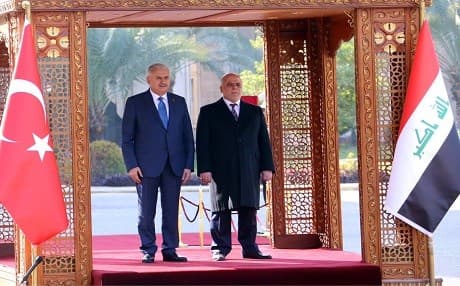

Yıldırım and Abadi were seen exuberantly normalizing diplomatic relations, putting to rest a tension which could have destabilized the region even further if prolonged.
Improving bilateral relations this fast was unexpected a month ago when both sides responded with tough rhetoric to the use of Iraqi territory by the Turkish army to set up a military camp in Bashiqa. But states can easily forgo the past and look to the future, ignoring yesterday and making tomorrow a day of signing treaties and memorandums of understanding for the sake of their mutual interests.
Contrary to conventional wisdom, I think the normalization of relations between the Turkish and Iraqi governments is in the interests of the region’s stability. It is also good for the Kurdistan Region, the United States, and Iran.
Erbil and Washington have therefore reportedly tried hard to contain the tension between Iraq and Turkey. Yıldırım’s visit to Iraq came after a telephone conversation between Abadi and the Turkish President, Recep Tayyip Erdoğan.
Yıldırım’s character
He is a founding member of the ruling Justice and Development Party (AKP) and is very close to Erdoğan. Yıldırım has served as transportation minister in most AKP cabinets during its 14-year reign over the country. He is an experienced engineer. In Turkey, the Prime Minister is known more as a ‘labor man’ than a seasoned politician.
Yıldırım comes from Izmir, the city known for its secularism and opposition. He is popular among people and opposition parties alike. Figures show that most roads and tunnels in Turkey were constructed during his tenure as transportation minister. For example, in 80 years of public service in the country, only 6 thousand kilometers of road were built, whereas 25 thousand kilometers were constructed during his 14-year service in the ministry.
During 80 years of government service, 50 kilometers of tunnel were built while the country’s tunnel length reached 346 kilometers, including underwater ones, in Yıldırım’s time.
He emerged as Prime Minister and leader of the AKP amid Turkey’s political instability. Yıldırım was a critic of the policies of his predecessor, Ahmet Davutoğlu.
Political and economic conditions in Turkey are unstable at the moment, owing to its flawed policies in Syria, and the internal friction and divisiveness engendered by Erdoğan’s desire to have a republican political system for the country.
Yıldırım established his foreign policy on the basis of the principle of making more friends and fewer foes. The normalization of relations with Russia, the recent developments we saw in Syria, and his visit to Baghdad are testament to his successful handling of foreign relations.
Turkey’s expectations in Iraq
The Middle East’s key political player looks to achieve three goals following improved relations with Baghdad.
First, it wants to reinvigorate economic ties with Iraq which is its second largest importer, after Germany. Turkey is now experiencing an annual 40% drop in business and trade dealings, which is a big blow to its economy. The Turkish government is hoping that its companies can play a key role in reconstructing Iraq’s Sunni areas ruined by the fight against the Islamic State (ISIS).
Its second aim is to fight the Kurdistan Workers Party (PKK) and the Fethullah Gülen Movement. The Turkish government has apparently suspended the peace process until the PKK militants lay down their weapons. It needs Baghdad to give legitimacy to its operations against the PKK in Qandil and Shingal.
Third, Turkey does not want to leave Baghdad the way Saudi Arabia did. Through improved relations, Ankara seeks to support Iraqi Sunni and Turkmen populations and implement its agenda in Mosul and Kirkuk.
What would Abadi gain?
First, he will be giving new strength to the war on ISIS as relations improve with neighboring Turkey, assuring Iraq’s Sunnis of their future in the country, especially those trapped in Mosul whose liberation is crucial for Abadi’s political life.
Second, he can use improved relations with Ankara to rally Iraq’s Sunnis against the reemergence of his predecessor Nouri al-Maliki to power. Abadi wants to show that he is the man who can regain the territory and relations which the former prime minister lost, as argued by The Economist. This can be a success story for him if he can achieve that.
Third, Abadi’s cabinet is in financial turmoil as he recently acknowledged that, at the moment, his government has funds to only pay the salaries of its civil servants. Who would then reconstruct the Iraqi towns ruined by the war on ISIS? The cost of the war against the militant group and the damage incurred is estimated to be nearly $40 billion.
How does Iran see improved Iraqi-Turkish relations?
First, Iran is arguably the main winner in parts of Iraq, and does not want other parts of the country to be unstable or in shambles. It wants Baghdad and Ankara to have good relations.
Second, knowing that the new US administration will be friendly to Turkey, Iran too would aim to further improve its relations with Ankara.
Third, Iran itself is in too poor a financial situation to be able to help out Iraq. That is why it wants Abadi to explore other ways to strengthen the country’s economy.
Fourth, Iran knows instability in Iraq directly bears on security situations in Syria where it wants to end the sacrifices it has been making to save Damascus.
Gains for the Kurdistan Region
First, the sale of Kurdistan’s oil is not now a big deal between Baghdad and Ankara. Those days are behind us. Iraq has now surrendered to the reality on the ground.
Second, Erbil will benefit from Abadi’s strong position and the blocking of Maliki from returning to power.
Third, the Kurdistan Region and its political climate will be more stable if relations between Ankara, Baghdad, and Tehran improve further.
Fourth, the stronger the Turkish political and economic position is, the better it is for Erbil in so far as we remain friends.
It will then be up to the Kurdistan Region to capitalize on these relations. Being non-state actors, the Kurds should deal with every step taken by states with caution and be prepared to make concessions within reason in negotiations with them in order to achieve their goals.

.webp&w=3840&q=75)