
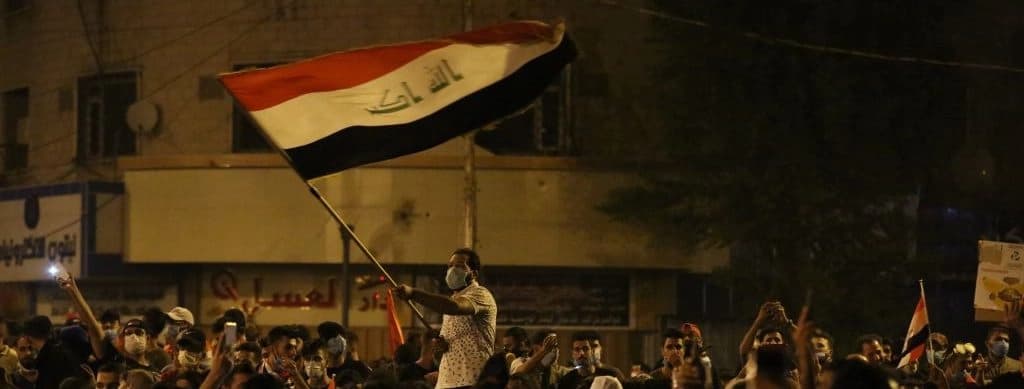

ERBIL, Kurdistan Region - Before the Tishreen protests - Tishreen is Arabic for October - erupted in Iraq in 2019, Hanan Salem had little interest in politics.
A graduate student at the time, Salem was focused on her studies and worried most about finding a job after graduation. But the protests, which some activists have described as a “revolution,” changed the course of her life.
She joined thousands of young Iraqi men and women protesting against the political system that had emerged after the 2003 US-led invasion.
Salem is now an investigative journalist from Babil province. She credits Tishreen with prompting her to pursue journalism.
At the urging of her family, Salem and two of her sisters joined the protests.
"We participated for the first time on October 3, 2019. But the situation changed on October 25, when thousands of women took to the streets. The decision to participate in the early days of October came after two bloody days in Baghdad. We felt that a female presence was necessary to prevent any expected violence against the demonstrators, given the sensitive situation of women in Babylon," Salem told Rudaw English.
"Our role in the early days was limited to encouraging women to join us. After October 25, with the influx of a huge number of women, their roles diversified, ranging from providing medical care to preparing food. As for me, I took up my camera and began documenting what was happening after we lost one of the most prominent young revolutionaries under mysterious circumstances," recalled the protestor-turned-journalist.
For Mohammed Husseini, an academic and political and social activist, joining the Tishreen protests was a natural step. He had already participated in protests in 2015 and 2018.
He recalled the protest squares as being "filled with patriotism and positive feelings."
Husseini told Rudaw English that he participated because he "feared the loss of the relative democracy and freedom that were the major benefits of change post-2003."
The Tishreen protests were the largest pro-reform movement in post-2003 Iraq. They began in October 2019, initially driven by young Iraqis, including university graduates with master's and doctoral degrees, who protested a lack of employment opportunities.
The demonstrations quickly expanded, drawing thousands of young men and women across the country.
Protesters demanded an end to corruption and the system of Muhasasa, Iraq's ethno-sectarian power-sharing arrangement. Demonstrations spread from Baghdad's central Tahrir Square to major squares in Nasiriya, Karbala, Basra and other cities.
The government of then-prime minister Adel Abdel Mahdi responded with force. What began with road and bridge closures escalated into the use of live ammunition against demonstrators.
Images of military-grade tear gas canisters striking protesters circulated widely on social media.
The protests largely subsided during the COVID-19 pandemic in 2020, although demonstrations continued intermittently into mid-2021.
Rights groups say more than 600 protesters were killed and about 20,000 injured during the unrest. No party was held accountable.
A government investigation referred to unnamed perpetrators as a “third party” without identifying them. Many activists and others accused Iran-backed armed factions in Iraq of involvement in the crackdown.
The issue has resurfaced following recent remarks by Hadi al-Amiri, head of the Badr Organization and a senior figure in the Shiite Coordination Framework, the main alliance of Shiite political parties that dominates Iraq's government.
Speaking at an event on August 29, Amiri described the Tishreen movement as “Fitna”, an Islamic term associated with discord and sedition.
“The [Islamic] resistance [in Iraq] stood courageously against the Fitna [sedition] of Tishreen, maintaining the state and political order in the process," said Amiri at an event.
His remarks angered activists and relatives of protesters killed during the demonstrations, with some interpreting them as an admission by armed factions involved in suppressing the movement.
"I was not surprised by al-Amiri's statement, as the attacks on the October Revolution by the followers and leaders of influential parties continue. The important thing in al-Amiri's statement is not his description of the October Revolution as sedition—we are accustomed to such descriptions—but rather his identification of those responsible for shedding all that blood and leaving thousands injured and permanently disabled," argued Hanan.
"Al-Amiri did not just justify the violence, but rather boasted about it because he knows that those who perpetrated the violence will escape punishment,” Hanan said.
Husseini agreed.
“Hadi al-Amiri's statement offered nothing new; everyone knows which entities oversaw the suppression of the protests or were involved in the killing of activists and protesters.”
Amiri's remarks were met with widespread condemnation from activists and political groups associated with the Tishreen movement.
Bayt al-Watani, one of several political parties that emerged from the protest movement, condemned the statement and called on the Iraqi judiciary to take legal action.
"This constitutes an honest admission that the factions repressed it," read the statement.
The party called on the public prosecutor and the Iraqi judiciary to “launch an immediate and urgent investigation about these statements, and to summon Hadi al-Amiri to investigate him concerning what he said.”
Ali al-Abadi, head of the Iraqi Center for Human Rights, also called for judicial action.
Hazim Mazin al-Badrie, a lawyer from Wasit province, filed a lawsuit with the provincial public prosecutor, calling for Amiri to be summoned and investigated.
Despite the controversy surrounding Amiri's remarks, Salem argues that they cannot alter the record of what happened during the protests.
In an era of widespread digital documentation, she says the events of Tishreen cannot simply be erased or rewritten.
"I will go out even if the October Revolution were to repeat itself a thousand times, regardless of the outcome. I will go out to prove that there is a living community in this country that wants to live,” said Hanan.

.png&w=3840&q=75)