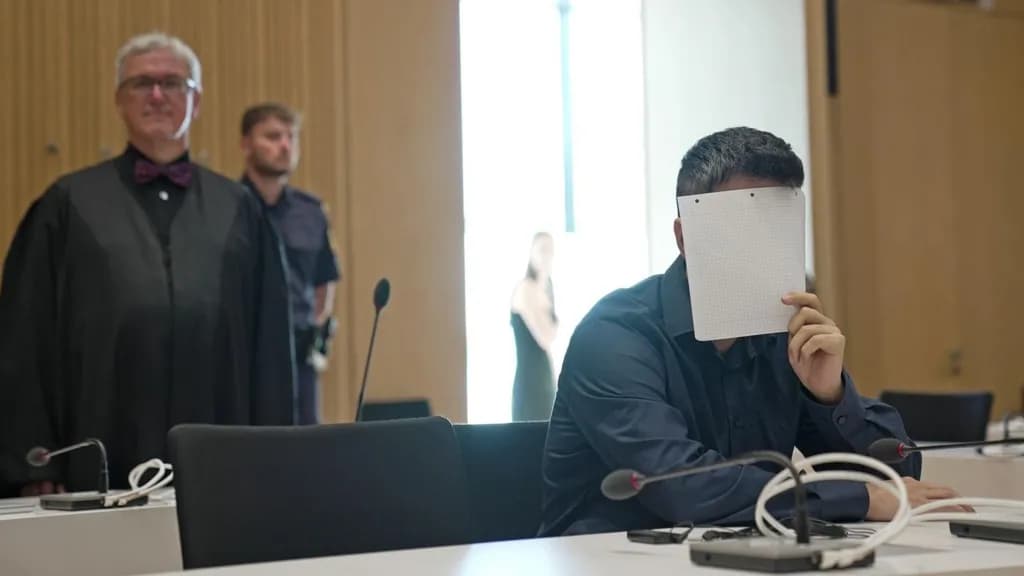
On Monday, July 13, the Munich Higher Regional Court convicted an Iraqi couple of genocide against the Yazidis. For survivors, the judgment represents far more than punishment - it is recognition of their suffering, a warning to perpetrators around the world and a challenge to Iraq.
More than eight years have passed since the fateful day when the plaintiff, young Yazidi woman, now 21, was purchased by a man at a slave market in Mosul. Before the purchase, he removed her veil and inspected her hair as though she were merchandise. She was only a child of 12.
In the Munich courtroom, she repeatedly broke down in tears as the judge delivered the court’s findings.
“My entire childhood was violence,” she told the court. “We Yazidi women were slaves. Even dogs were worth more than we were.”
The man was sentenced to life imprisonment. His former wife received a juvenile sentence of nine years and six months after the court applied German juvenile law to a portion of her conduct.
Both were convicted of genocide and other offenses, including crimes against humanity, war crimes, human trafficking and membership in a foreign terrorist organization. The judgment is not yet final.
One could summarize the case as two defendants, two sentences, and one judgment, but that would miss its true significance. This ruling is an act of recognition and holds a message that reaches far beyond Munich.
Recognition is where healing begins
For more than two decades, I have treated and supported survivors of war, torture and genocide. In the spring of 2015, I examined more than 1,400 Yazidi women and girls who had escaped Islamic State captivity in camps around Duhok in northern Iraq. Around 1,100 particularly vulnerable women and children were subsequently brought to Germany through a special humanitarian program established by the state of Baden-Württemberg.
I met girls as young as 10 who had been repeatedly sold and raped. I met mothers whose children had been killed before their eyes.
Over the years, I have learned that trauma on this scale cannot be healed through therapy alone. Survivors need something psychotherapy cannot provide: a public and institutional declaration that says, “You were wronged. You did not imagine it. The world has seen what was done to you.”
That is what a judgment of this magnitude can achieve.
When a German court determines that the enslavement and rape of Yazidi girls constitutes genocide committed with the intent to destroy, in whole or in part, the Yazidi religious community, that finding is not a mere legal technicality for the survivors - it recognizes their identity, their history and their right to exist.
Many Yazidis describe the Islamic State’s 2014 assault as the 74th ferman, or order [of genocidal campaigns], a word that evokes the repeated onslaughts of persecution and annihilation their community has endured. Today, however, people who once considered themselves masters over life and death in their self-proclaimed caliphate are sitting in the dock.
For a community that has carried trauma across generations, it marks a historic reversal.
The judgment also underscores a central principle of genocide law: killing is not the only act through which genocide can be committed. The forcible transfer of children from one group to another can also constitute genocide when carried out with the intent to destroy the original group, in whole or in part.
The court further found that the defendants understood that rape by men who were not Yazidi could threaten the girls’ standing within their religious community. Sexual violence was not merely a byproduct of war; the Islamic State used it deliberately as an instrument of destruction, targeting the girls’ bodies, their identities and the social bonds holding their community together.
When a court names that strategy and holds its perpetrators accountable, it gives force to international law and restores dignity to the victims.
A message to the perpetrators
The Munich judgment also sends an unmistakable message to those who believe themselves safe from justice: there is no place where you can hide forever, and the passage of time does not erase your crimes.
Genocide, crimes against humanity and war crimes are not subject to a statute of limitations under German law.
The two defendants were living in Bavaria when they were arrested in April 2024, years after the crimes and thousands of miles from the places where they had been committed. Germany’s principle of universal jurisdiction, which permits the prosecution of international crimes committed abroad, is not an abstract legal doctrine. It is being put into practice.
In 2021, the Frankfurt Higher Regional Court delivered the world’s first conviction of an Islamic State member for genocide. Munich is continuing along that path.
I have interviewed imprisoned Islamic State fighters in an effort to understand how human beings become capable of such crimes. Again and again, I encountered the same claim: the Yazidis are not human.
That dehumanization was the psychological foundation of the genocide. It is also why impunity would be so dangerous. When perpetrators are told, through inaction, that their crimes will have no consequences, their ideology is reinforced, and the lives of people they call unbelievers count for nothing.
Every judgment of this kind refutes that ideology. It declares that these girls were, and are, human beings and that those who abused them must answer for what they did.
A message to Baghdad
As welcome as the Munich judgment is, it also exposes a profound failure. Justice is being delivered by Germany instead of one of the countries in which these crimes were committed.
Iraq has yet to establish a comprehensive legal framework that would allow genocide, crimes against humanity and war crimes to be prosecuted systematically as such. When suspected Islamic State members are tried, proceedings generally rely on counterterrorism legislation.
Survivors are often neither heard nor formally recognized as victims of the specific crimes committed against them.
The rape, enslavement and attempted destruction of the Yazidis therefore remain largely absent from Iraqi criminal proceedings.
Approximately 2,500 Yazidis are still missing. Not all mass graves in Sinjar have been exhumed. Roughly 200,000 Yazidis remain displaced, many in camps, because their homeland has not been adequately rebuilt and is still not sufficiently safe.
By adopting the Yazidi Survivors Law in 2021, the Iraqi government took an important first step. However, reparations without criminal accountability remain incomplete.
I appeal to the federal government in Baghdad and the Kurdistan Regional Government in Erbil: identify the perpetrators who continue to live among you. Establish the legal foundations needed to prosecute genocide as genocide, enslavement as enslavement and sexual violence as part of a deliberate strategy of destruction.
The international community must not leave Iraq alone in this task. It should provide investigators, forensic expertise and sustained diplomatic support. Considerable evidence has already been collected, and many witnesses are still alive. What remains insufficient is the political will to transform that evidence into comprehensive criminal accountability.
What justice can do
Germany’s own history demonstrates that law cannot undo the past, but it also shows that law can preserve memory and help societies find their way back to humanity.
The Nuremberg trials did not bring back the dead. They did, however, give the world a legal language with which its gravest crimes could be named.
After my lectures in Germany, older people sometimes approach me and say, “We know these things from our own past.” In those moments, I understand why this country, of all countries, was prepared to listen to Yazidi women.
The young woman who testified in Munich as a joint plaintiff will never recover the childhood that was taken from her. No judgment can restore it.
She has, however, experienced something that matters: a state governed by the rule of law who took her story seriously. Her voice carried weight and the people who bought her and treated her as merchandise were required to answer for their actions.
The court ruling is the restoration of an order in which she is recognized as a human being, with a name, with dignity and with rights.
For the survivors of genocide, this judgment marks the beginning of many restitutions to come.
The views expressed in this article are those of the author and do not necessarily reflect the position of Rudaw.