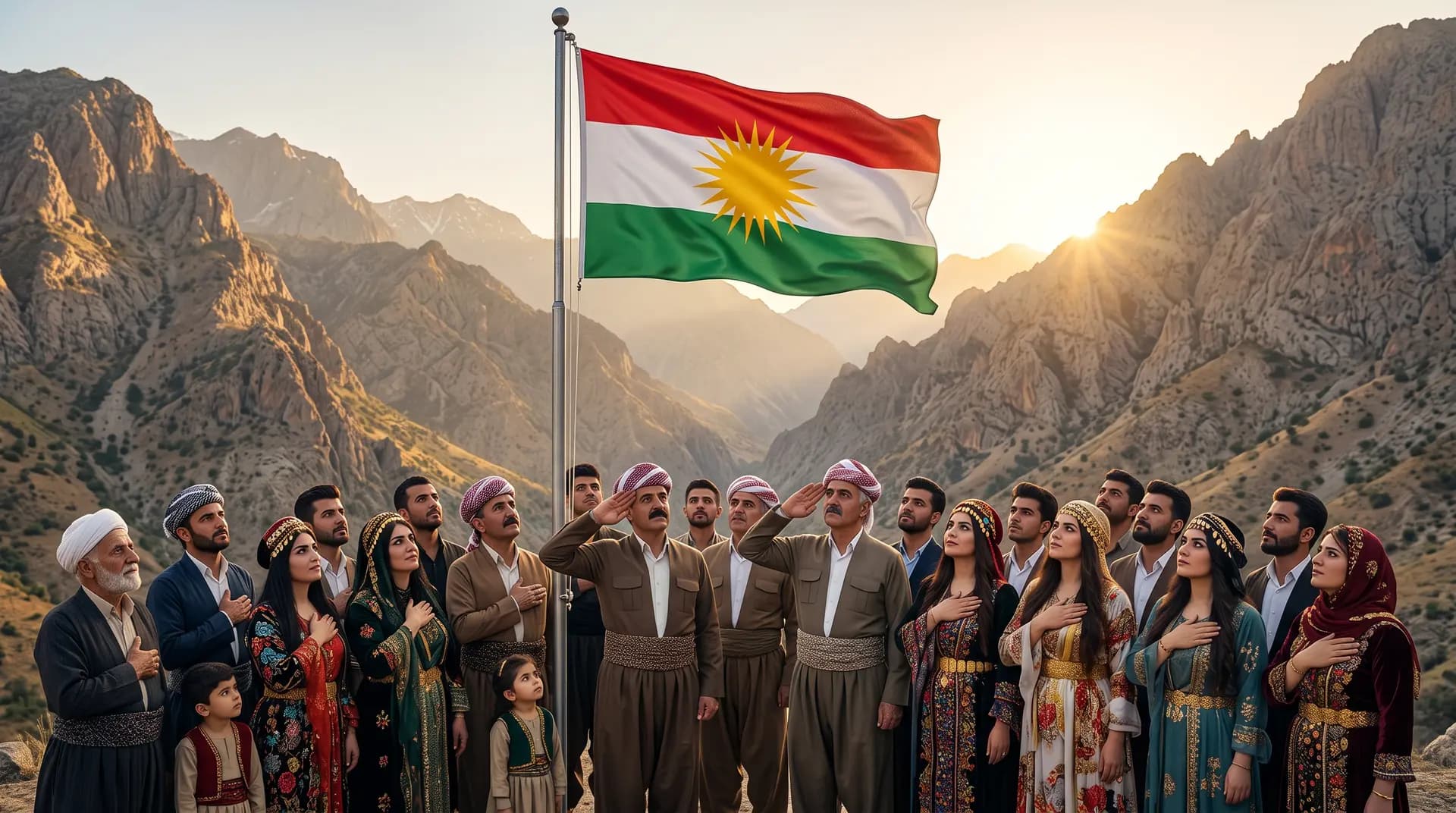
The new Kurd is a person of Kurdistan. Being Kurdish is no longer a crime in the countries among which Kurdistan has been divided, nor is it prohibited anywhere in the world. In this new phase, a Kurd can be described as a committed, freedom-seeking Kurd if they identify themselves as a Kurdistani. Today, Kurds are at a stage of affirming the Kurdistani identity of the Kurdish individual — in thought, in the expression of identity, and through its legal recognition.
A Kurdistani living in Kurdistan does not join an organization unless its name and identity are Kurdistani. They do not become a member of a political party unless its name and identity are Kurdistani and its objective is to affirm the existence of Kurdistan. This is a phase of consolidating Kurdistan’s political and geographical identity.
The new Kurd is not racist and opposes discrimination. They believe in civil, political and democratic struggle. They regard Kurdistan as the homeland of the Kurds and of everyone who believes in the Kurdistani identity of that land.
The new Kurd knows the history of Kurdistan, understands its geography and openly defends it. Kurdistan has historically been a geographical reality, but in modern political history, this reality — for political, ideological and religious reasons — was first erased from the mind of the Kurdish individual and was subsequently removed from the political map. Being Kurdistani is a path toward restoring that reality in the minds and thinking of Kurdish people and on the political map of the region and the world.
Kurdistan is a large country, but it is not a state. A state is essential for protecting the identity of a nation and its homeland. The absence of a state leaves a nation’s national identity under constant threat and places the survival of its language at serious risk. In many cases, statelessness excludes stateless nations from interstate interests and from the global arena. It also leaves them outside international frameworks of recognition because the global system is organized around states rather than the existence of nations.
The emergence of nations was a major development in human history. Nationhood became an important driver of human progress because it created a sense of commonality, reduced conflict, unified the workforce, expanded markets and advanced civilization. The formation of nations also fostered relations and cooperation among peoples, gave rise to advanced institutional systems, and contributed to the emergence of the international system. As a result, trade and economies developed, generating greater prosperity around the world. It also strengthened the protection of national human values. Today, the state is both a necessity and the principal pillar for protecting a nation, its identity and its interests in the world.
The Kurdish nation currently lacks a unified, nationwide institution. Because of the growing demands of everyday life and the absence of a state, the Kurdish nation is becoming increasingly dispersed. Apart from the Kurdistan Region of Iraq, Kurds have no Kurdish education system in any other part of Kurdistan or any other country where both the curriculum and its content are in Kurdish. This poses a serious threat to the survival of the Kurdish people.
Because Kurds do not have a politically recognized geography for their homeland, language constitutes an essential part of Kurdish national identity and even their sense of homeland. Linguistic identity is therefore far more important for Kurds than it is for a nation that possesses its own state. The lack of adequate conditions for Kurdish-language learning and education poses a serious threat to the Kurdish nation and, ultimately, to the survival of Kurdistan.
The new generation of Kurds may not fully appreciate the seriousness of this danger. Yet the decades-long contraction of the geographical space of Kurdistan, caused by restrictions on the Kurdish language and demographic changes carried out by the states among which Kurdistan has been divided, makes this danger clear for all to see. The identity of cities is changing as knowledge of the Kurdish language declines. Likewise, the inability to speak the language of the Kurdish nation distances new generations of Kurds — both in Kurdistan and around the world — from their community and from Kurdish aspirations.
For nations that possess their own states, the loss of certain national characteristics may not pose such a serious danger. For Kurds, however, it can be extremely consequential. By the same token, every visible expression of Kurdish national identity and attachment to the homeland carries considerable significance. For example, giving Kurdish children Kurdish names is extremely important for Kurdish identity and for preserving the national identity of the Kurdish people. Naming institutions after Kurdistan is likewise a major necessity.
The world is changing rapidly. Defending oneself has become increasingly difficult, and survival without a state is becoming harder with each passing day. Nevertheless, securing any right on the condition that the Kurdistani identity is recognized carries enormous value. Even rights that fall short of this are important for the survival of Kurdistan and the Kurdish people. But what fundamentally strengthens the Kurdish individual is becoming Kurdistani — in mind, in thought and in action.
Zhero Hoshyar is a commentator on Kurdish affairs.
The views expressed in this article are those of the author and do not necessarily reflect the position of Rudaw.