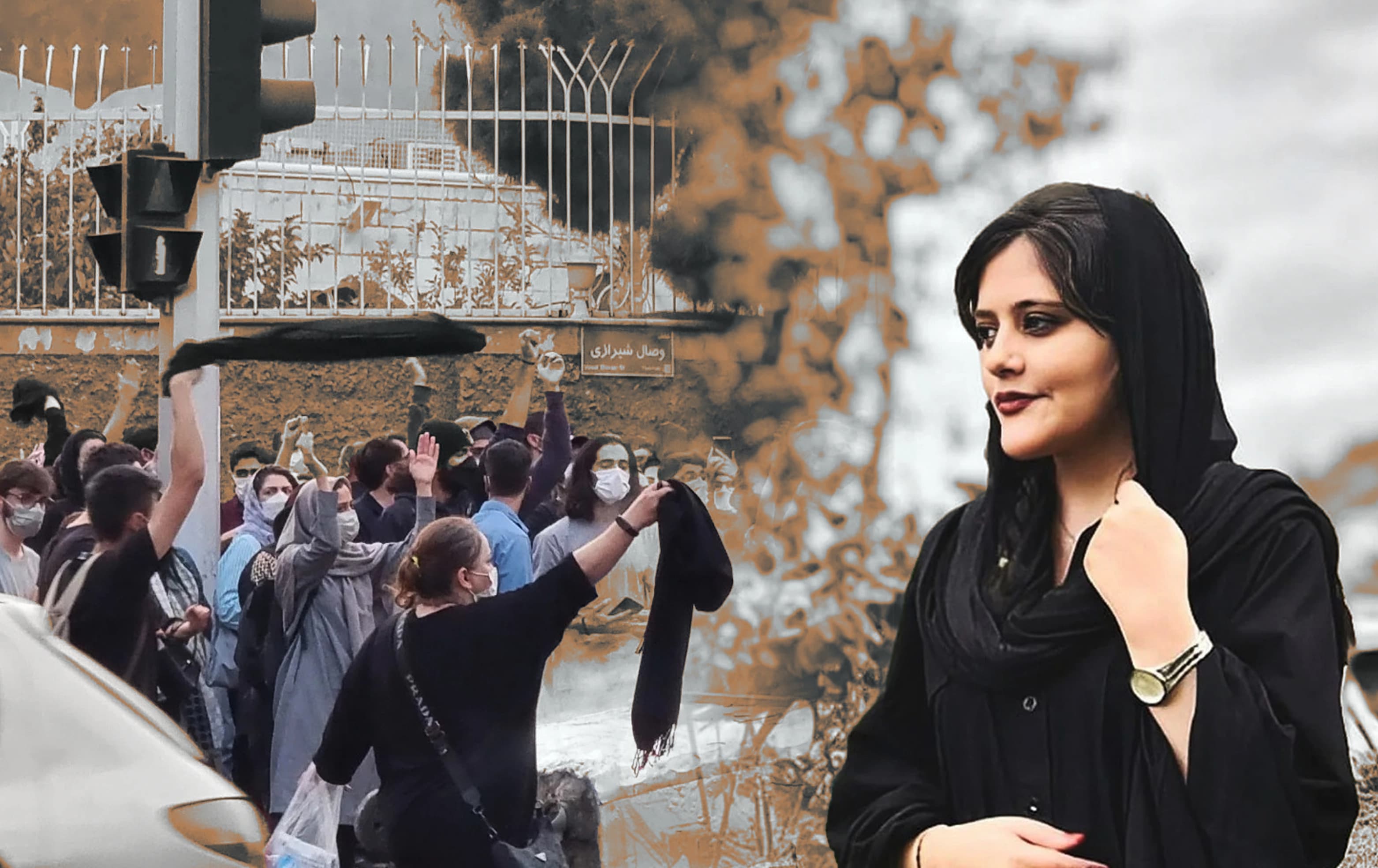
Her name was Zhina, and that is where this story must begin, because even her name was taken from her. Zhina is a Kurdish name. It means life. The world came to know her as Mahsa Amini, the name on her official documents, because the Iranian state views Kurdish names with suspicion and often refuses to register them. Like many Kurdish children in Iran, she grew up with two names: one for the authorities and one for the people who loved her.
She was 22 years old when, in September 2022, she travelled to Tehran with her brother to visit relatives and spend a few days in the capital. At a metro station, the morality police, as they are called, detained her because of the way she wore her headscarf. “Don’t take her,” her brother is reported to have said. “We are strangers here.” They took her. Three days later, she was dead.
At her funeral in Saqqez, in Iranian Kurdistan, something happened that would soon reach far beyond one family, one city or one people. Her mother called her by her real name. The women at the grave removed their headscarves, all together, and cried out three Kurdish words that had long belonged to the language of resistance: Jin, Jiyan, Azadî (Woman, Life, Freedom).
Within days, the words had travelled across Iran, first through Kurdish cities, then into Tehran and beyond. Soon they were spoken in other languages, on university campuses and in public squares far from Iran. A young woman who had never chosen to become a symbol had become the face of a movement.
This text is about Zhina. It is also about what her death made visible: the close bond between political repression and control over the body, the way fear settles into everyday life, and the moment when fear begins to lose its power because people suddenly discover that they are not alone.
It also demands a certain restraint from me. As a man, and as a psychologist who has worked for many years with survivors of war, persecution and sexual violence, I can try to understand what oppression does to the human mind. But I cannot claim to know what it means to move through each day as a woman under rules written largely by men. Listening closely to an experience is not the same as owning it. When men write about the lives of women, that difference matters.
Twice a stranger
We are strangers here. There is more in her brother’s sentence than he probably meant. A Kurdish woman in Iran is a stranger twice over in her own country.
She is a stranger as a Kurd. For decades, Kurds in Iran have faced political, economic and cultural discrimination. Their language has little place in schools, their provinces are among the poorest in the country, and Kurds are represented among those executed far beyond their share of the population.
And she is a stranger as a woman. Iranian law regulates her appearance, limits her autonomy and gives the state the power to decide how much of her hair or body may be seen in public.
Where the two meet, the result is more than the sum of its parts. A Kurdish woman may be viewed with suspicion because she is Kurdish and left unprotected because she is a woman. Within her own community, she may also face expectations that limit her education, her movement, her choice of partner or her place in public life.
In those weeks, a young woman from Sanandaj (Sna) described what this feels like. She had to buy her headscarf herself, she said, and choose the color of her own prison chain. “It is as if they kill you and make you pay for the bullet.”
Here I must say something uncomfortable, also for Kurds. Patriarchy is not an invention of the Islamic Republic, and it does not end at the borders of Iran or Kurdistan. Any society that wants to speak credibly about freedom must be willing to look at the unfreedom in its own homes, families and traditions.
For generations, women in many societies have been told whom to marry, how to dress, how loudly to speak and how far they may stray from expectations tied to honor, religion or family. Men usually enforce these rules. Over time, however, the rules can become so deeply woven into daily life that women pass them on to their daughters. Not because they believe in inequality, but because they have learned that obedience means safety.
As a psychologist, I know this mechanism well. People adapt to threatening environments. They learn which behavior reduces danger, which words are better left unspoken and which lines must not be crossed. What begins as protection becomes a habit. A survival strategy in one generation can become a prison in the next, long after its original cause has been forgotten.
That is one reason oppression can last so long. At some point it no longer seems imposed from outside. It looks like custom, decency, faith. And the oppressed become the custodians of their own unfreedom.
The face
I have long been preoccupied with what it means to take away a person’s face.
A face is more than what allows us to recognize someone. It is where another human being becomes real, where categories fall apart and we meet a single life that no number, political label or ideology can replace. Every face carries a history, relationships, fears, hopes and vulnerability. And before a word is spoken, it makes a silent plea: You will not kill me.
Systems of oppression work in part by weakening this recognition. They turn a person into something else: a security risk, a moral problem, an enemy, a dissident. Once that has happened, violence becomes easier, because the person is no longer met as a human being. Zhina becomes Mahsa in a file.
That is why control over women’s bodies is never only about clothing. When a state decides how a woman may dress, where she may go, whether she may sing and how visible she may be, it is claiming authority over her life.
The same logic can repeat itself within families and communities. A girl married off to protect a family’s honor is used as a means to another person’s ends. A woman whose choices are limited by what neighbors or relatives might say is made to carry a whole family’s reputation on her body.
In my work with Yazidi survivors of the group calling itself Islamic State, I encountered this logic in its most brutal form. Women and girls were abducted, sold in markets, raped and treated as property, because their captors believed one human being could own another.
These contexts are not the same, and they must not be blurred into one. But beneath these very different forms of violence lies a disturbingly simple question: who decides over a woman’s life?
How fear enters the body
Political repression does not rest only on police stations, prisons and courts. It works through anticipation: through knowing what can happen, and through adjusting one’s behavior long before any direct threat is made.
When a woman sees another woman dragged into a police van because of how she is dressed, the message is not meant only for the woman being arrested. It is meant for everyone watching. The punishment of one becomes a lesson for all. Fear is meant to travel farther than violence itself.
This is how repression enters daily life. People begin to calculate risk before they act. They censor themselves before anyone orders them to be silent. They learn where not to go, what not to say and which parts of themselves must stay invisible.
The body learns this language too. Under acute threat, the nervous system prepares us to fight, flee or freeze. When the threat becomes chronic, that alarm becomes part of everyday existence. Sleep changes. Concentration suffers. Vigilance rises. The future shrinks, because so much psychological energy is spent anticipating danger.
I have seen these patterns again and again in people who survived war, torture, persecution and genocide. Fear does not stay outside the body. It enters memory, posture and sleep, and the way a person scans a room for the exit before deciding whether it is safe.
Yet psychology also teaches us something else. Fear is most powerful when people believe they are alone. The moment someone discovers that others share what she has been afraid to say, the meaning of fear itself can change.
That is what made the images from Zhina’s funeral so significant. One woman removing her headscarf could be dismissed as an isolated act of defiance. Many women doing it together revealed something far more dangerous to an authoritarian system: private resistance had become visible, and collective.
We are not alone
Authoritarian systems depend not only on violence, but on isolation.
People may reject a system in private while obeying it in public, because they do not know how many others think as they do. Social psychologists call this pluralistic ignorance. Silence creates the illusion of agreement, and the illusion of agreement produces more silence. Dictatorship lives on this loneliness.
Each person also needs to see a different number of others before daring to step forward. The sociologist Mark Granovetter described this as a threshold. One woman will go into the street only when a thousand are already there. Another will go when ten go. A very few go alone. As long as the bravest remain alone, nothing changes. But when enough people in one place reveal at the same moment what they truly think, they draw others with them, and those draw others still.
At Zhina’s grave, that moment came. When the women removed their headscarves and cried Jin, Jiyan, Azadî, others saw that their anger and their longing for dignity were shared. The slogan moved from Kurdish cities into Tehran, where it was answered in Persian: Zan, Zendegi, Azadi.
What began with the death of a young Kurdish woman grew larger than any one people or province. Women stood at the center of the protests. Young men placed themselves in front of women without headscarves to shield them. Students in Tehran declared their solidarity with Kurdistan. In Zahedan, the capital of the Baluch province, security forces shot dozens of protesters on a single Friday at the end of September, and in Kurdistan they were mourned as if they were their own dead. For decades, the state had played Persians against Kurds, Shiites against Sunnis, men against women. Now people discovered that, at heart, they wanted the same thing: to be recognized as human beings.
In that moment, fear changed sides. The state shut down the internet because it feared images. It placed funerals under surveillance because it feared graves. Then it answered with force. People were killed, thousands were arrested, and human rights organizations later documented torture, sexual violence and enforced disappearances.
Yet repression could not fully restore the psychological order that had existed before September 2022. People had seen one another. They had learned that obedience does not mean belief, and that silence does not mean consent. No authoritarian system can easily take that knowledge back.
A Kurdish history, but not only a Kurdish one
Jina did not come out of an empty history.
For almost a century, Kurdish women have challenged the roles assigned to them: through education, political organization, language, public office and, at times, armed resistance. In the 1920s, Hepsa Xan Neqîb went from door to door in Sulaimani to win over fathers who distrusted the city’s first school for girls. In 1974, Leyla Qasim, a student of just 21, was executed in Baghdad for opposing the erasure of Kurdish identity.
In 1991, Leyla Zana caused an uproar in the Turkish parliament when she added a sentence in Kurdish to her oath of office, a sentence about the brotherhood of Turks and Kurds, at a time when even speaking Kurdish in public could be treated as a provocation. She spent ten years in prison. The three words later cried out at Zhina’s grave came from this Kurdish women’s movement in Turkey.
Then came the summer of 2014. When the group calling itself Islamic State (ISIS) overran Shingal (Sinjar) and laid siege to the Syrian Kurdish town of Kobane, young Kurdish women took up arms against it. They fought in the Women’s Protection Units, the YPJ, in the ranks of the Peshmerga and, later, in units that Yazidi women formed in Sinjar to defend their own community. With courage and determination, they helped break the siege of Kobane in early 2015 and drive the jihadists out of Raqqa, the capital of what they called their caliphate, in 2017. It is said that ISIS fighters believed a man killed by a woman would not enter paradise. Whether or not that is true, it reveals the fear hidden inside every male fantasy of absolute power. Thousands of Kurdish fighters lost their lives in this war, many of them women, many no older than Zhina. They defended not only their people, but something that concerns us all: the conviction that no human being may own another.
In the same summer, Nadia Murad, a young Yazidi woman from the village of Kocho, was abducted and enslaved by ISIS. She lost her mother and six of her brothers. After her escape, she chose to speak publicly about what had been done to her and to thousands of other Yazidi women and girls. In 2018, she received the Nobel Peace Prize.
From my work with survivors, I know how hard this act of speaking can be. Telling is not automatically healing. It can reopen memories, intensify distress and force a person back, again and again, into experiences she is still trying to survive. No survivor owes the world a testimony.
But when a person chooses to speak, that choice can change her relationship to what happened. Someone who was treated as an object of violence becomes a witness who decides what will be said, when and to whom.
That is why Nadia Murad’s voice mattered. And that is why the women at Zhina’s grave mattered.
Their experiences are not interchangeable, and they should not be merged into a single heroic story. They lived in different times, under different regimes and in different kinds of danger. What connects them is simpler: each, in her own circumstances, refused to accept that others had the final word on who she could be. Some did so with a school, some with a sentence in their mother tongue, some with their testimony, and some with a weapon in their hands.
Courage without romance
There is always a danger, especially when writing from the safety of Europe, of romanticising women who resist oppression. We call them brave, carry their pictures on banners and repeat their words. But admiration can hide the price they pay.
The same is true of the women who fought ISIS. Behind the photographs of young fighters that went around the world were women who knew they might not come back, and families who buried their daughters. Their determination deserves respect, not decoration.
A young woman who walks through an Iranian city without a headscarf does not become fearless because others admire her. She may know people who have been arrested. She may know what happens in detention: torture, rape, revolutionary courts that decide on life and death within minutes. She understands very well that she is risking her studies, her job, her freedom, perhaps her life.
That is why I am cautious about claiming to know what such a woman feels. Her experience belongs to her. What we can see is not her inner life but her actions. She steps outside, goes to university, meets friends, leaves the scarf at home and goes on living in public in a way the state has declared unacceptable.
Courage is not the absence of fear. It is the decision not to let fear have the last word, and that decision must be made again every day. Courage does not require us to turn another human being into a heroine. Sometimes it simply means insisting on an ordinary life in conditions that have made ordinary life dangerous.
That is what makes Zhina’s story so painful. She was not trying to become a symbol. She was a young woman visiting Tehran.
Four years later
Four years after Jina’s death, the balance is deeply contradictory.
The authorities crushed the protests of 2022 with severe violence. Human rights organizations documented hundreds of unlawful killings, along with arbitrary detention, torture and sexual violence. When people took to the streets again around the turn of 2025 and 2026, the state responded with violence that surpassed anything before. Human rights organizations have documented thousands of deaths, and tens of thousands were detained. Then came the war, and with it a new wave of arrests and death sentences. Women still wait on death row. Among them is Pakhshan Azizi, a Kurdish social worker who helped women and children in camps in northern Syria.
At the same time, something has changed in the relationship between many women and these rules. Women walk into cafés, lecture halls and streets without headscarves, particularly in the large cities and among the young. No one has summoned them. No one leads them. This is not a simple story of victory. The laws remain, and the state remains capable of great violence. But refusal has become imaginable.
Psychologically, that matters. Power depends in part on the conviction that nothing can change. Once people have experienced themselves acting differently, even briefly, that conviction is hard to restore. A regime that needs ever more violence does not reveal its strength. It reveals that it has lost what once sustained it.
Jin, Jiyan, Azadî
There is a reason these three words travelled so far. In Kurdish, jin (woman) and jiyan (life) share the same root. The language preserves a truth older than any political theory: where women are imprisoned, life itself becomes a prison.
There can be no meaningful freedom while half of society lives under rules it did not choose, and no dignity where a woman’s body becomes the property of the state, the family or a religious authority.
This principle applies to Kurdish society too. A Kurdish man who demands freedom from political oppression while denying his daughter the right to study, to choose her partner or to shape her own life reproduces at home the very domination he rejects outside it. It is an uncomfortable truth, and every movement for freedom must face it.
Freedom that applies only to men is not freedom.
Why Zhina remains
Zhina’s story belongs to Iran and to Kurdistan, but not only to them.
According to the United Nations, about one in three women worldwide experiences physical or sexual violence in her lifetime. Every day, around 140 women and girls are killed by a partner or family member. In Germany, statistically, a woman dies almost every day at the hands of a man who was close to her. In Afghanistan, girls are barred from school beyond the sixth grade.
Patriarchy is not an Iranian phenomenon, nor a Kurdish or an Islamic one. Societies produce different forms of inequality and control, sometimes through law, sometimes through violence and sometimes through customs that seem harmless only because they are familiar. The question beneath them remains recognizable: who may live as a full human being, and who must still ask permission?
Perhaps this is why Zhina’s face travelled so far. People who had never been to Saqqez understood what they were seeing: a young woman whose ordinary life had collided with a system that demanded obedience.
She did not choose to become a heroine, or to represent Kurdish women, Iranian women or women everywhere. She wanted what most young women of 22 want: to live, to travel, to laugh, to decide for herself what to wear and to have a future of her own.
That such ordinary wishes could be deadly is the indictment. That millions of women and men spoke her name after her death is the answer.
Her name was Zhina, and her name means life.
They tried to reduce her to a file, a rule and a body that had failed to obey. Instead, her face appeared on walls and banners in Tehran and Saqqez, in Berlin, Paris and cities around the world. It says what every human face says: I am a human being. You will not kill me.
The face they tried to take from her remained, and with it the three words first spoken at her grave and then carried far beyond it: Jin, Jiyan, Azadî.
Dr. Jan Ilhan Kizilhan is a psychologist, author and publisher, an expert in psychotraumatology, trauma, terror and war, transcultural psychiatry, psychotherapy and migration.
The views expressed in this article are those of the author and do not necessarily reflect the position of Rudaw.