
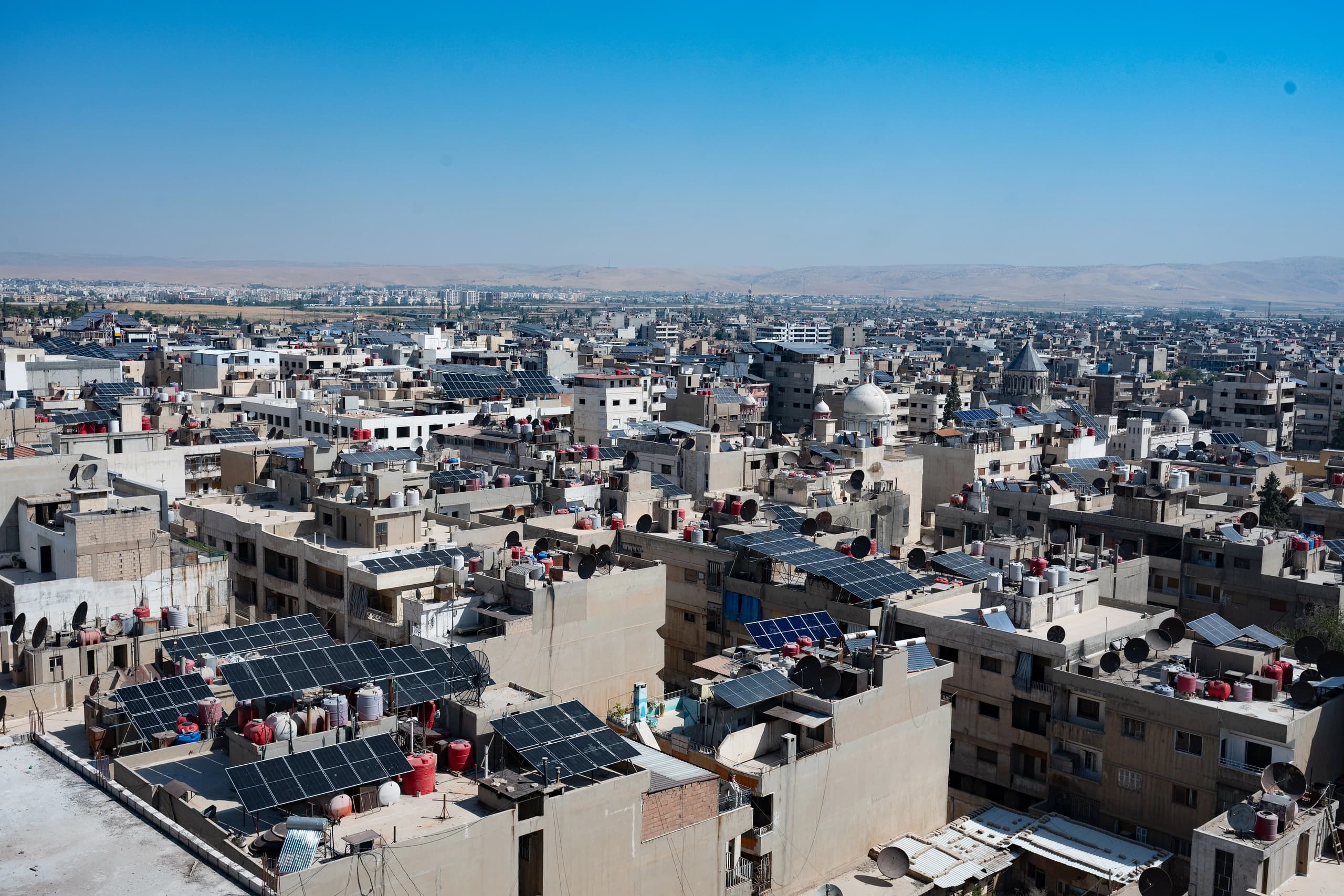

ERBIL, Kurdistan Region - Residents of northeast Syria’s Qamishli are increasingly turning to solar power as unreliable public electricity and soaring private generator costs strain household budgets, with some families selling gold or borrowing money to afford solar systems.
Demand for solar panels has surged in recent months as the cost of electricity supplied by private neighborhood generators has risen sharply.
“Over the past three months, there has been extremely high demand for solar panels because the price of electricity from private generators has risen significantly, reaching $20 to $25 per ampere per month,” Fadi Jardo, a solar panel supplier in Qamishli, told Rudaw.
At those rates, a household requiring 10 amperes of round-the-clock generator electricity would pay between $200 and $250 a month, or close to $3,000 a year, according to Jardo.
“That is why residents are considering [buying] solar panels, because for the same price they can get a complete system that provides 20 amperes of electricity, with lithium batteries that have warranties ranging from five to 15 years. There are also cheaper systems available between $1,000 and $1,500 that can provide eight amperes of electricity,” he said.
The upfront cost, however, remains beyond the immediate means of many households. Jardo said some residents have sold family gold and jewelry or borrowed from relatives to pay for the systems.
“Some people whom we know personally and who are not in a good financial situation are sold panels on credit or through short-term installment plans as a form of assistance so that they can benefit from them,” he said.
Importing solar equipment also poses challenges. Jardo said traders transport supplies from Jordan and Turkey’s southern port city of Mersin to Damascus before bringing them to northeast Syria (Rojava), with high customs duties making routes through the Kurdistan Region costly.
“If we want to bring our goods through Basra’s port [Faw], by the time they reach Rojava, we have to pay different duties around four or five times, which significantly increases the price,” he said.
The shift toward solar energy is already taking a toll on Qamishli’s private generator business.
Mohammed Marwan, the owner of a private generator serving around 250 subscribers, said demand for generator electricity has fallen dramatically over the past two months.
“Because of the high demand for solar panels, the number of our subscribers has decreased significantly over the past two months. For example, two months ago we were providing 1,300 amperes to subscribers, but now that figure has fallen to 300 amperes, and we expect it to fall even further next month,” Marwan told Rudaw.
He attributed the high cost of generator electricity mainly to diesel prices, saying he purchases fuel at 80 cents per liter.
Marwan’s generator receives government support, with part of its diesel supplied at a subsidized price of around one cent per liter. Electricity from generators operating eight hours a day costs around $5 per ampere.
Local authorities in Qamishli set the July price of 24-hour generator electricity at $25 per ampere, while an eight-hour unsubsidized service was priced at $12 per ampere.
Ala Rezan, a Qamishli resident who installed a solar power system, said high generator costs and environmental concerns drove her decision.
“The first was the very high price of 24-hour generator electricity, which was costing me nearly $200 a month. The second reason was protecting the environment, because people around the world are now turning to clean energy,” she told Rudaw.
The proliferation of private generators has also brought noise, pollution and sprawling electricity cables to Qamishli’s neighborhoods, according to Rezan.
“In Qamishli, all these private generators have caused dirty smoke and very disturbing noise throughout the neighborhoods and the city. In addition, their wires hang over streets and buildings like spider webs, making the city look ugly,” she said.
“Generators also frequently break down, leaving us without electricity when we need it. That is why solar energy is a more suitable and reliable solution,” she added.
The growing reliance on solar energy is not limited to Qamishli. Residents elsewhere in northeast Syria have increasingly turned to solar systems amid shortages of public electricity, rising fuel prices and mounting generator costs.

.png&w=3840&q=75)