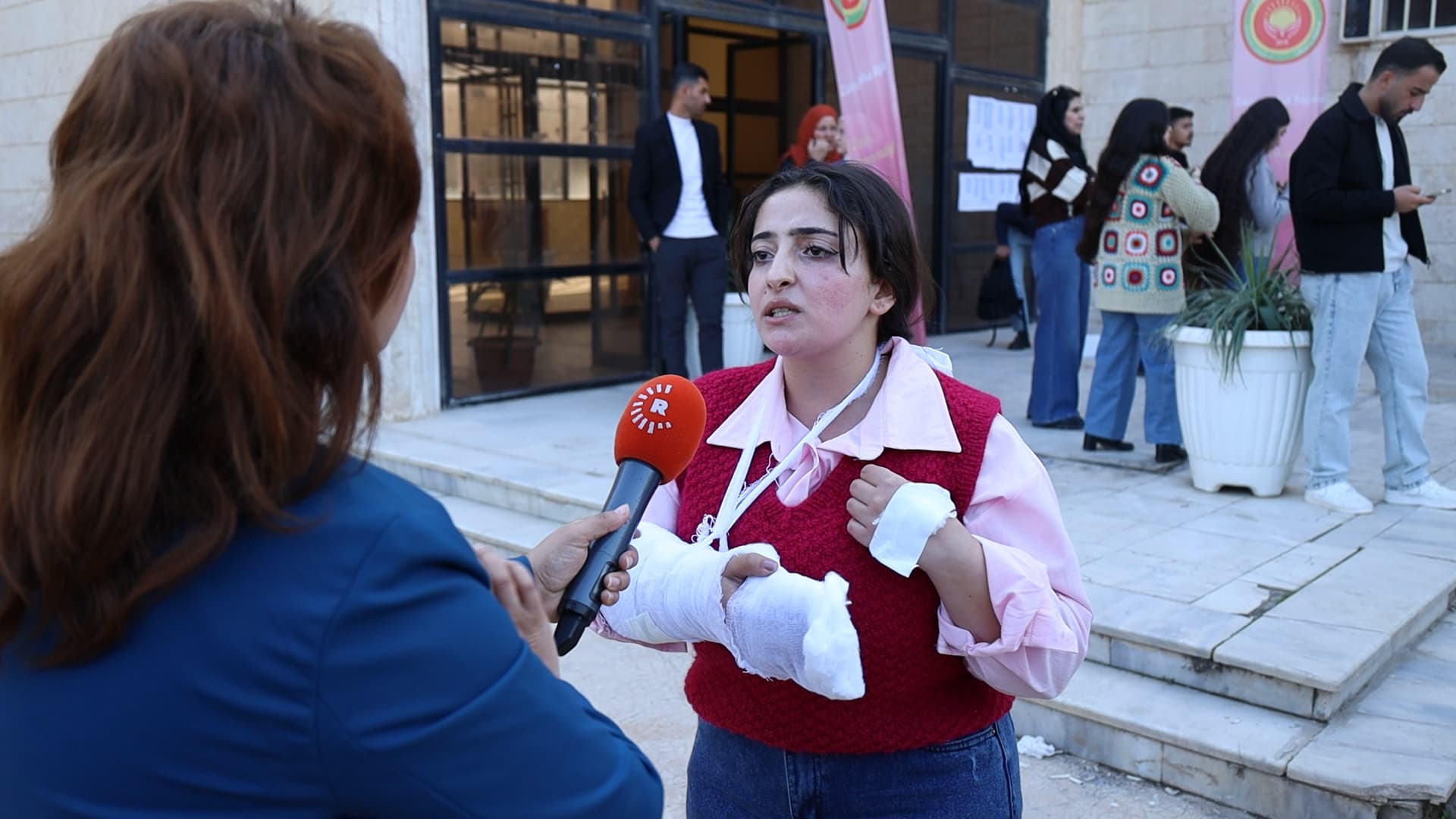
ERBIL, Kurdistan Region - Syrians headed to polling stations across Damascus-held areas to select members of the country's first post-Assad parliament on Sunday, in a process criticized by many as being undemocratic, as the new assembly is set to consolidate the power of Ahmed al-Sharaa.
Voting began at 9 am. The process is set to run until noon, with possible extensions until 4 pm “if all members of the electoral body have not cast their votes," state-run Syrian Arab News Agency (SANA) quoted Nawar Najmeh, spokesperson for the Higher Committee for People’s Assembly Elections, as saying.
According to SANA, nearly 1,600 candidates are vying for 210 seats, 14 percent of whom are women. Of these, 140 are selected through indirect voting by around 6,000 representatives from regional subcommittees, while 70 will be appointed by Sharaa under the constitutional declaration he approved in March.
The electoral committee formed subcommittees after visiting Syria’s provinces, choosing members reportedly drawn from local residents. These subcommittees constitute electoral colleges that represent their regions and are tasked with selecting 140 of the 210 members of parliament through indirect voting.
Once the polls have been closed, ballot boxes will be opened publicly for media coverage, and preliminary results will be broadcast live. The Higher Committee is set to announce the final results early next week.
Seat distribution released in August shows Aleppo province receiving the largest share with 32 seats, followed by Rif Dimashq, Homs, Hama, and Idlib with 12 seats each. Damascus and Deir ez-Zor were allocated 10 seats each, while Latakia and Tartus received seven and five, respectively. In the Kurdish-controlled northeast Syria (Rojava), Hasaka and Raqqa were assigned ten and six seats, and the southern Druze-majority Suwayda province three.
However, the electoral committee announced that voting in Hasaka, Raqqa, and Suwayda will be postponed due to what it described as “a lack of a secure and stable environment.”
Najmeh told Rudaw in August that elections in those provinces will take place once “appropriate security and political conditions” are restored.
In government-held areas of northern Syria, local committees were formed in Raqqa’s Tal Abyad (Gire Spi) and Hasaka’s Ras al-Ain (Sari Kani) to nominate parliamentary representatives. Both towns are currently controlled by Turkish-backed militia groups following Turkey’s 2019 Operation Peace Spring offensive against the Kurdish-led Syrian Democratic Forces (SDF).
The Democratic Autonomous Administration of North and East Syria (DAANES), which governs Rojava, has already slammed the vote as “exclusionary and undemocratic.”
Under the new electoral system, 70 percent of parliamentary seats are reserved for “competencies” - candidates who must hold a university degree or higher - while the remaining 30 percent are for “notables,” who must have at least a high school diploma.
Candidates and voters must have held Syrian citizenship before May 1, 2011, the date linked to a decree that granted nationality to many stateless Kurds. Candidates must be at least 25 years old, legally competent, and of good standing. Those linked to groups designated as terrorist organizations, former Ba’ath regime loyalists, or individuals who previously sought the presidency or advocated for foreign intervention are barred from running.
Members of the armed forces, senior officials, ministers, and governors are also ineligible to stand for election.