
ERBIL, Kurdistan Region - Devlet Bahceli, the leader of Turkey's Nationalist Movement Party (MHP) on Wednesday called for the release of imprisoned Kurdistan Workers' Party (PKK) leader Abdullah Ocalan and former Peoples' Democratic Party (HDP) co-chair Selahattin Demirtas, following his party’s submission of a draft law aimed at advancing Turkey's peace process.
"Ocalan should be granted the 'Right to Hope,' the Ahmeds should return to their duties, and Demirtas should return to his home," Bahceli told Millet News Agency on Wednesday, in added reference to Kurdish politicians and DEM party members, Ahmet Ozer and Ahmet Turk, who were removed from their posts as mayor of Istanbul's Esenyurt district and the southeastern city of Mardin, respectively.
"This historic step we have taken is the strongest guarantee of social reconciliation and national unity," Bahceli announced, hoping that the "signature we have placed brings goodness and blessings. Our thousand-year-old brotherhood has been reaffirmed once again. In this process, 86 million people will be winners," he said.
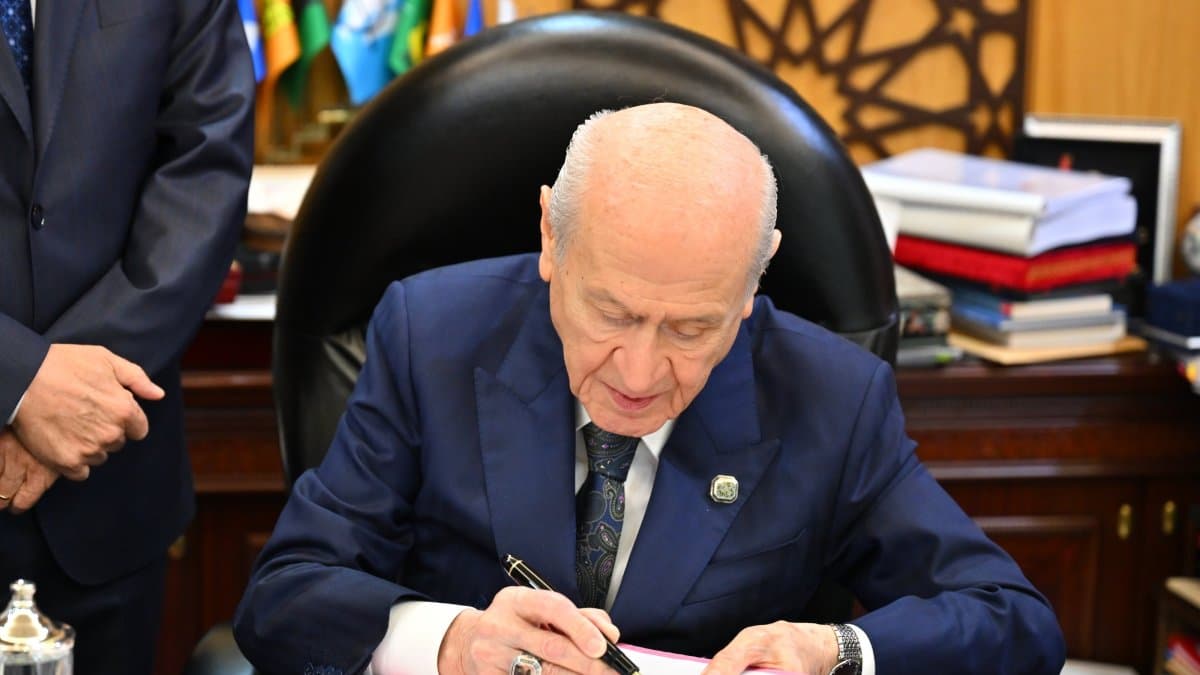
Bahceli signed his party's proposed bill for the renewed peace process in Turkey during a ceremony at the Turkish parliament on Tuesday, describing the legislation as a pivotal step for Turkey's future and regional stability.
The proposal, which outlines a legal framework for the return of PKK fighters and civilians from the Kurdistan Region of Iraq, details their proceedings and adjudication through the justice system and reintegration into society.
The bill comes amid joint efforts by Turkish and Kurdish parties to enact a legal framework for disarmament and the social reintegration of former militants who led armed struggles against Turkey in the last several decades.
The proposal is expected to undergo a review process by relevant parliamentary committees before lawmakers approve the legal framework this week, after it is formally submitted to the speaker of parliament.
Nearly two years ago, the PKK and Ankara initiated a peace process that has largely stayed intact despite delays and distrust.
Among the steps taken by the PKK are its decision to dissolve and lay down arms, the symbolic burning of some weapons, and its withdrawal from some strategic frontlines.
If Ankara proceeds with the bill and grants the process legal status, it would mark the government's first visible contribution to a process aimed at ending more than four decades of armed conflict that has claimed over 40,000 lives.
The "right to hope" refers to Ocalan's irreducible life sentence to conditional release. Turkey's decision to impose an absolute life sentence has been criticized by the European Union and various rights groups.
Bahceli applauded the initiative and said he has maintained contact with Demirtas through the former HDP leader's legal team despite not visiting him in prison.
"I have not visited Selahattin Demirtas. However, I communicate with him regularly through his lawyers and ask about his well-being. He also sends me his greetings. We have a good relationship. I also ask if he has any requests or needs. We worked together in the Turkish Parliament," Bahceli said.
Demirtas has been held in a prison in Istanbul since 2016 over alleged ties to the PKK.
A handshake between Bahceli - leader of an ultra-nationalist party and an ally of President Recep Tayyip Erdogan - and pro-Kurdish lawmakers on the floor of parliament in October 2024 marked the first visible sign of the process to resolve a four-decade-long armed conflict with the PKK.
The initiative led to meetings between a DEM Party delegation and Ocalan, followed by talks with other political parties.
Following Ocalan's February 27, 2025 'call for peace and a democratic society,' which urged the PKK to disarm and dissolve, the group declared a ceasefire on March 1, 2025. On July 11, 2025, a group of 30 PKK fighters symbolically burned their weapons in the Jasana cave near Sulaimani.
Turkey's parliament later established a special commission on the peace process, which approved a joint report in February 2026. Lawmakers are now working on legislation intended to implement the next phase of the initiative.