
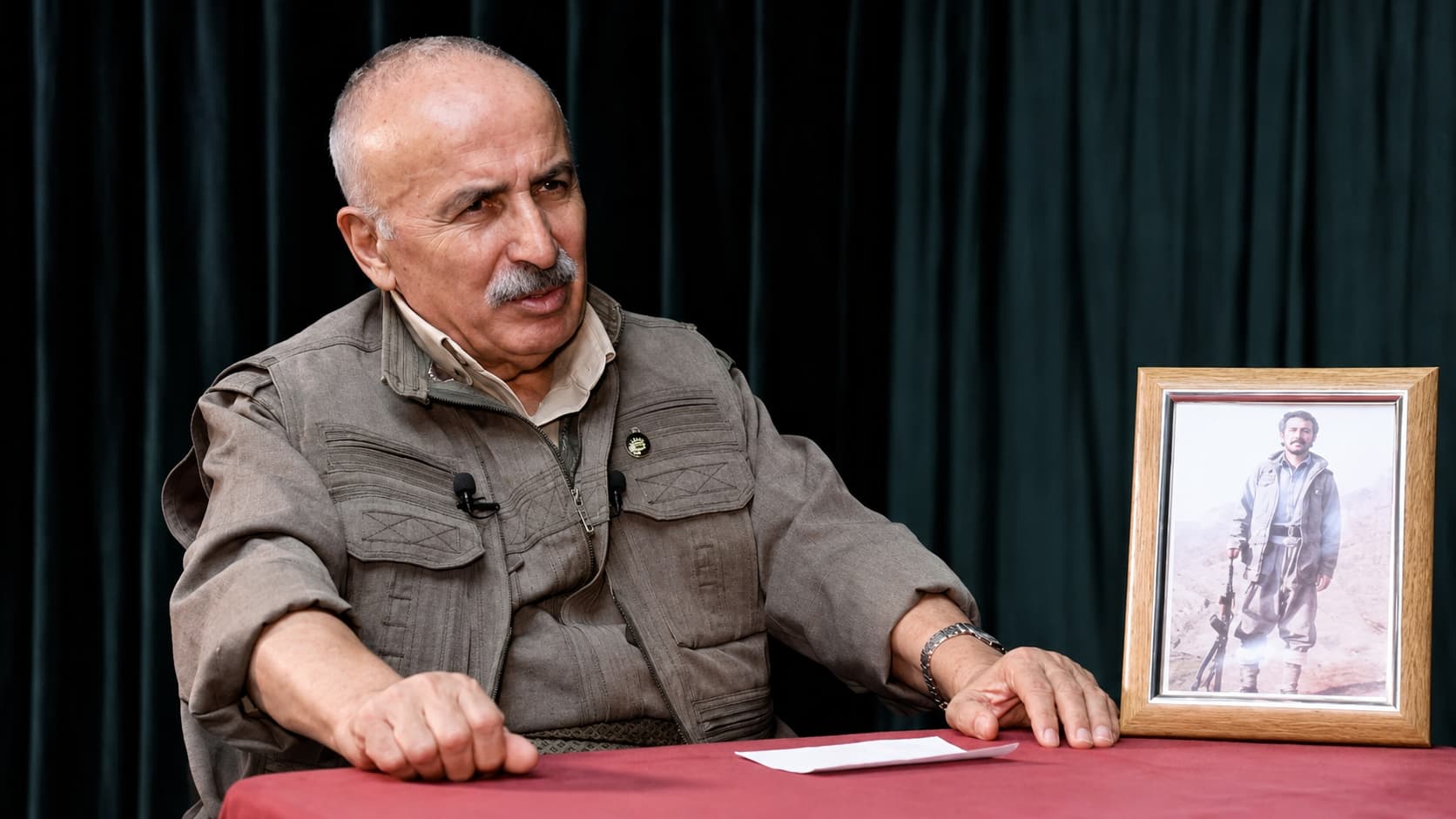

ERBIL, Kurdistan Region - A senior member of the Kurdistan Communities Union (KCK) Executive Council has criticized Turkey’s new framework law for failing to define the status and role of imprisoned leader of the Kurdistan Workers' Party (PKK) Abdullah Ocalan, saying his direct participation is essential for the peace process to move forward.
Mustafa Karasu, a senior member of the KCK, an umbrella organization consisting of several groups including the PKK, said the law was an important “first step” but did not address the core issues behind the conflict.
“The failure to refer to the resolution of the Kurdish issue in the law is considered a significant shortcoming,” Karasu said in a recent interview with the PKK-affiliated Firat News Agency (ANF) published on Wednesday.
“It concerns thousands of fighters. It concerns thousands of cadres. Yes, the PKK has dissolved itself, but there is still a community here,” said Karasu, affirming that, “without the direct and official participation of Ocalan, this law will not be effective."
The Kurdistan Communities Union defines itself as an umbrella of various democratic confederalist Kurdish parties in Turkey, Syria, Iraq, and Iran. The group promotes Abdullah Ocalan's model of democratic confederalism and has taken on a proactive role in weighing in on the peace process and tangible mechanisms of its implementation - issues which have a direct impact on its members.
Karasu's remarks come two days after the Turkish parliament approved the 12-article titled the "Law on Strengthening National Solidarity and Social Integration," with 467 votes in favor.
The law is expected to take effect after the Turkish National Security Council confirms the disarmament and dissolution of the PKK and the legislation is published in the Official Gazette.
Karasu said the legislation focuses too heavily on disarmament while failing to address the Kurdish issue and democratic reforms.
“The approach that says ‘if arms are laid down, everything will be solved’ is not sufficient,” he said. “Unless the underlying causes behind the issue are looked into, no issue can be solved.”
Karasu also objected to the use of terms such as “terrorist” and “terrorist organization” in the context of the process, criticizing the rhetoric used by officials and in the law as incompatible with efforts to establish peace.
“Peace begins first with language,” he said. “Unless the language and style change, and unless the approach changes, achieving peace will not be possible.”
Despite his criticism, Karasu said the legislation represented a beginning after months of discussions.
“This law is not a law that achieves the resolution of the Kurdish issue, but it should be evaluated as a first step toward a position aimed at achieving this end,” he said.
“Leader Apo [Ocalan] wanted to transfer the struggle to the political and legal ground,” Karasu said. “This should be viewed as a beginning.”
Karasu said the movement had ended its armed struggle and would pursue what he described as a “democratic-political struggle,” seeking to build a “Democratic Republic” through a democratic society and cooperation with democratic forces and Turkey’s opposition.
“There is a peace process. It is necessary to act carefully and consciously,” reiterated Karasu, insisting on the importance of establishing a democratic framework and its ramifications on the future of Kurds, in sharp contrast to what he characterized as a “careless approach” on the Turkish side.
“This law, too, has demonstrated a careless approach in this regard. Naturally, we have criticized it. In particular, the fact that this law does not use the term ‘Kurd’ at all, does not make any reference to or define future steps to be taken, and does not mention democratization - because this is crucial,” said Karasu. “This process can truly only move forward through democratization.”
The bill was jointly drafted by Turkish President Recep Tayyip Erdogan's Justice and Development Party (AKP) and the Nationalist Movement Party (MHP), and was also signed by the pro-Kurdish Peoples' Equality and Democracy Party (DEM Party), along with lawmakers from the opposition Republican People's Party (CHP).
The move comes 18 months after PKK leader Ocalan in February 2025 called on the group to lay down its arms and dissolve itself as a prelude to a political solution to the decades-long conflict with the Turkish state - a conflict that has claimed nearly 40,000 lives, mostly Kurds.
In May 2025, the group declared its dissolution and an end to its armed campaign, temporarily rebranding itself as the Kurdistan Freedom Movement and later in October, it announced the withdrawal of all its fighters from Turkey as part of its push for peace with Ankara.
RELATED: Turkish parliament passes partial amnesty bill for PKK members who disarm
.webp&w=3840&q=75)
.png&w=3840&q=75)