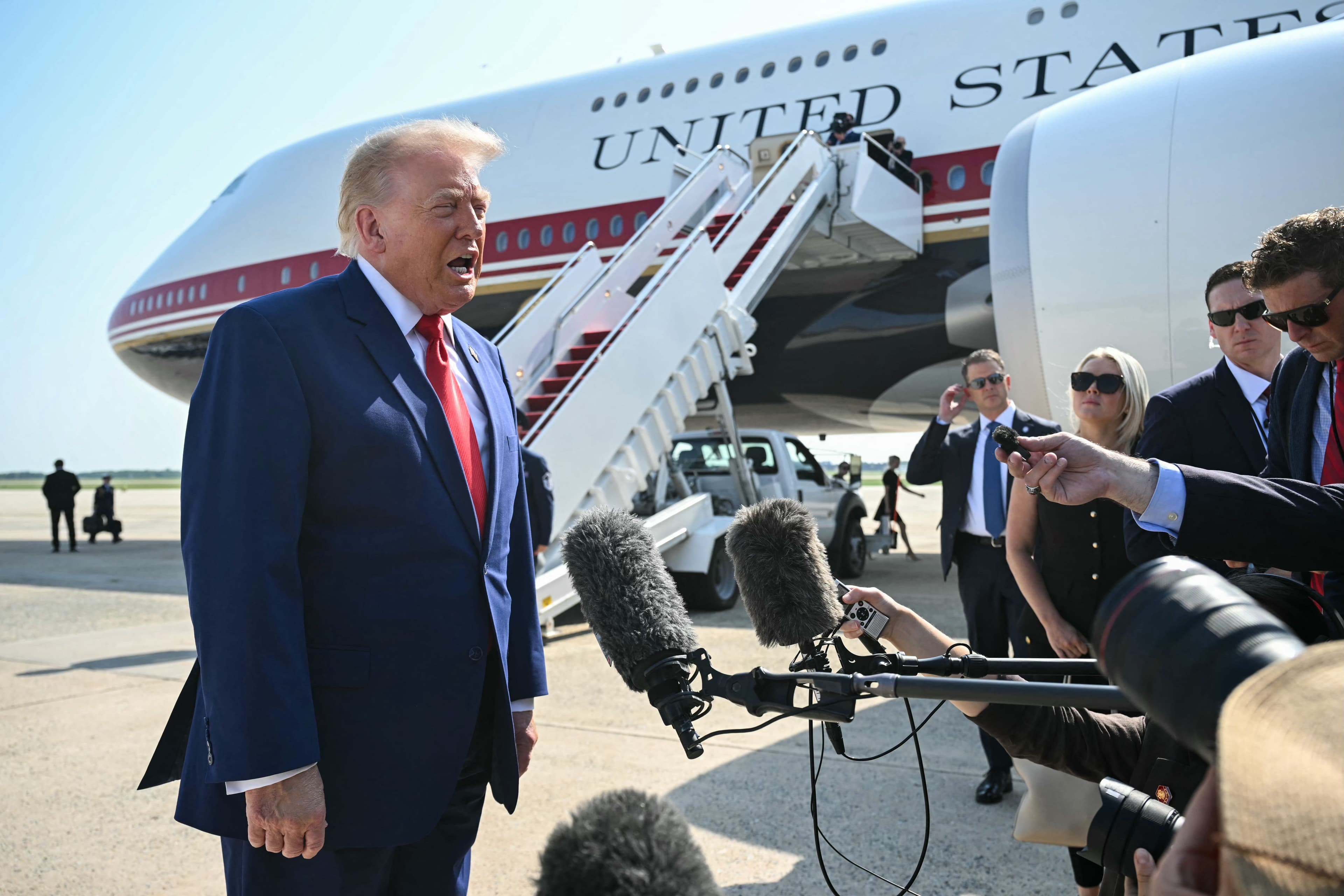

ERBIL, Kurdistan Region - US President Donald Trump warned Wednesday that a “bridge or power plant” will be struck and destroyed in Iran for every vessel Tehran targets in the Strait of Hormuz. This comes as strikes and counterstrikes between Tehran and Washington entered their fifteenth day on Wednesday, as the mid-June ceasefire understanding between them continues to unravel.
"From this point forward, any time the Islamic Republic of Iran shoots at a ship in the Strait of Hormuz - whether by missile, rocket, drone, or any other device or weapon - the United States will bomb and destroy one bridge or power plant," Trump said in a statement posted on his Truth Social platform.
The US president added that targets would comprise "those located next to, or in, the capital city of Tehran."
The sharp remarks came a day after Trump cautioned that the US would "absolutely attack" a deeply buried underground nuclear complex Iran is allegedly preparing at Pickaxe Mountain in central Isfahan province, adjacent to the Natanz nuclear facility - which US and Israeli military strikes targeted during the 12-day war in June 2025 and again earlier this year.
"We would absolutely attack ... the new site that they're talking about," the US commander in chief told reporters at the White House, reiterating that Iran "cannot have a nuclear weapon."
For its part, the US Central Command (CENTCOM) reported Wednesday that its forces had "completed the 11th consecutive evening of strikes against Iran" overnight, targeting "Iranian military operations centers, maritime capabilities, aircraft hangars, drone storage facilities, and military logistics infrastructure to further degrade Iran's ability to threaten commercial shipping in the Strait of Hormuz."
CENTCOM said that "over the past three months, Iran has attacked more than 30 commercial vessels" transiting Hormuz, in what it said "endangered hundreds of innocent mariners and undermined freedom of navigation."
It added, nonetheless, that the Strait "remains open for commercial vessel transit," noting that since early May, its forces "have helped facilitate the transit of approximately 900 commercial vessels and 450 million barrels of crude oil."
In parallel to the strikes, the state-run Islamic Republic of Iran Broadcasting (IRIB) said Wednesday that air defenses were triggered "in the west, east, and northeast of Tehran," and that explosions were heard in the southern port city of Bushehr, home to the Bushehr nuclear power plant.
Meanwhile, Iran's Islamic Revolutionary Guard Corps (IRGC) said Wednesday that "in retaliation" for the US strikes, its aerospace forces "pounded US bases in Jordan," detailing that "a missile and drone attack" was launched on the "King Faisal and Prince Hassan bases, where an F-15 preparation hangar was targeted."
"Furthermore, in an attack on a drone preparation hangar, eight brand-new MQ-9 drones in their original packaging were completely destroyed before preparation, and heavy damage was inflicted on two others that were in the courtyard," the Corps added.
"In a subsequent attack on a helicopter maintenance hangar, serious damage was inflicted on two heavy US helicopters," the IRGC said, pointing also to an "attack on a housing center" for US forces, which the Iranian military claimed had left "a number of them ... killed and wounded."
Hours earlier, the Corps claimed to have targeted "an early warning radar, a tactical radar complex around the Ali Al Salem base, and another radar system on Kuwait's Bubiyan Island, destroying these radars and taking them out of commission."
The escalation comes as Tehran and Washington have, since July 8, been locked in continuous strikes and counterstrikes, weeks after they signed the Islamabad Memorandum of Understanding in mid-June, which established a halt to military operations on all fronts and reopened the Strait of Hormuz to commercial shipping.
Iran and the US also committed to holding talks toward a comprehensive settlement within 60 days of signing, with room to extend by mutual consent. However, the latest developments suggest a return to the negotiating table will likely not happen anytime soon.