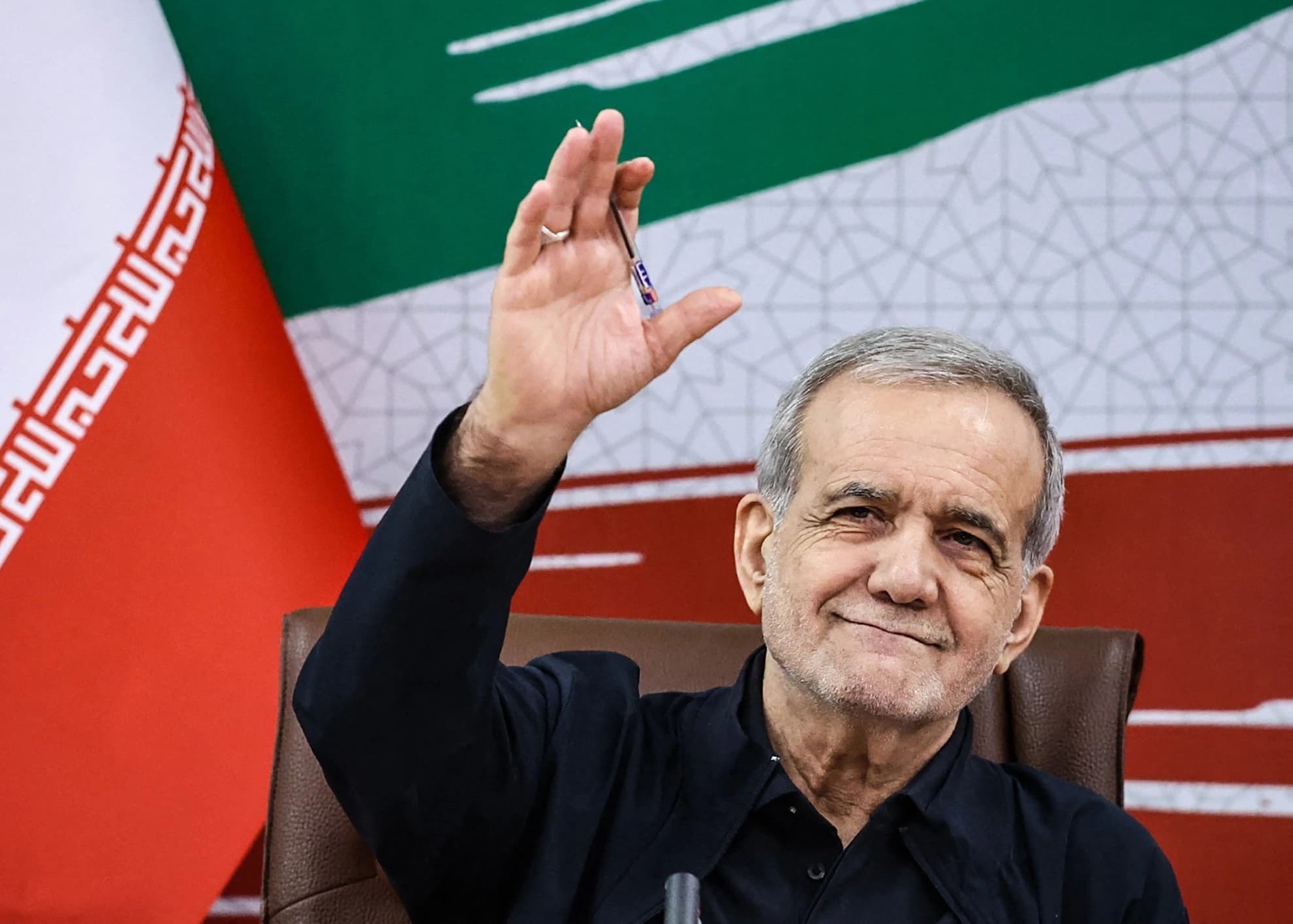

ERBIL, Kurdistan Region - Iranian President Masoud Pezeshkian said Tuesday that Tehran is willing to return to the June memorandum of understanding if the US resumes its “commitments,” following a return to strikes and counterstrikes between the two sides on Sunday.
"I am saying frankly that if the US returns to its commitments in the aforementioned Memorandum of Understanding, the Islamic Republic of Iran will immediately reciprocate,” Pezeshkian said at a Shanghai Cooperation Organization summit in Bishkek, Kyrgyzstan, according to a statement from the presidency’s office.
Strikes and counterstrikes between Washington and Tehran resumed following a month of intermission late Sunday, after an aerial strike by US forces on the southern Iranian island of Larak left casualties.
Iran has repeatedly maintained that it exercises sovereign control over the Strait, a vital waterway through which around one-fifth of global energy supplies transit, which has emerged as a point of contention between the US and Iran since the onset of the war when the US and Israel launched a joint aerial campaign on February 28 striking thousands of targets across Iran.
The two sides reached a preliminary ceasefire in early April, followed by the Islamabad Memorandum of Understanding (MoU) in mid-June, which established a truce and set a 60-day window for negotiating a final agreement that passed its deadline in August.
Some of the stipulations of the 14-point framework that Iran insisted upon have entailed ending the US blockade, withdrawing US forces from the Strait, US Treasury sanctions waivers on oil to enable immediate access to energy markets, release of frozen Iranian assets, and most notably, the “sovereign right” to impose a fee-collection system - a condition that the US and global bodies have unilaterally rejected.
Pezeshkian claimed Tuesday that the US commitment to the MoU “lasted less than two weeks” before the US's “excessive demands and reneging on its commitments” began and “still continues,” whose “violation” was met with a “proportionate response from Iran.”
On the sidelines of the summit, Pezeshkian met with India’s prime minister, the Kyrgyz president and leaders from Kazakhstan, the latter with whom he stated Tehran was “ready to pursue without reservation any initiative aimed at strengthening political, economic, scientific, cultural and other forms of cooperation” and that existing capacities offer “considerable room for further expansion,” according to semi-official Fars news agency.
During the summit, Pezeshkian presented three specific initiatives to members in the form of “deepening financial and banking cooperation, which includes the wider use of national currencies in settlements.”
Iran’s meetings with leaders of the summit signal a broader shift to alternate economic and financial partnerships, reflecting an urgent need for relief following Washington’s tightening enforcement on sanctions coupled with escalating hostilities.
The Iranian president rejected the new sanctions last week, saying they “will not achieve anything,” while reiterating on state television on Friday that “the route is closed and goods are not entering.”
Gasoline is one of those goods,” he said, directly linking the pressure to the war and blocked trade routes.
Pezeshkian added that government revenues had also fallen and that even if the route reopened, Tehran would still need the money to purchase additional gasoline.
He said the government intends to double the third-tier gasoline price from 5,000 tomans ($0.025) to 10,000 tomans ($0.05) per liter, although the timing has yet to be finalized.
This comes as the US on Friday moved to sever the Emirati branch of Egypt's second-largest bank from the US financial system, calling it a "critical node" for Iranian illicit finance amid a widening crackdown on Tehran's global economic lifelines.
As part of its sweeping sanctions package dubbed Operation Economic Outcast, designed to aggressively curtail Iran's military capabilities and sever primary revenue streams, the US Treasury proposed a rule to revoke Banque Misr UAE’s correspondent banking access to US financial institutions in addition to sanctions on Bank Melli Dubai manager Reza Mohammad Taeedi, along with a Hong Kong-based front company that has “helped launder funds for a sanctioned Iranian exchange house.”
According to the Treasury’s Friday press release, Banque Misr UAE processed approximately $1.8 billion for 103 companies that are potentially part of the Iranian “shadow banking network” via front companies to evade US sanctions and launder money on behalf of Iranian Supreme Leader Mojtaba Khamenei.
While Iran on Sunday said it is in no hurry to reopen the Strait of Hormuz despite reaching an understanding with Oman, Pezeshkian’s increased interest in achieving “sustainable security” with its west Asian neighbors amid calls “for the simultaneous strengthening of security and economic cooperation in the Shanghai Cooperation Organization,” coupled with a willingness to return to the MoU, suggests that the US naval blockade has its grip on Iranian trade and Tehran risks being pushed into a worsening economic crisis.
.png&w=3840&q=75)