
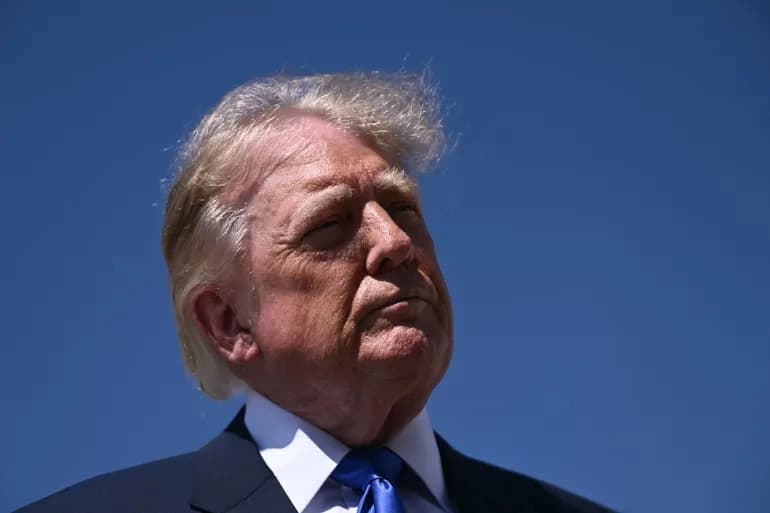

ERBIL, Kurdistan Region - US President Donald Trump expects the war with Iran to end “immediately after” November's midterm elections, dismissing prospects for ceasefire talks with Tehran in the interim, while signaling further strikes on Iranian vessels in regional waters. This comes as Tehran says it has expanded its “prohibited zone” beyond the strategic Strait of Hormuz to cover waters as far as the Arabian Sea.
“I think the war is going to end immediately after the [midterm] elections ... because they can't hold out any longer,” Trump told reporters at Joint Base Andrews in Maryland on Wednesday, adding that Iranian leadership was “desperate to try and affect the election.”
On the prospect of renewed war-end talks with Tehran, Trump said a negotiation "could possibly happen" but that Washington was not seeking one. “Originally, I wanted to make a deal,” he said, adding, “We're so far down the line; they have very little country left right now, so we're not looking for it.”
Trump’s remarks come against the backdrop of renewed tit-for-tat strikes between Iran and the US in regional waters.
“The sounds of several explosions were reported in the coastal areas of Sirik, Qeshm, and Minab County” in the southern Hormozgan province, Fars News Agency, an affiliate of Iran’s Islamic Revolutionary Guard Corps (IRGC), reported on Thursday. Fars cited the Hormozgan governor's office as stating that “the source of the sounds came from the direction of the sea.”
The blasts were also confirmed by state-run Islamic Republic News Agency (IRNA) which reported that several areas in Sirik were hit by “hostile projectiles” without providing further details. Meanwhile, Tehran’s national Islamic Republic of Iran Broadcasting (IRIB) reported that “an explosion was heard from the Strait of Hormuz.”
Earlier on Wednesday Fars said that “an explosion was heard in the southern areas of the port city of Jask, coming from the sea,” as Iran's semi-official Mehr News Agency reported late Wednesday that “several explosions were heard in the cities of Bandar Abbas and Sirik” in Hormozgan as well.
The reports come as the IRGC said Wednesday that it targeted two US vessels, eight oil tankers and ten other ships attempting to cross what it called a “prohibited and unsafe zone” of the Strait of Hormuz.
In a statement carried by IRNA, the Corps said the attacks were “in response to the aggression” of the US military which struck “five Iranian oil tankers in the Persian Gulf.”
The US Central Command (CENTCOM) confirmed that its forces “destroyed five Iranian crude oil carriers” in regional waters after the IRGC “targeted a U.S. Navy warship with ballistic missiles twice over the past two days,” adding that the warship “successfully evaded the attempted Iranian attacks" and that "no American personnel were harmed.”
“Iran has used the tankers as part of a multibillion-dollar shadow network that funds the IRGC and its regional proxies,” CENTCOM added, noting that its forces had destroyed three other Iranian crude oil carriers on Saturday “after the IRGC tried to attack a U.S. aircraft carrier and guided-missile destroyer.”
Trump on Wednesday said the attacks off Iran’s southern coast are “by us, we've knocked out nine of their ships and you're going to see a lot more,” he told reporters.
IRGC Spokesperson Brigadier General Hossein Mohebbi said Wednesday that Iran is expanding its maritime control zone beyond the Strait of Hormuz to include waters off its southeastern port city of Chabahar, extending across the Sea of Oman and into the Arabian Sea.
“The scope previously designated for managing vessel traffic was not limited strictly to the Strait of Hormuz, and now the domain of this scope has broadened," he said, adding that "part of this scope begins around Chabahar and encompasses routes in the Sea of Oman and the Arabian Sea."
“Exact coordinates” as well as “details of potential measures and restrictions will also be announced at the appropriate time,” Mohebbi added.
The Strait of Hormuz - a major energy chokepoint through which roughly one-fifth of global oil supplies pass - has been a flashpoint since the war's outbreak in late February, when the US and Israel launched a joint aerial campaign striking thousands of targets across Iran over six weeks.
Tehran responded with drone and missile strikes across the Middle East, targeting alleged US assets in Gulf Arab states and launching retaliatory strikes against Israel.
The warring sides reached a preliminary ceasefire in early April, followed by the Islamabad Memorandum of Understanding in mid-June, which established a truce and opened a 60-day window for negotiating a final agreement. Despite the MoU, both sides have traded repeated rounds of strikes.
Moreover, tensions in the Strait of Hormuz remain elevated, with a US naval blockade on Iranian ports still in effect and Iran continuing to assert sovereignty over the key waterway, forcing commercial vessels to seek authorization for passage.
Mohebbi on Wednesday described the Strait as "one of the decisive elements in the global order and the outcome of the war,” saying Iran exercises “effective management and authority” over the region by virtue of its “geography, operational capacity, and weapons capabilities.”
He added that whereas previously Iran had treated the Strait itself as the primary zone of confrontation, "now the intended zone is much wider."

.webp&w=3840&q=75)
