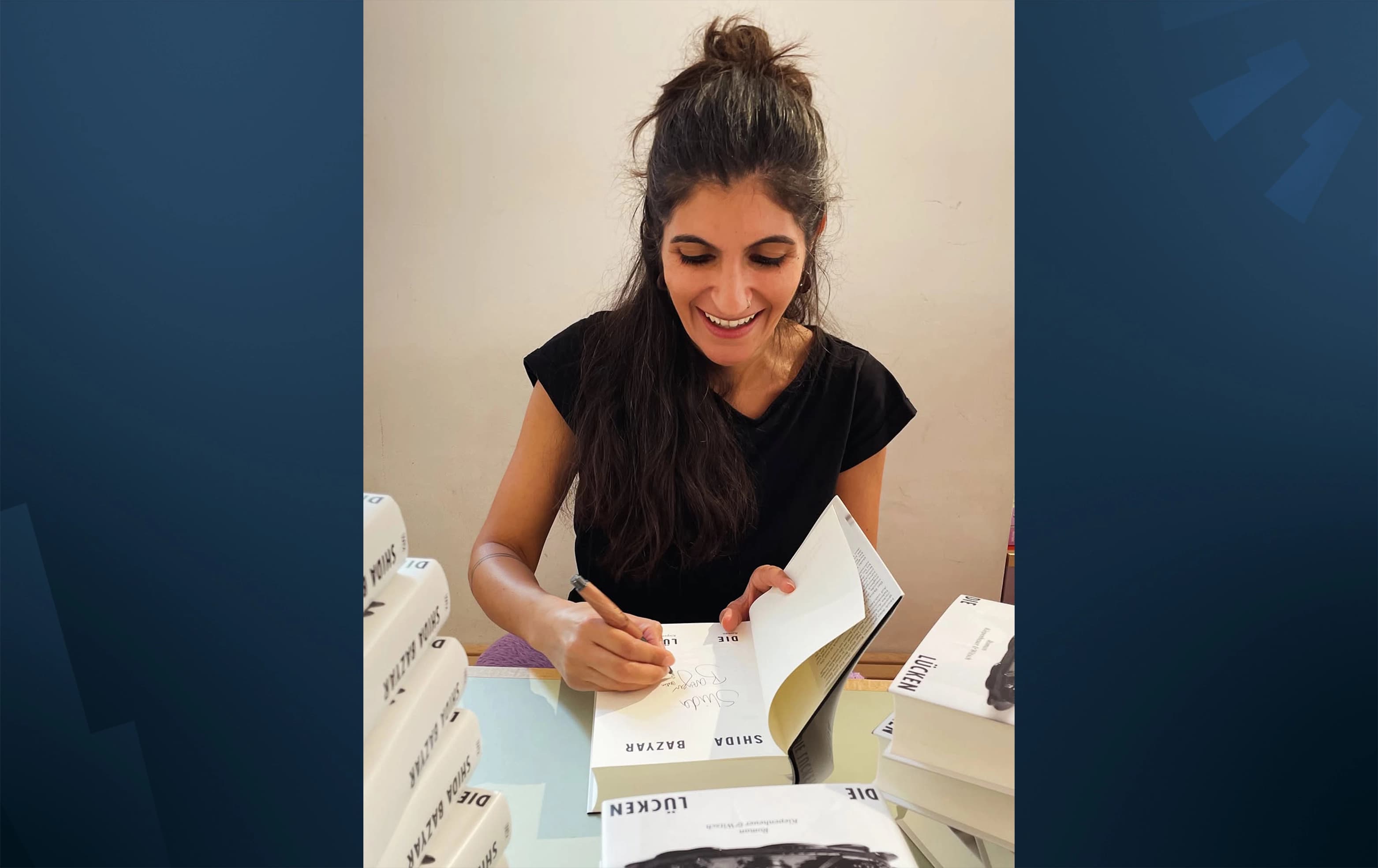

ERBIL, Kurdistan Region - Kurdish-German author Shida Bazyar, the daughter of Iranian-Kurdish political refugees, won the 2026 German Book Prize on Monday for Die Lücken, a novel linking the buried Nazi past of a small German town with the arrival of Iranian refugee families decades later.
Bazyar received the 25,000-euro award at Frankfurt’s Römer city hall for the 512-page novel, published by Kiepenheuer & Witsch in September. The German Book Prize jury selected Die Lücken, translated in English as "Omissions," from among 205 novels considered for this year's award.
The jury described the book as a “novel that stands against indifference,” praising Bazyar’s compelling use of "a dead narrator and the text's kaleidoscopic structure" moving between different periods in combining historical research with fiction.
Bazyar used her acceptance speech to connect the novel’s examination of Germany’s past with present-day concerns over antisemitism, racism and the treatment of minorities. She said uncovering what happened in her hometown challenged the idea that Nazi crimes were confined mainly to Germany’s major cities rather than small towns and villages.
“Antisemitic and racist crimes are at their peak,” she said, according to German public broadcaster ARD, urging people against the normalization of extremist rhetoric.
Die Lücken unfolds in Heimesbach, a fictional town in Germany’s Hunsrück region modeled partly after Hermeskeil, the western German town where Bazyar was born and raised.
Across roughly 90 years, the novel follows Jewish families persecuted under the Third Reich (1933 -1945). Heimesbach outwardly offers refuge to newcomers behind a veiled backstory of residents who participated in and benefited from their dispossession and later presented themselves as innocent bystanders, contrasting with the Sharifi and Karimpour families, who fled Iran decades later and sought safety and refuge in the same community.
Hermeskeil, which provides much of the historical foundation, became a Nazi stronghold and was promoted during the Third Reich as a Gaumusterdorf, or model community intended to embody Nazi ideals. Bazyar has said that she grew up passing a memorial connected to the town’s destroyed synagogue without fully understanding how the persecution of Jewish residents related to the place around her.
The novel shifts between the narratives of victims, perpetrators and later generations, rather than treating the end of Nazi rule as a clean break from the past.
German public broadcaster Deutschlandfunk also described the book as a portrayal of Kurdish and Iranian people seeking refuge in Germany.
Bazyar told Vogue Germany that she had long absorbed a version of Nazi history in which perpetrators were the distant “other” rather than ordinary people with whom later generations might recognize uncomfortable similarities.
In addition to providing the novel's thematic context, Hermeskeil occupies a unique and pivotal space in Bazyar’s family history; it was the first town that welcomed her Kurdish parents seeking political asylum after fleeing Iran.
Bazyar has said her parents’ experience rendered the story a second historical layer. In an interview published shortly before Monday’s award, Bazyar said the connection between her parents’ arrival in Germany juxtaposed against the Nazi history of Hermeskeil was central to the project.
Germany’s postwar constitutional protection of political asylum itself emerged partly from the lessons of Nazi persecution, she stated.
Her parents fled Iran before her birth after involvement in political activism, according to Bazyar. In an interview with the International Booker Prize earlier this year, she said she spent hours interviewing them about their political lives in Iran and the factors that led them to flee to Germany while researching her first novel.
Born in Hermeskeil in 1988, Bazyar later studied literature in Hildesheim and worked for years in youth education. She now resides in Berlin.
Bazyar's 2016 debut novel Nachts ist es leise in Teheran - The Nights Are Quiet in Tehran - was shortlisted for the 2026 International Booker Prize, while Die Lücken was awarded the 30,000-euro Wilhelm Raabe Literature Prize in September. Bazyar is due to formally receive that award in November.
Her debut follows an Iranian-Kurdish family over four decades, beginning with a young communist revolutionary during the 1979 revolution before moving to the family’s exile in West Germany and later returning to Iran through the experiences of the next generation.
The novel explores the overthrow of the Iranian monarchy, the Islamic Republic’s consolidation of power, political repression, exile and the 2009 Green Movement. Its English translation by Ruth Martin reached the International Booker Prize shortlist this year.
Her second novel, Drei Kameradinnen, published in 2021 and translated into English as Sisters in Arms, examined friendship, racism and belonging among three young women in Germany. It was longlisted for the German Book Prize. Bazyar received the Ernst Toller Prize in 2023 for her literary work.
Her first two novels have sold more than 120,000 copies and have been translated into around 20 languages, according to her publisher.
Die Lücken ties in many of the themes prevalent in Bazyar’s earlier work, including exile, migration and belonging.
Bazyar is also an outspoken advocate for Kurdish and minority rights in Iran.
In an interview earlier this year, Bazyar described the 2022 “Woman, Life, Freedom” uprising as a movement that began in Iran’s Kurdish regions and grew out of a long tradition of feminist activism.
“It began in Kurdistan, a region where people were oppressed by both the Islamic Republic and the Shah [monarchy],” said Bazyar, while the protest movement sparked by the death of Kurdish woman Zhina Mahsa Amini forged critical alliances among Kurds, women, members of the queer community, and other minorities - movement that represents, in her view, a foundation for a more democratic Iran.