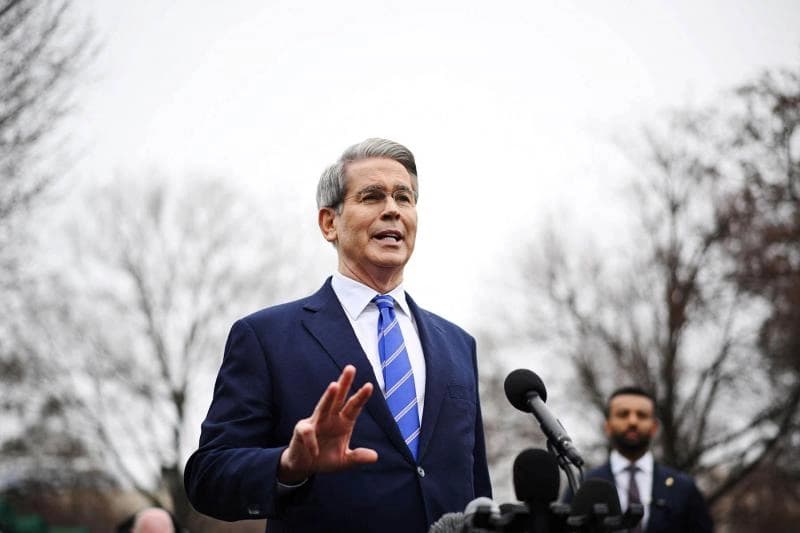

ERBIL, Kurdistan Region - US Treasury Secretary Scott Bessent said Sunday that Washington’s expanding sanctions and naval blockade have left Iran economically isolated, as Tehran reported another oil tanker explosion in the Strait of Hormuz and threatened vessels violating its navigation rules.
“This is a full-throated attack on their economic system like has never been seen before,” Bessent told Fox News, referring to Washington’s intensified economic pressure campaign against Tehran.
“Iran now has no oil on the water, they have negative cash flow, we have cut them off, we have cut off their airline service to the world,” he claimed.
The remarks come amid renewed attacks on commercial shipping in the Strait of Hormuz, a critical global energy route, where the United States is enforcing a blockade on Iranian ports while Tehran maintains that it controls passage through the waterway.
On Sunday evening, the Islamic Revolutionary Guard Corps (IRGC) Navy announced that a crude oil supertanker had struck a naval mine in the southern part of the strait, causing an explosion and a fire in its engine room.
According to the IRGC, the tanker had switched off its navigation systems and was attempting to leave the strait through an unauthorized route. It claimed the incident was the third involving a tanker striking a mine since Saturday.
The IRGC warned that vessels in the strait that switch off their navigation and identification systems would be considered hostile and confronted.
Bessent, meanwhile, argued that US military operations had largely curtailed Iran’s ability to disrupt shipping, claiming that approximately 1.2 billion barrels of oil had passed through the Strait of Hormuz since the US-Israeli war against Iran began in late February.
“What they [Iranian armed forces] are doing is every night they throw up some UAVs, they are blind, they don't have radar, and occasionally they will nick a ship, but the ships are going through,” ge saudsaid.
Washington resumed a naval blockade on vessels entering or departing Iranian ports on July 14, following the collapse of an interim agreement reached after nearly six weeks of conflict.
On Saturday, US Central Command (CENTCOM) said its forces had disabled four commercial ships and turned back another 135 since the blockade resumed. It also reported destroying 10 oil tankers linked to the IRGC’s oil-smuggling network.
The latest US operation involved a Panama-flagged cargo vessel, M/V Ocean Molica, also known as Arika Sun, which CENTCOM said was struck by an American fighter jet in the Gulf of Oman after its crew ignored repeated warnings and attempted to breach the blockade.
THe strike disabled the vessel’s propulsion system without injuring its crew, according to CENTCOM.
In late August, Washington launched Operation Economic Outcast, expanding sanctions against Iran’s financial, maritime, aviation, technology and other sectors in an effort to sever Tehran’s remaining economic connections.
On Thursday, the US Treasury imposed new sanctions on 17 vessels it accused of transporting Iranian oil and petroleum products through the country’s remaining shadow fleet network.
Bessen said Sunday that the campaign had isolated Iran from the rest of the world.
Meanwhile, Mohsen Rezaei, the head of Iran’s Supreme National Security Council, accused the Trump administration of “smuggling” in the waterway while claiming control over the strategic waterway.
"He [Donald Trump] claims every day that the Strait of Hormuz is open, but in response I say: You are engaging in smuggling, but the strait is under Iranian control and we are managing it,” Rezaei said in a statement carried by state media on Sunday.