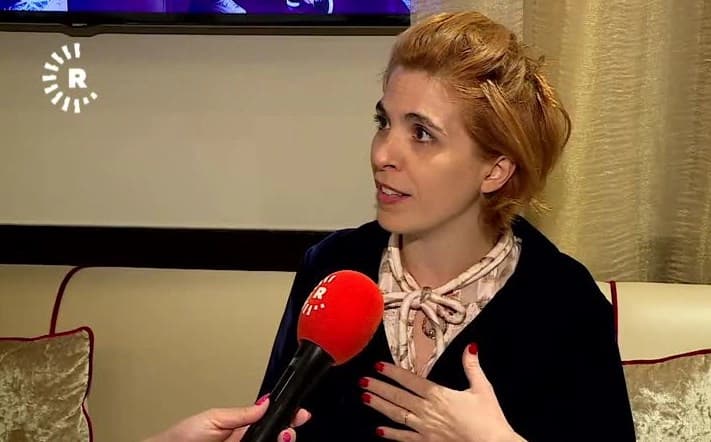

Husson explains why some roles were given to non-Kurdish actors, and why emblems and insignias on uniforms were changed. She adds that she conducted extensive research and many interviews to learn about Yezidis and the ‘complex situation.’ Husson hopes the film will be screened in other places after its release this fall. It was acquired by Cohen Media Group.
In your Sunday press conference, you said that you belong to a family who are victims of fascism. Why did you direct the 'The Girls of the Sun?'
My grandfather enlisted as a soldier when he was 16 to fight fascism in Spain. He was Spanish. He was a communist. He then had to exile himself from Spain in 1939 when the republicans lost the war against France. So he walked to France and stayed in a concentration camp, came to Paris, and became part of the resistance. All of this is a big part of my family. When you have such a heavy history in your blood, it has a big mark on your imagination and what you want to do later on so I always knew I wanted to do a movie about the Spanish civil war at one point.
When I came across the story of these women who were held captive and had escaped and became fighters, and when I started researching about the Kurdish fight, it was really surprising and impacted me because so many things were in common with the
 I went to Makhmour. I visited these women who had escaped.
How did you become familiar with Yezidi women and fighters? How did you make contact with them so you could direct this film?
At first, I knew about the Kurdish women, but as a French woman I didn't know much. I started reading a lot about it because I'm from an academic background, so that was my first contact. I read a lot of books. I read a lot of books about the Yezidi people as well. Then I went to Kurdistan, I went to Erbil, Duhok, I visited the refugee camp of Sharia. I went to Makhmour. I visited these women who had escaped. I interviewed a lot of survivors. I went to Germany, I went to France where there is a strong Yezidi community. I met with Aminah Sa'id, her husband, and Vian Dakhil, Abu Shuja'. I met with a lot of women who could give me information, and a lot of war reporters as well, that I could really research.
Why did you choose Golshifteh Farahani as the main actress? Why did not you choose a Yezidi or Kurdish woman?
To be very honest with you, it was very hard to find the actress that could make the movie happen. I know a lot of people do not
if I've made cultural mistakes, people don't think that I'm going one way or another.
You talk about a story in the movie which is still alive. When you talked about Yezidi girls and fighters, did you change the logos? I cannot see the Peshmerga's insignia and you have changed Kurdistan Region's. Why?
When I went to Kurdistan, I realized again that once again it was very similar to what happened in Spain between 1936 and 1939. There were a lot of different groups that they don't all agree with one another. It's very complex and I'm really aware of that. My grandfather was a communist, my great-uncle was an anarchist and it's a complex situation. I figured that if I stayed with all the
the movie is released in the fall, we're going to involve a lot of the Kurdish networks in France
I tried to be as discreet as possible about the Yezidi women and the Yezidi people because when I visited Lalish and when I talked to the people who were in charge there, I got the strong feeling that they wanted to be as discreet as possible, and not to be exposed, and I respected that. I didn't want to be intrusive and I didn't want to be disrespectful. That way, if I've made cultural mistakes, people don't think that I'm going one way or another. It's really the world of the movie and everybody that knows a little bit about the geopolitical situation knows who's who in the movie. I tried to make that very clear.
What is your plan after the Cannes festival is over? Do you intend for it to be presented in Kurdistan? What is your message for the viewers of this film?
Right after the festival it's going to be very calm, but what's going to happen when the movie is released in the fall, we're going to involve a lot of the Kurdish networks in France, and we're going to do screenings with people who are going to intervene and talk. I'm
Everybody was crying after the projection at the screening