کوردیKURDÎENGLISHTÜRKÇEعربي
Rudaw Logo
Live
Kurdistan
Middle East
OpinionsAnalysisWorldECONOMYInterviewCultureMultimedia
Live
Rudaw

Download the Rudaw app

App StoreGoogle Play
Privacy Policy•Terms of Use

© 2026 All rights reserved.

Rudaw

Download the Rudaw app

App StoreGoogle Play
Privacy PolicyTerms of Use

© 2026 All rights reserved.

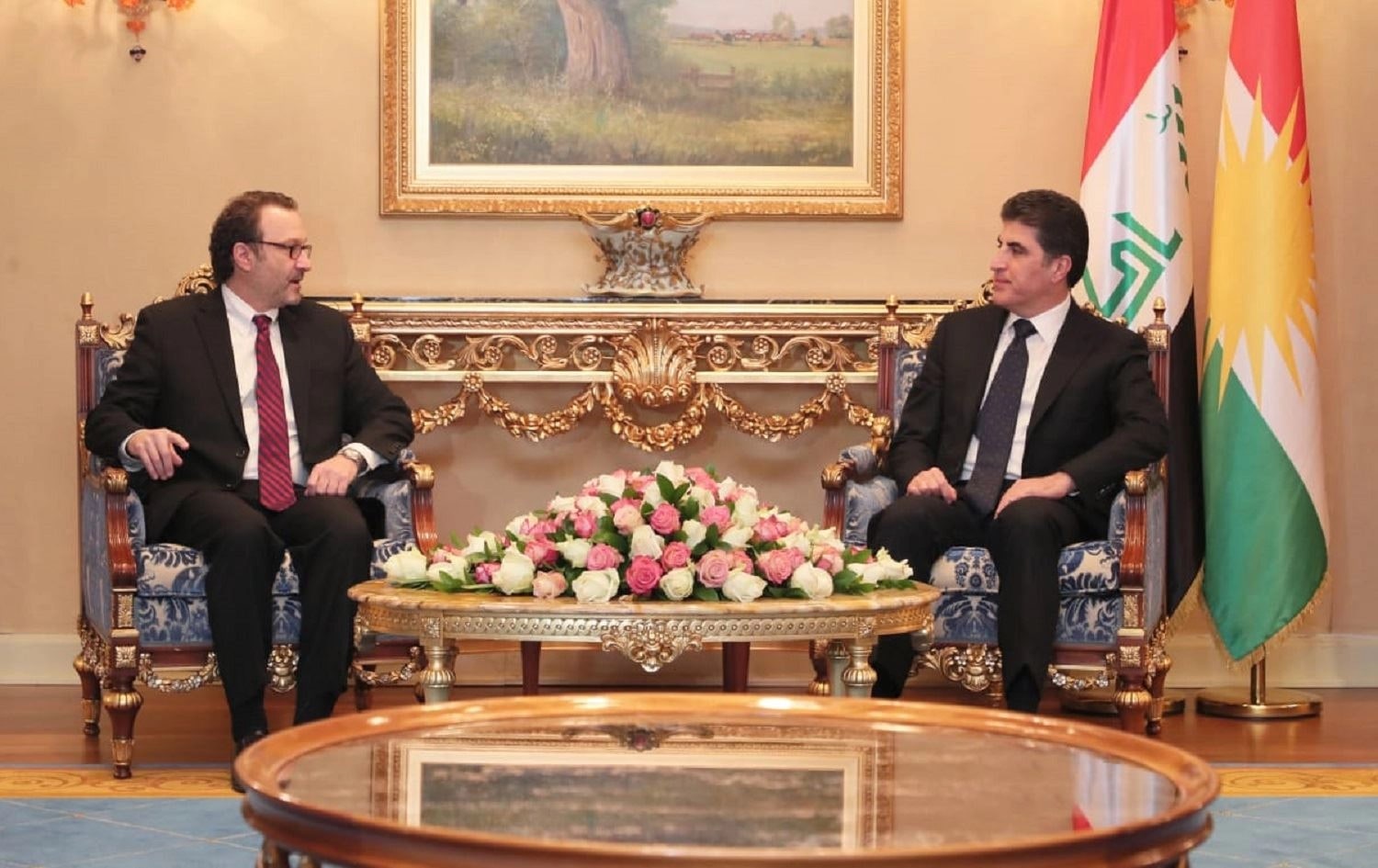
US Assistant Secretary of State for Near Eastern Affairs David Schenker (left) meets with President of the Kurdistan Region Nechirvan Barzani in Erbil on January 9, 2020. Photo via presidency website

US Assistant Secretary of State for Near Eastern Affairs David Schenker (left) meets with President of the Kurdistan Region Nechirvan Barzani in Erbil on January 9, 2020. Photo via presidency website

Kurdistan

Top American official discusses de-escalation of US-Iran tensions in Iraq with Kurdish leaders

Karwan Faidhi Dri

Karwan Faidhi Dri

09-01-2020
Listen
0:00
0:00
Text Size

Senior editor Karwan Faidhi Dri is an Erbil-based Kurdish journalist covering Kurdistan Region, Iraq, Turkey, and Syria.

Karwan Faidhi Dri
Karwan Faidhi Dri09-01-2020

Senior editor Karwan Faidhi Dri is an Erbil-based Kurdish journalist covering Kurdistan Region, Iraq, Turkey, and Syria.

Related Articles

Kurdistan finance minister warns of ‘existential threat,’ signals readiness to return to former post
Kurdistan24-11-2026

Kurdistan finance minister warns of ‘existential threat,’ signals readiness to return to former post

Disputes must be resolved through the constitution, not ‘military language’: President Barzani
Kurdistan24-11-2026

Disputes must be resolved through the constitution, not ‘military language’: President Barzani

Three attack drones target KDPI camps in Kurdistan Region
Kurdistan24-11-2026

Three attack drones target KDPI camps in Kurdistan Region

ERBIL, Kurdistan Region – The US Assistant Secretary of State for Near Eastern Affairs met with senior Kurdish officials and political leaders on Thursday to discuss the need for dialogue to de-escalate the situation in Iraq, as intensified tensions between Washington and Tehran play out on Iraqi territory. 

David Schenker’s visit to the Kurdistan Region follows a series of airstrikes on targets on Iraqi soil, by the US on one side and Iran and its Iraqi proxies on the other.

A US drone strike killed Qasem Soleimani, commander of Iran’s Islamic Revolutionary Guard Corps (IRGC), and the deputy leader of the Iranian-backed Popular Mobilization Forces (PMF), locally known as Hashd al-Shaabi.  Iran responded to the death of the commander by firing almost two dozen missiles at bases hosting US troops in Erbil and Anbar. The US reported no casualties among its personnel.

US President Donald Trump said late Wednesday that his country would impose “additional punishing economic sanctions” on Iran. He said on Thursday that these sanctions have already taken effect. 

In his meeting with Masrour Barzani, Prime Minister of the Kurdistan Region, Schenker agreed with the premier “on the need for dialogue to de-escalate the situation in Iraq,” according to a tweet by Barzani.  

“I restated the [Kurdistan Regional Government] KRG’s concern about recent events and their implications for the people of the region. We agreed on the need for dialogue to de-escalate the situation in Iraq,” read the tweet. 

The US official also “welcomed the Kurdistan Regional Government’s role as a partner and an advocate for peace and stability in the region,” according to a readout from the PM’s office. 

US officials, most notably Secretary of State Mike Pompeo, have been in contact with Kurdistan Region officials in the last few days to discuss the heightened tensions. 

Among topics touched upon by Schenker and President Barzani was the possibility of the “re-emergence of terrorism and how to fight it with the support of the Global Coalition,” according to a readout from President Nechirvan Barzani’s office. 

The US Assistant Secretary and Qubad Talabani, the Region’s deputy prime minister, agreed that “it is necessary to calm and contain the present situation in Iraq,” tweeted Talabani.

Schenker also met with Masoud Barzani, leader of the ruling Kurdistan Democratic Party (KDP) and former president of Kurdistan Region.    

The KDP leader "emphasized the importance of continuing the status quo insofar as the presence of the U.S.-led coalition in concerned, adding that the threat of the terrorists of the Islamic State is still alarming."

Kurdish lawmakers boycotted an Iraqi parliament session on Sunday, where it was decided to ask the government to expel foreign troops from the country. Kurdish leaders have said Iraq still needs coalition forces present to fight Islamic State (ISIS).
 

Related Articles

Kurdistan finance minister warns of ‘existential threat,’ signals readiness to return to former post
Kurdistan24-11-2026

Kurdistan finance minister warns of ‘existential threat,’ signals readiness to return to former post

Disputes must be resolved through the constitution, not ‘military language’: President Barzani
Kurdistan24-11-2026

Disputes must be resolved through the constitution, not ‘military language’: President Barzani

Three attack drones target KDPI camps in Kurdistan Region
Kurdistan24-11-2026

Three attack drones target KDPI camps in Kurdistan Region

Questions