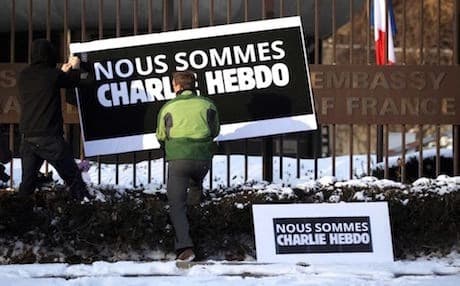

ERBIL, Kurdistan Region - Mainstream Kurdish media were overwhelmingly swift to denounce last week’s deadly attack on the French satirical magazine Charlie Hebdo, describing it as an assault on free speech.
Even some moderate religious figures in Kurdistan accused the perpetrators of the Paris attacks of “giving Islam a bad reputation by killing innocent people.”
“Prophet Mohammed did not punish those who mocked him or God for blasphemy, so why should we?” Ali Bapir, the leader of the Kurdistan Islamic Society (KIS), wrote on his Facebook page.
Although the majority of Kurds confidently share Bapir’s view, there are also differing voices within the Kurdish Islamic parties.
“When you insult the sacred beliefs of one billion Muslims, you have to expect that one or two Muslims will react vehemently to your insult,” said Mutalib Bilbas, a theology researcher and member of KIS. “Will that (the attack) give Islam a bad reputation or not is a different question,” he added.
But even in the Kurdistan Region, where authorities strive for secular institutions, blasphemy cases are not uncommon. Kurdish writers have accused the government in Erbil of not taking strong legal measures against religious leaders who incite public sentiment against critics writing unfavorably about Islam.
The most famous Kurdish blasphemy case may be that of Mariwan Halabjayee in 2007. He fled Kurdistan for Norway after a cleric issued a conditional fatwa against him, which meant that he would either apologize for his critical writings about Prophet Mohammed or simply face death. Halabjayee was convicted in absentia of blasphemy.
“If the West is really serious about democracy and human rights, then they should not insult someone who is so sacred for more than a billion people,” Islamic scholar Irfan Ahmad said about cartoons of the Prophet. “The world should have reacted to the insults that the magazine directed at our Prophet in the first place, but no one said a word,” he added.
Just days before the Paris attacks, prominent Kurdish critic Hemeseid Hesen drew angry reactions after he wrote: “I will block anyone who propagates for the Prophet of ISIS on my Facebook page.”
The web campaign against Hesen was so profound that around 150 Kurdish writers stepped in and signed a petition to defend the embattled critic.