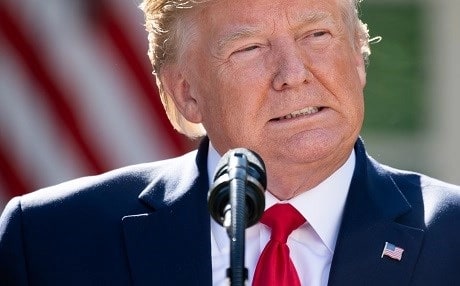
Most Kurds greeted US President Donald Trump’s election in 2016 with a great deal of hope. In Iraqi and Syrian Kurdistan, new restaurants with names such as “Trump Fish” even popped up. The vast majority of Kurds this columnist spoke with at the time brimmed with enthusiasm for the new American president.
In just a few short years, much – if not all – of that enthusiasm has evaporated. The US’s seeming indifference to the Iraqi and Iranian seizure of Kirkuk and other disputed territories from Kurdish Peshmerga forces in October 2017 played a big part in this. As Baghdad and Iranian-sponsored Shiite militias drove their American tanks and armored vehicles north towards Kurdistan, Trump stated that the US “was not taking sides” in the conflict.
Syrian Kurds now fear a similar sort of abandonment. As Kurdish-led forces were ousting the so-called Islamic State (ISIS) from its last remaining bits of territory in December 2018, Trump got off the phone with Turkish President Recep Tayyip Erdogan to make a surprise announcement about American troops (all 2,000 of them) withdrawing from Syria. Without the tripwire presence of a few US special forces, the Turks would have the green light to invade and destroy the de facto autonomy in Syrian Kurdistan.
After his secretary of defense and his envoy to the coalition against ISIS, among others, resigned over the issue, Trump began to walk back his Syrian withdrawal announcement. He claimed “I never said fast or slow.”
Then Trump, redeeming himself a little, went on to warn the Turks of severe economic consequences should they attack the Kurds in Syria, and reportedly ordered his secretary of state to follow a policy of “ensuring that the Turks don’t slaughter the Kurds.”
This reassured many, but only for so long. Presently, Trump’s officials have agreed to establish a coordination center with Turkey, supposedly aimed at creating a “safe zone” in northern Syria. Kurds in the region wonder who will be safe in such a zone, particularly if the plan is to invite Turkish troops into the area. No one really knows what to expect from the Trump administration.
That’s why so many Kurds were excited about Trump in 2016, of course. An outsider and maverick promising not to play by old rules and to shake up Washington sounded good at the time. After nearly one hundred years of cold, calculating policy makers in the West insisting that the international community had no room for even one Kurdish state, they reasoned that Trump might just be the leader to change that old broken record.
“He will recognize and help true friends of America,” one Kurdish man told me in Erbil in 2016. “And the Turks and the Arabs will finally get what they deserve for doing what they do to us.”
Many Kurds reasoned that Trump would be the man not afraid to challenge conventional orthodoxies about current borders in the Middle East. They hoped America under his leadership would not be afraid to challenge Turkish and Arab red lines on Kurdish independence, as well as Iranian ones, if America cared about them.
Although Israel does seem to now enjoy more support than ever before from Washington, and Saudi Arabia, along with a few other friendly Arab regimes, get on very well with the Trump administration, Trump has not provided Kurdish groups the amount of support they hoped for. On the contrary, his apparent callous disregard in October 2017, and his erratic statements regarding Syria, leave many Kurds in the region feeling like they should be careful what they wish for.
An erratic political outsider in Washington may shake things up, but the pieces might not fall where people wish.