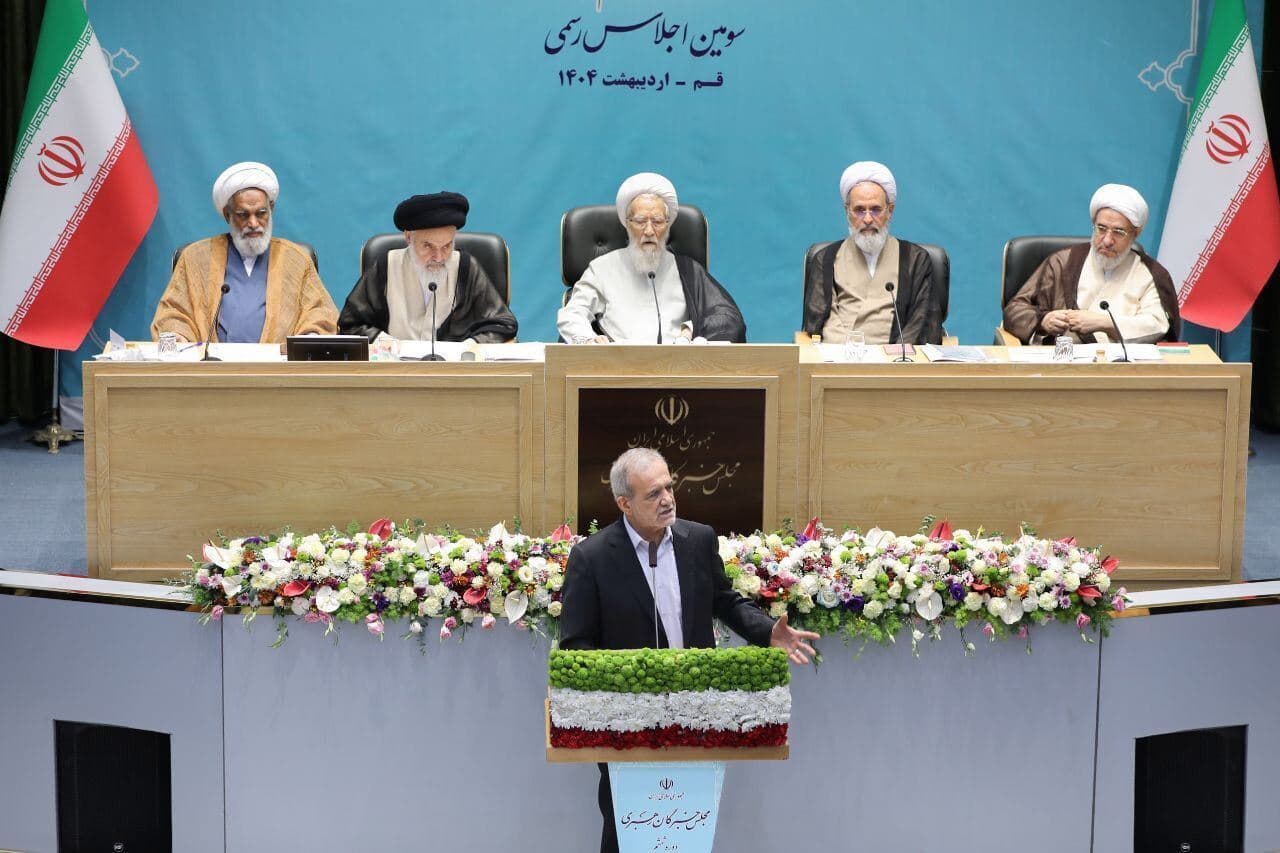

ERBIL, Kurdistan Region – Iranian President Masoud Pezeshkian on Wednesday stated that his country would not “bow down to any bully,” a day after US President Donald Trump had labeled Tehran as the "most destructive force" contributing to regional instability. Trump made the comments during an ongoing Gulf tour.
In an address broadcast on Iranian state TV, Pezeshkian said, "He (Trump) thinks he can come here, chant slogans, and scare us. For us, martyrdom is far sweeter than dying in bed. You came to frighten us? We will not bow to any bully.”
Speaking at the US-Saudi Investment Forum 2025 in Riyadh on Tuesday, the US President labeled Iran as the "most destructive force" behind instability in the region.
He emphasized that while “Iran will never have a nuclear weapon,” the country could still have “a much brighter future” if it chooses a path of peace, referencing the ongoing Oman-mediated nuclear talks between Washington and Tehran.
“I want to make a deal with Iran,” Trump added but warned that "if Iran's leadership rejects this olive branch and continues to attack their neighbors, then we will have no choice but to inflict massive maximum pressure, drive Iranian oil exports to zero like I did before.”
“Iran has a choice… between continuing its chaos and terror or embracing peace,” the US president said, stressing, “We don't have much time to wait.”
In his response, Pezeshkian on Wednesday criticized Trump for making “remarks that reveal his profound misunderstanding of the Iranian people,” rejecting “the claim that Iran is a source of insecurity.”
“How can they label Iran as a threat when they have caused the deaths of 60,000 women and children in Gaza?” the Iranian president asked, referencing the war between Israel and the Palestinian movement Hamas.
“Whether they want peace or not, we will build and develop this country [Iran],” Pezeshkian added.
Iranian Foreign Minister Abbas Araghchi also criticized Trump’s statements on Wednesday, calling them “a deceptive view,” blaming “US sanctions, pressure and threats” for “hindering Iran's progress and causing economic problems over 40 years.”
“Ignoring Israeli threats and crimes, while calling Iran a threat is pure deception,” Araghchi said.
The exchange of sharp rhetoric comes despite the continuation of indirect talks between Iran and the US over Tehran’s nuclear program.
The two sides held their fourth round of negotiations on Sunday, which Araghchi later described as “significantly more serious” than previous meetings. “We moved beyond generalities and into specifics,” he noted, adding that although the talks were difficult, they were also productive and led to a clearer understanding between the parties.
The next round of talks will be held this week, Araghchi anticipated.
A senior US official, quoted by CNN on Sunday, also said that the latest talks were “both direct and indirect” and lasting over three hours, calling them “encouraging” and noting that agreement was reached to continue working through technical issues.
“Agreement was reached to move forward with the talks to continue working through technical elements,” the official said, adding that the US was “encouraged by today’s outcome” and looked forward to the next meeting “in the near future.”
The diplomatic engagement, launched in Oman on April 12, marks the first substantial dialogue between Tehran and Washington since the 2015 nuclear deal - formally known as Joint Comprehensive Plan of Action (JCPOA) - began to collapse.
In 2018, during his first term, President Trump unilaterally withdrew the US from the accord, reimposing harsh sanctions. In response, Iran began rolling back its commitments under the deal.
Tehran has consistently maintained that its nuclear program is for peaceful purposes and that the development of atomic weapons contradicts the Islamic Republic’s principles.