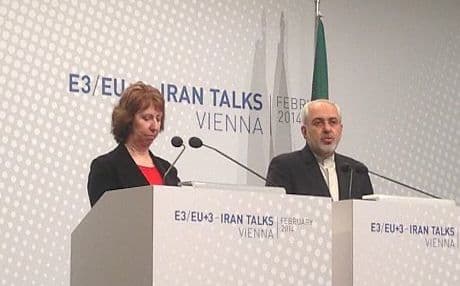
VIENNA, Austria - Formal talks between Iran and six world powers in the Austrian capital of Vienna have ended with an agreement on a nuclear negotiation framework and timetable for reaching a comprehensive and final agreement.
“We have had three very productive days during which we have identified all of the issues we need to address in reaching a comprehensive and final agreement,” European Union foreign policy chief Catherine Ashton announced at a joint press conference with Iranian Foreign Minister Mohammad Javad Zarif.
The discussions between Iran and the P5 +1 countries, the five permanent members of the United Nations Security Council -- US, Russia, China, France and Britain -- plus Germany, were formally led by Ashton who represents the world powers and Zarif.
Speaking about the task at hand, Ashton said: "We have set a timetable of meetings, initially over the next four months with a framework to continue our deliberations."
Ashton also told reporters: “There is a lot to do. It won't be easy, but we've made a good start."
The involved parties will reconvene for another meeting in Vienna on March 17.
The talks in Vienna marked the first round of high-level negotiations between Tehran and the P5+1 Group after they reached a landmark interim deal in the Swiss city of Geneva on November 24, 2013.
The initial deal, which took effect in January, saw Iran scaling back some of its nuclear activities in exchange for easing parts of nuclear-related sanctions.
Under this six-month interim deal Iran has suspended enrichment of uranium to the 20-percent purity level at Natanz and Fordow nuclear sites. In return the P5+1 has eased sanctions on petrochemicals exports and trade in gold and other precious metals. They have also promised Iran access to $4.2 billion of its oil revenues frozen in foreign banks.
The challenge now is to reach a permanent deal that would satisfy both sides. This has been a decade-long dispute between the West and Iran. The P5+1 group want Iran to curb sensitive nuclear activities permanently to ensure that it cannot assemble a nuclear weapon. But Tehran insists that its nuclear program is exclusively peaceful, with the sole purpose of providing energy and medical research.
Notably, as Iran is a signatory of the Nuclear Non-Proliferation Treaty, it has repeatedly signaled its resistance in dismantling nuclear installations. Tehran maintains that its nuclear program has no military aim, and should be treated in the same way as those of other countries that have signed the NPT.
Hence, Iran wants the United Nations, the EU and the United States to comprehensively lift all nuclear-related sanctions that have battered its economy for years.
It is hoped that the future talks will bring a long-term resolution. Central to the resolution of Iran’s nuclear issues are its uranium enrichment capabilities, the Arak heavy water reactor and enhanced levels of monitoring of key nuclear sites by the International Atomic Energy Agency.