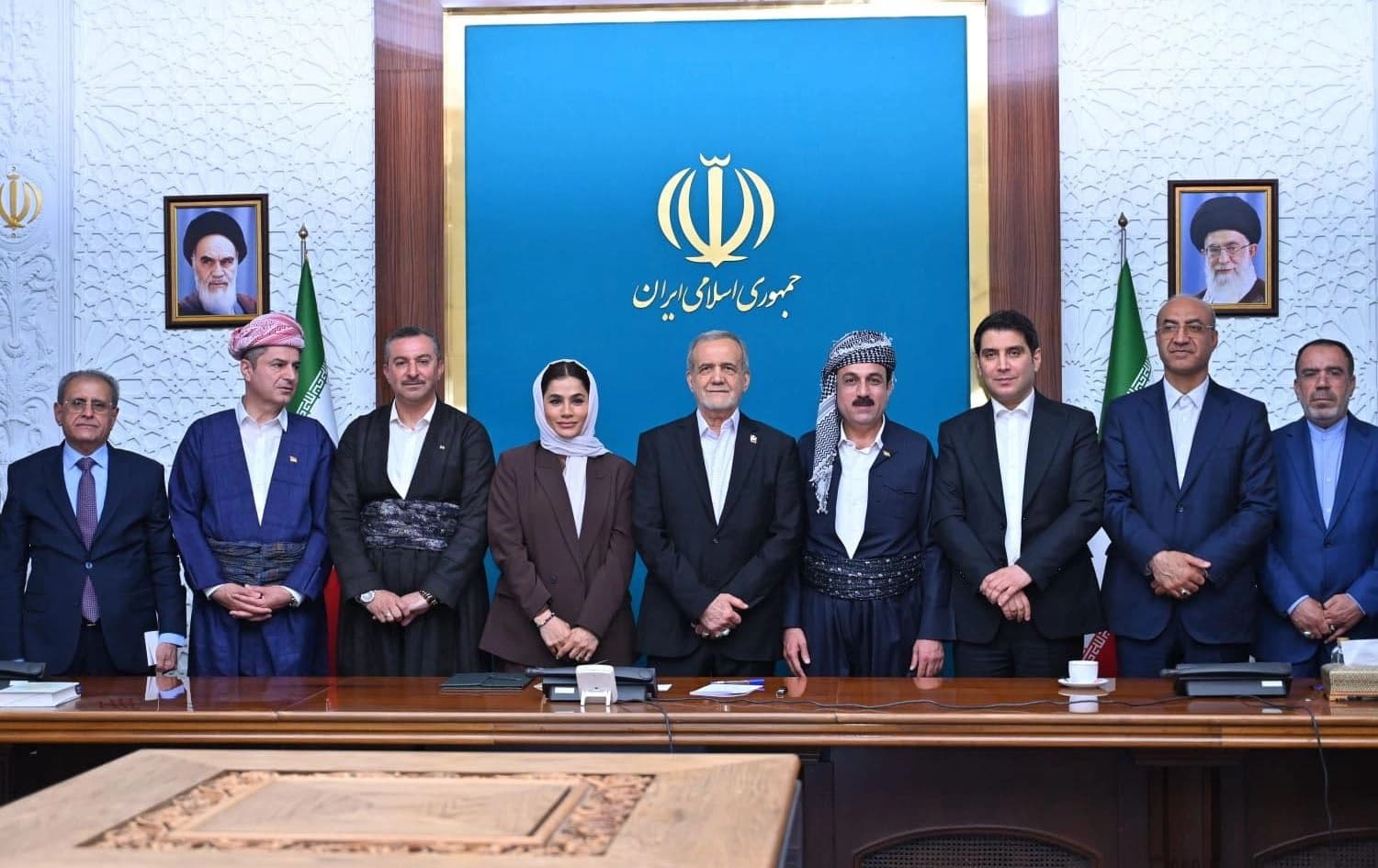

ERBIL, Kurdistan Region - The four provincial governors from the Kurdistan Region met with Iranian President Masoud Pezeshkian in Tehran on Thursday to discuss furthering ties in a range of sectors.
“In the meeting, the president of the Islamic Republic of Iran expressed his satisfaction with the good level of relations between the neighboring provinces of the Kurdistan Region and Iran, and reaffirmed his support for agreements between them,” read a statement from Erbil Governor Omed Xoshnaw on Facebook.
“He also demonstrated the Islamic Republic of Iran's desire for coexistence, brotherhood, stability, and peace in the region, and emphasized increasing joint cooperation between the Kurdistan Region and the Islamic Republic of Iran,” he added, noting Kurdistan Region’s commitment to strong historical and political ties with Iran.
In addition to Xoshnaw, the Region’s delegation included Sulaimani Governor Haval Abubakir, Duhok Governor Ali Tatar, and Halabja Governor Nuxsha Nasih. They also met with their counterparts from Iran’s Kurdistan, Kermanshah, and West Azerbaijan provinces during a visit to western Iran (Rojhelat).
Pezeshkian noted the deep cultural and familial ties across the border. “The president stressed that sustainable development is crucial for enhancing mutual ties, calling on scholars from both sides to develop a comprehensive program addressing scientific, cultural, agricultural, industrial, communications, energy, and mineral sectors. He stated that this program should aim to provide future generations with a peaceful environment,” read a statement from his office.
Pezeshkian also warned against what he called divisive efforts by the United States to sell weapons and sow discord.
“The United States extracts the capital and resources of Islamic countries from the region and, in return, sells military weapons to incite conflict among Muslims. This is the calamity that the US has inflicted upon Muslims in the Middle East. Therefore, scholars, intellectuals, academics, and cultural figures among Muslims bear a significant responsibility to confront these US conspiracies and raise awareness, ensuring that Islamic countries do not succumb to these devilish actions,” he said.
There are several armed Iranian Kurdish opposition groups based in the Kurdistan Region. Under pressure from Tehran, the Iraqi government is reigning in these groups, relocating and disarming them.
Sulaimani Governor Abubakir highlighted critical issues facing border regions, including drought and infrastructure needs. He called for extending Iran’s railway network to the Bashmakh crossing and granting special status to certain trade gateways to boost economic activity. Abubakr also advocated for equitable development across border provinces.
Halabja Governor Nasih raised concerns about missing person cases dating back to the 1988 chemical attack on Halabja by the Iraqi Baathist government. Dozens of families are still looking for their children who went missing in the aftermath of the attack. Some were adopted by Iranian families.
Duhok Governor Tatar described the meeting as a candid and productive exchange, with both sides discussing regional cooperation, development, and future coordination.
On Tuesday, the governors participated in a key summit in Sanandaj, Iran, aimed at enhancing economic ties and cross-border cooperation. This marks the third such meeting between governors of the provinces along the shared border between the Kurdistan Region and Iran.
Trade ties between Erbil and Tehran are extensive and economically vital, with annual trade between the Kurdistan Region and Iran reaching significant figures, often cited around $6 billion.
The robust exchange is facilitated through three main border crossings - Haji Omran, Bashmakh, and Parviz Khan - and several other smaller or unofficial crossings, through which Iran primarily exports food products, construction materials, manufactured goods, and petrochemicals.
Both sides are actively working to enhance these economic relations and overcome obstacles through high-level visits, agreements, the potential establishment of joint free zones, and a notable presence of Iranian companies in the Kurdistan Region.