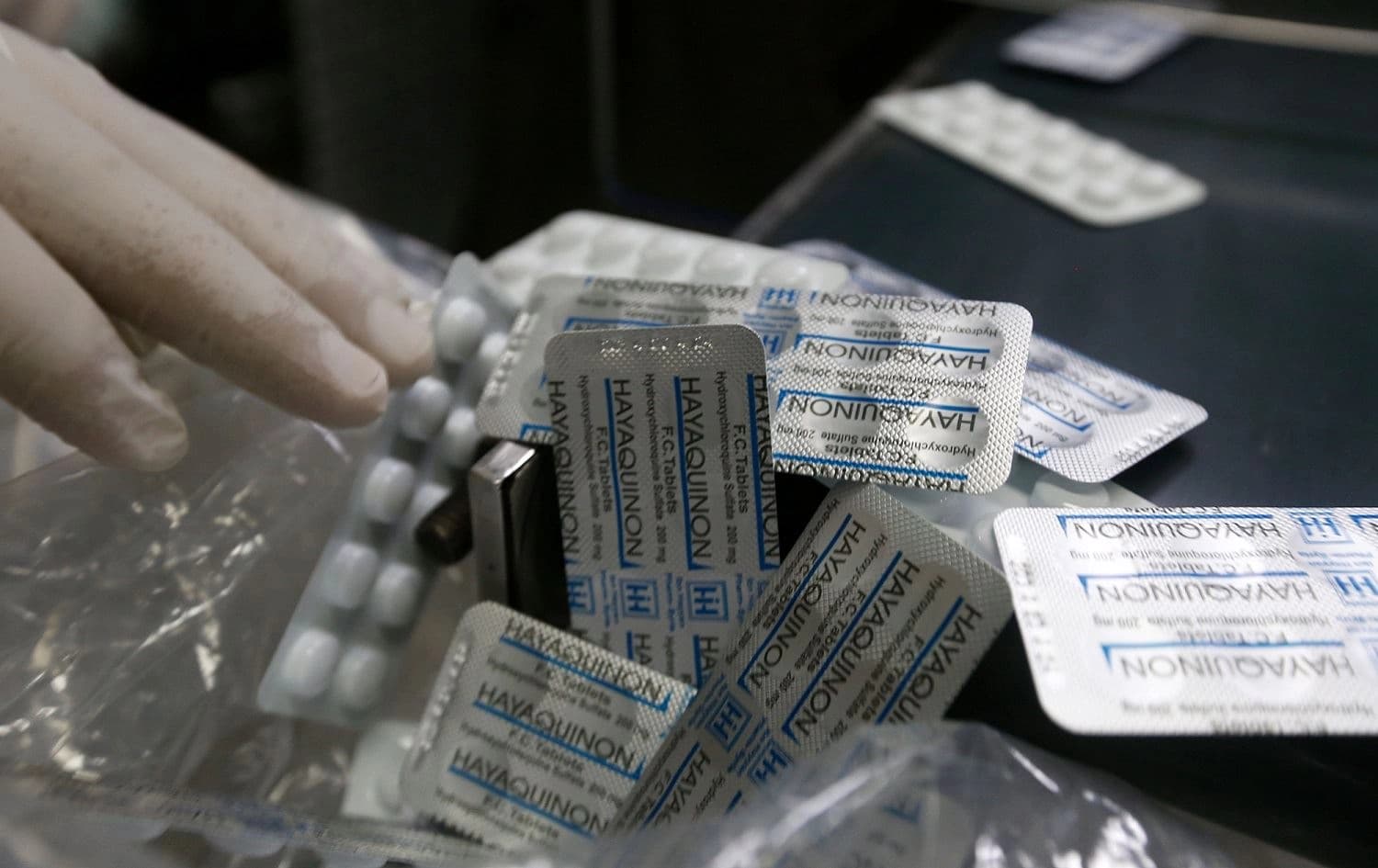

HOMS, Syria – In central Syria, factory owner Rashid al-Faysal watches his staff working tirelessly to churn out a controversial antimalarial drug that Damascus hopes can help treat the novel coronavirus.
There is no proof yet hydroxychloroquine works to prevent or cure COVID-19, but Syrian doctors have been told to join others around the world in prescribing it for the time being.
Faysal’s factory is one of several authorities have authorised to manufacture the drug, in a country with 45 official cases of COVID-19 illness, including three deaths.
On the outskirts of the central city of Homs, the pharmaceutical expert watches as a machine spurts out endless sheets of round red pills.
“We’ve had a permit to produce this medicine since 2016. Back then we used to produce it in really small quantities according to demand to treat illnesses such as lupus,” he says, as workers busy themselves behind him.
But “demand increased hugely after the coronavirus crisis, so we imported the primary components and started to prepare it,” he says.
Wearing a long white lab coat, turquoise hair net, blue face mask and gloves, Faysal examines the newly produced pills.
In another room, employees in face masks sit round a table, stuffing rows of pills into small rectangular boxes.
Sanctions
In the past week, they have produced 12,000 boxes – each containing 30 pills – and plan to manufacture 40,000 more boxes in the coming days.
“That quantity covers market demand and more” if each patient is prescribed one packet, Faysal says.
There has been controversy over the drug’s use to treat COVID-19, which has killed a quarter of a million people worldwide and for which no vaccine has yet been developed.
Hydroxychloroquine showed early promise against COVID-19 in small-scale studies in France and China to reduce virus levels in badly infected patients.
US President Donald Trump hailed it as a possible “gift from God” against the pandemic.
But the World Health Organization insists there is no proof hydroxychloroquine or any other drug can cure or prevent COVID-19, and that its misuse can cause serious side effects and even death.
Health ministry official Sawsan Berro says six out of 96 drug laboratories across Syria have been given licences to produce hydroxychloroquine.
But she says synthesising the drug is challenging in a country under Western economic sanctions over the nine-year civil war.
These measures complicate “obtaining primary materials and laboratory machine spare parts”, she says.
Exports?
Faysal says he initially hesitated before producing the drug, given the difficulty of importing precursor ingredients.
“We’re in a country under siege,” he says, referring to the economic sanctions imposed by the United States and the European Union since the start of the war in 2011.
“Financial transactions are very difficult, as are imports and exports,” he says.
Faysal is reluctant to explain how he obtained the drug’s components, but he described it as “the biggest risk I have ever taken in my life”.
“I could have lost a lot,” he says.
Syria has suspended international flights and closed its border with Lebanon to stem the pandemic.
Despite all this, the factory’s quality control officer Abdelkareem Derwish hopes Syria might be able to export the medicine after meeting local demand.
“We are fully prepared to export the surplus if conditions permit,” he says.
In recent days, the medicine has been in such demand in Syria that a box can sell for over $100 on the black market.
But on the official market, its price has been fixed at 6,800 Syrian pounds (less than $10).
We’re producing “one of the drugs most in demand in the world at the lowest prices”, Derwish says.
By Maher al-Mounes